













When we hear the word “dementia,” our minds often jump straight to Alzheimer's. And for good reason; Alzheimer’s accounts for roughly 60-80% of all cases. But dementia isn't a single disease; it’s an umbrella term for a complex spectrum of brain changes.
Imagine trying to treat a headache when the cause is actually a migraine, a fever, or a concussion. In the same way, treating a “memory problem” without knowing the specific type of dementia can lead to ineffective care or even harmful medication interactions.

As we move into 2025, the World Health Organization reports that someone in the world develops dementia every three seconds. To provide the best care, we must look beyond the generic and understand the “hidden” forms that often go undiagnosed.
The Dementia “Umbrella”: Why Specifics Matter
For many families, receiving a “dementia diagnosis” feels like the end of the conversation. In reality, it should be the beginning. Think of dementia as an umbrella term; it describes a group of symptoms (like memory loss or confusion), but it doesn't tell you the cause.
Moving toward a precision diagnosis for dementia is the most important step you can take. Why? Because the care plan for someone with Alzheimer’s is often fundamentally different from the care plan for someone with Vascular Dementia.
Understanding the specific “hallmarks” of each type helps you anticipate behavior changes, choose the right medications, and, most importantly, reduce the trial-and-error stress that often leads to caregiver burnout.
The “Big 4” Common Types of Dementia
While there are dozens of brain changes, these four types account for the vast majority of cases seen by doctors today.
Alzheimer’s Disease
The most well-known form, Alzheimer’s Disease is characterized by the buildup of plaques and tangles in the brain. It typically starts with short-term memory loss (forgetting conversations or appointments) and progresses predictably through the 3 stages of dementia.
Vascular Dementia
Often the result of minor strokes or restricted blood flow, vascular dementia is about “logic and speed” rather than just memory. Families often notice a “step-wise” decline – where an older adult stays stable for a long time and then suddenly drops to a new level of impairment after a vascular event.
Lewy Body Dementia (LBD)
This is a “fluctuating” dementia. One hour, Mom might be perfectly lucid; the next, she may experience vivid visual hallucinations or Parkinson ’s-like tremors. According to the Lewy Body Dementia Association, LBD is one of the most underdiagnosed types because it mimics both Alzheimer's and Parkinson's.
Frontotemporal Dementia (FTD)
Unlike the others, FTD often presents as a young-onset dementia cause, frequently appearing in people in their 40s or 50s. The struggle here isn't memory; it’s behavior and language.
When comparing Frontotemporal vs. Vascular dementia, FTD stands out because of drastic personality shifts – a previously kind person may suddenly become socially inappropriate or emotionally detached.
INFOGRAPHIC: “The Big 4” Types of Dementia
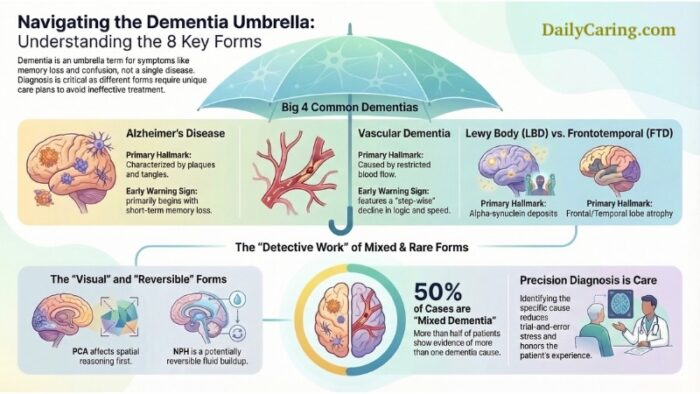
The “Detective Work” of Diagnosing Dementia
Most people don't realize that it's common to have more than one type of brain change at the same time. This is known as Mixed Dementia. A person might have the plaques of Alzheimer’s alongside the blood vessel damage of Vascular Dementia.
Because symptoms overlap, getting a clinical diagnosis is like detective work. For example, Frontotemporal Dementia (FTD) primarily affects personality and language, making it frequently misdiagnosed as a psychiatric disorder in younger adults.
The Other Rare & The Remarkable Forms of Dementia
Beyond the “Big Three” (Alzheimer's, Vascular, and Lewy Body), there are rarer forms that require specialized approaches:
- Posterior Cortical Atrophy (PCA): Often called “Visual Alzheimer's,” this type primarily affects vision and spatial reasoning, rather than memory.
- Normal Pressure Hydrocephalus (NPH): This is one of the few potentially “reversible” forms of hydrocephalus, caused by fluid buildup. It often presents with the “triad” of walking difficulty, confusion, and bladder control issues.
- Korsakoff Syndrome: A chronic memory disorder caused by a severe deficiency of thiamine (Vitamin B1), often linked to alcohol misuse.
VIDEO: Understanding Dementia Beyond Alzheimer's Disease
The Dementia Comparison Guide
Conclusion: Knowledge is the Best Care Tool
Understanding the nuances between these 8 forms of dementia isn't just academic; it’s practical. It helps you manage expectations, prepare for the 3 stages of dementia, and most importantly, honors the person living through it. After all, this isn't about dementia – it's about your loved one.
Whether you are navigating atypical dementia signs or managing a mixed dementia diagnosis, remember that you aren't just a caregiver; you are an advocate. The more we learn, the better we can bridge the gap between “management” and true quality of life.
Recommended for you:
- What Is Alzheimer’s Disease? Get the Facts
- 3 Stages of Dementia: What to Expect
- What Is Vascular Dementia? Everything You Need to Know
About the Author

Chris is a seasoned healthcare executive and entrepreneur from the Pacific Northwest. He strongly advocates for older adults and the caregivers who serve them. Chris has personal experience caring for his father, who had dementia. Chris is a technology enthusiast and an avid outdoorsman; if he's not in his office, he can usually be found on a golf course or fly-fishing out west somewhere.



Hello went into this website to read up on dementia. My dad is 76yrs old and the past few years I have noticed a change in him. He can’t remember what you have told him a minute ago. See people in our yard or house. He goes completely blank on what to do with his catheter in his bladder. I have to check it and then tell him to change clothes. It is really heart breaking and he was such an active person always doing something . Hope I am strong enough to help him. Really appreciate all the tips.
Has your dad been diagnosed with Alzheimer’s, dementia, or a treatable health condition that causes cognitive issues?
If he isn’t already diagnosed, it’s a good idea to have his doctor give a thorough exam to rule out treatable health conditions that could be causing this behavior. Even something as simple as a urinary tract infection could cause cognitive symptoms.
And if it is Alzheimer’s or another dementia, here’s more information about what to expect as the disease progresses — 3 Stages of Dementia: What to Expect https://dailycaring.com/3-stages-of-dementia-what-to-expect/
These articles discuss some of the treatable health conditions that can cause these types of symptoms:
— 8 Treatable Diseases That Mimic Dementia https://dailycaring.com/8-treatable-diseases-that-mimic-dementia/
— 7 Treatable Health Conditions with Symptoms Similar to Dementia https://dailycaring.com/7-treatable-health-conditions-with-symptoms-similar-to-dementia/
Here’s our section on Alzheimer’s and Dementia — https://dailycaring.com/category/health-conditions/alzheimers-dementia/
Thank you. I wonder how one decides if its a tia, or something else.
, i was in a car accident wherr i driving andwas hit on drivers side by 2. Kids who were drunk and on drugs. They hit my car at about 72 miles per hour. I was very badly hurt and unconscious
This was 4 years ago.
I have severe dizzy spells now, and fall sideways.
I had also sustained a lump on the trapezious muscle left side. It is moving up the back of my neck…and hurts alot, as well as gives me dizzy spells.
Am i having tias from these events ?
I’m so sorry that happened and that you’re having symptoms. It sounds like you must see a doctor ASAP. These are serious symptoms and you need immediate medical attention in order to find out the cause and get the proper treatment.
I find all of your articles informative. I would like a paper copy of these articles. Ive saved them to my email but I would like to get them all in one booklet. How could I get that?
We’re so glad our articles are helpful! You can print out a paper copy of any article by scrolling down to the end of the content and looking for the “Print this page” icon and text.
How can I get copy of 11 ways to get someone with dementia to take medication
Hi William — Here’s the link to that article: https://dailycaring.com/11-ways-to-get-someone-with-dementia-to-take-medication/