












In the challenging journey of caring for a loved one with Alzheimer's, it's natural to feel hopeful when encountering claims of a cure or a breakthrough treatment online. Ads for “miracle” supplements, “medical foods,” and “natural” remedies that promise to enhance memory or halt disease progression can be highly compelling.
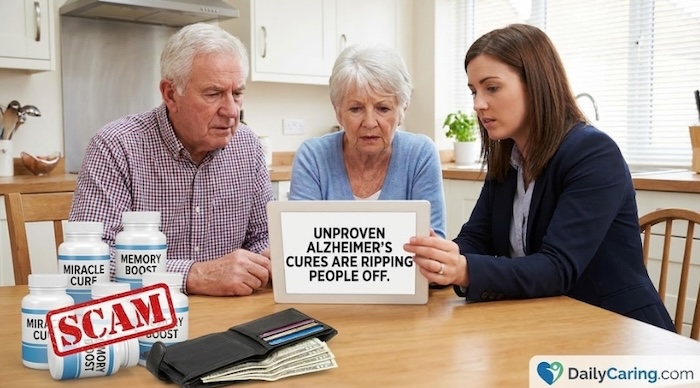
However, these unregulated and unproven treatments pose significant risks to the health and safety of vulnerable seniors.
This article highlights the hidden dangers of these products, explaining why they lack scientific evidence and how they can interact dangerously with prescribed medications. It provides caregivers with the information they need to protect their loved ones from exploitation and potential harm, while guiding them toward safer, evidence-based approaches.
Alzheimer’s cure claims are ripping off vulnerable families
Advertisements for an Alzheimer’s cure are everywhere, especially on the internet.
These herbal remedies, dietary supplements, and “medical foods” are promoted as safe, “natural” treatments that enhance memory or delay or prevent Alzheimer’s or dementia.
Their false claims are supported only by pseudoscience (theories that have no basis in scientific fact), fake testimonials, and hard-sell tactics.
The reality is that these are unregulated products sold by unscrupulous companies and former doctors who prey on vulnerable seniors and families to rip them off and make vast amounts of money.
Reputable organizations like the Alzheimer’s Association, the New York Times, and Next Avenue share concerns about the serious harm these dietary supplements and medical foods could cause.
We share three key reasons why an unproven Alzheimer’s cure could seriously harm your older adult’s health and explain why eight commonly advertised treatments should be avoided.
3 reasons why unproven Alzheimer’s medications could be harmful
It’s important to know that, at this time, there are no medications that can cure Alzheimer’s or stop it from progressing. (But healthy lifestyle habits like regular exercise could improve symptoms.)
And there’s a massive difference between FDA-approved medications versus supplements, nutraceuticals, and “medical food.”
Alzheimer’s and dementia research or medications based on some of these unproven treatments could potentially be proper in the future. Still, there are three key reasons to avoid dementia treatments that aren’t currently FDA-approved.
1. They haven’t been proven to be safe and effective
FDA-approved drugs undergo rigorous review to demonstrate that they are both safe and effective.
When something is sold as a supplement, nutraceutical, or “medical food,” the FDA is not authorized to review it for safety and effectiveness before it is marketed.
The problem is that many supplements contain active ingredients that have strong effects in the body.
That could make them unsafe in some situations and harm or complicate your older adult’s health.
2. There could be serious drug interactions
Dietary supplements can have serious interactions with prescribed medications or reduce their effectiveness.
Seniors should never take a new supplement without first speaking with their doctor and having them review all their current medications, vitamins, and supplements.
3. The real ingredients are unknown
The FDA oversees the manufacturing of approved drugs to ensure they contain the ingredients listed on the label in the specified amounts.
But supplements, nutraceuticals, and “medical food” products don’t undergo rigorous reviews or meet strict quality standards. They’re not FDA-approved.
So you wouldn’t know if the pills truly contain the ingredients shown on the label – and the ingredients that are actually inside could even be harmful.
Beware the “Alzheimer’s cure” and avoid 8 commonly advertised treatments
We share essential facts about eight unproven Alzheimer’s and dementia treatments that are widely advertised in the U.S., especially on the internet.
These treatments are NOT recommended by reputable experts, including the Alzheimer’s Association.
If you feel strongly about experimenting with any of these, it’s essential to speak with your older adult’s doctor before adding any supplements or medical foods to their diet.
That protects their health by preventing adverse drug interactions or reducing the effectiveness of their current prescription medications.
1. Caprylic acid / Axona / coconut oil
Caprylic acid is found in medical foods like Axona and in regular coconut oil.
Some treatments claim that caprylic acid is an alternate energy source for brain cells that are damaged by Alzheimer’s disease.
Manufactured caprylic acid supplements and medical foods sold by companies may be counterfeit or harmful because they’re unregulated.
But some families say that regular coconut oil has helped their senior with dementia. However, there isn’t any conclusive scientific evidence that it works.
However, eating small amounts of regular coconut oil isn’t likely to be harmful.
If you’re interested in testing this theory by adding a small amount of regular coconut oil to your older adult’s diet, first speak with their doctor to make sure it won’t harm their heart health or worsen other health conditions.
2. Coenzyme Q10
Coenzyme Q10, also called CoQ10 or ubiquinone, is an antioxidant that’s naturally found in the body.
It’s unknown what dosage of coenzyme Q10 is considered safe. There could be harmful effects if too much is taken.
CoQ10 hasn’t been studied as a treatment for dementia. A synthetic version called idebenone was tested for Alzheimer’s disease, but didn’t show any benefit.
3. Coral calcium
Coral calcium supplements have been heavily marketed as a cure for Alzheimer’s disease, cancer, multiple sclerosis, and other severe health conditions.
The claim is that it’s a form of calcium that’s made from shells from coral reefs and is better absorbed by the body.
In reality, coral calcium has no extra health benefits and isn’t significantly different from regular calcium supplements. There is no scientific evidence that the body absorbs it better.
If your older adult’s doctor has recommended a calcium supplement for bone health, it’s best to buy from a reputable brand.
The Federal Trade Commission (FTC) and the Food and Drug Administration (FDA) have already filed formal complaints against companies selling coral calcium.
They did this because there’s no reliable scientific evidence supporting the exaggerated health claims, and it’s against the law to make such unproven claims.
4. Ginkgo biloba
Ginkgo biloba is a plant extract that’s thought to be an antioxidant and anti-inflammatory. It’s believed to protect cell membranes and regulate neurotransmitter function.
It’s been used in traditional Chinese medicine for centuries and is currently being used in Europe for cognitive symptoms associated with neurological conditions.
But results of a randomized, double-blind, placebo-controlled clinical trial conducted in 5 U.S. academic medical centers over 8 years showed that ginkgo was not effective in preventing or delaying Alzheimer’s disease.
If you’re interested in testing this theory by adding gingko biloba to your older adult’s diet, first speak with their doctor to make sure it won’t cause any drug interactions or harm.
5. Huperzine A
Huperzine A (HOOP-ur-zeen) is a moss extract used in traditional Chinese medicine.
It’s marketed as a treatment for Alzheimer's disease because it has properties similar to cholinesterase inhibitors, which are a type of FDA-approved Alzheimer's medications.
But in a large-scale U.S. clinical trial of huperzine A as a treatment for mild to moderate Alzheimer’s disease, huperzine A was not better than a placebo (a sugar pill).
Even worse, the huperzine A currently sold is unregulated and manufactured without uniform standards.
So, taking a huperzine A supplement could increase the risks of serious side effects, mainly if used in combination with FDA-approved Alzheimer's drugs.
6. Omega-3 fatty acids
Research has shown mixed results in linking omega-3 fatty acid supplements to a reduced risk of heart disease and stroke.
But some research has also found that a high intake of omega-3s could reduce the risk of dementia or cognitive decline.
This may be because omega-3s support heart and blood vessel health, have anti-inflammatory effects, and protect nerve cell membranes.
However, experts say that more research is needed. There isn’t enough evidence to recommend DHA or any other omega-3 fatty acid supplements to treat or prevent Alzheimer's disease.
But eating a few servings of fish per week could help improve cardiovascular health and reduce inflammation. This is a healthy, safe way to test whether adding fish to their regular diet has cognitive benefits for your older adult.
7. Phosphatidylserine
Phosphatidylserine (FOS-fuh-TIE-dil-sair-een) is a kind of fat that’s the primary component of the membranes around nerve cells.
In Alzheimer’s disease and dementia, nerve cells degenerate for unknown reasons. The rationale for phosphatidylserine treatment is that it may strengthen the cell membrane and protect cells from degeneration.
However, experts agree that more research is needed and do not currently recommend use of phosphatidylserine.
Warning: The FDA allows supplements containing very high-quality soy-derived phosphatidylserine to display a “qualified health claim” stating that “Very limited and preliminary scientific research suggests that phosphatidylserine may reduce the risk of dementia in the elderly. FDA concludes that there is little scientific evidence supporting this claim.” This doesn’t mean that it’s FDA-approved or that it works.
8. Tramiprosate
Tramiprosate, also known as Alzhemed or ViviMind, is a modified form of taurine, which is an amino acid found in seaweed. It currently has no proven health benefits.
Tramiprosate was tested in a significant Phase 3 clinical study as a possible Alzheimer's treatment, but the trial results were inconclusive.
Then, the manufacturer decided to stop developing it as a prescription drug and instead sell it on the internet as a “medical food,” which means that it’s not an FDA-regulated drug.
Final Thoughts About Unproven Alzheimer's Cures
Navigating the world of Alzheimer's treatments requires both hope and vigilance. While the desire to try anything that might help is understandable, prioritizing safety through FDA-approved pathways and professional medical advice is paramount.
The risks associated with unproven supplements (from unknown ingredients to serious drug interactions) are real and can compromise your loved one's health. By focusing on evidence-based care, consulting openly with doctors, and relying on reputable sources like the Alzheimer's Association, you can make informed decisions that truly protect your loved one.
Your role as a caregiver is critical, and arming yourself with this knowledge is a decisive step in ensuring their well-being and avoiding the financial and emotional pitfalls of unproven cures.
Recommended for you:
- 5 FDA-Approved Medications for Alzheimer’s Treatment
- What Is Alzheimer’s Disease? Symptoms, Causes, Treatments
- 3 Stages of Dementia: What to Expect
About the Author

Connie is the founder of DailyCaring.com and was a hands-on caregiver for her grandmother for 20 years. (Grandma made it to 101 years old!) She knows how challenging, overwhelming, and all-consuming caring for an older adult can be. She also understands the importance of support, especially in the form of practical solutions, valuable resources, and self-care tips.

Hello and I wish you all health and wellness.
I agree that there are a lot of people just trying to make a buck. I have personally spent too much money for some doctors with my special needs child. However, I know that some of the things we tried helped. If I did not try at all, I would not have benefited from the things that **did** work. My advice – if you have some extra money, the supplement is safe, and you limit your evaluation period, it is worth a try. If the caregiver or person receiving the supplement can objectively say it’s helping, then continue. If not, stop taking it and do not buy any more. I would not ever advise putting anything on a credit card that you can’t immediately pay off. If you can’t afford it, don’t buy it. There’s my two cents.
We applaud your thoughtful approach! It’s wise advice to make sure that the person’s doctor reviews the supplement and it won’t harm them or interfere with existing treatments. Then, try it for a limited amount of time to see if there are any noticeable improvements. If there are no improvements or if there are negative effects, stop the supplement. It’s also a great point that if it’s not in the budget, don’t go into debt to try something unproven and unregulated.
Thank you for the piece on Unproven Treatments. I was hoping you would have mentioned Prevagen since it is so widely advertised.
Thanks for bringing this up! Unfortunately, there are so many fake supplements out there that it can be hard to keep up. Prevagen is another supplement with fraudulent claims.
Here’s a story by NBC News about the Federal Trade Commission and New York’s attorney general charging the company with fraud for selling this memory supplement based on a glowing jellyfish protein — https://www.nbcnews.com/health/health-news/jellyfish-memory-supplement-prevagen-hoax-ftc-says-n704886
Thank you so much for sharing this important information. I once knew an elderly man who ordered “Vitamin O” through the mail. Its claim was that there is no longer enough oxygen in the air, so we need to get extra oxygen in the form of pills. This sounds ridiculous to us, but this man was desperate to try anything to protect his mind. Therefore, he became easy prey for an unscrupulous company looking to make money. So sad!
Oh no! That’s terrible 🙁 Those shady companies are awful.