













Imagine a world where everyday tasks like brushing your teeth or choosing a shirt feel like an unsolvable puzzle. For a person living with dementia, this overwhelming confusion is a daily reality, and anger is often not a personal choice but a final, desperate form of communication. It’s the “last straw” frustration of a brain struggling to process a world that no longer makes sense.
This article offers a compassionate shift in perspective: by understanding the root of these outbursts, we can move from reacting to frustration to proactively creating a calmer, more supportive environment.
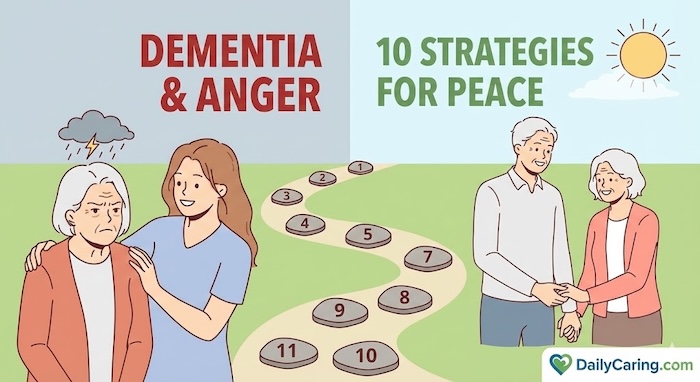
Here are ten practical, empathetic strategies to reduce stress, ease confusion, and help your loved one find more moments of peace.
Seniors with Dementia May Get Frustrated and Stressed Out
Sometimes it seems like seniors with Alzheimer’s disease or dementia become angry at the drop of a hat.
Most likely, they're reaching a breaking point due to accumulated frustration from everyday tasks. This might be the root cause of aggressive behavior or angry outbursts.
To reduce these “dementia and anger” flare-ups, they need help to decrease their stress and feelings of overwhelm.
We share 10 ways to make everyday life easier and less stressful for seniors with dementia.
Why do People with dementia Experience Anger so Often?
When someone has dementia, their ability to function effectively declines.
Tasks we consider simple, such as brushing teeth, are actually quite complex.
For someone with dementia, it can be challenging to remember all the steps and sequence them correctly.
For example, these are the key steps needed to brush teeth:
- Please enter the correct bathroom (the one with their toothbrush)
- Find the switch and turn on the light
- Locate the correct toothbrush (theirs)
- Locate toothpaste
- Take the cap off the toothpaste
- Put an appropriate amount of toothpaste on the toothbrush
- Put the toothbrush (with toothpaste still on) in your mouth and gently brush every tooth surface
- Spit out toothpaste
- Rinse mouth thoroughly with water – spit, don’t swallow
So, even a simple task isn’t that simple
Once we break it down, brushing our teeth is far less straightforward than we might think.
A person with dementia may also struggle with the smaller steps that underlie many of these significant steps.
When even the most basic parts of the day can be complicated and overwhelming, it’s easy for frustration to build up.
When someone with dementia needs to complete yet another “simple” daily task, it could cause angry outbursts.
For example, when you’ve had an extremely stressful day, someone coming to you with even a simple request can cause you to lose your temper – it’s the last straw, right?
That’s often what’s happening to seniors with dementia.
As their world becomes increasingly confusing and difficult to navigate, it doesn’t take much for them to reach a “last straw” moment and react with anger.
10 ways to reduce anger in dementia
1. Accept their limitations
Avoid pushing seniors with dementia beyond their limits by expecting them to do things they’ve been struggling with.
They aren’t refusing to do things because they’re lazy or refuse to remember.
Their brains are failing, and they’re losing the knowledge and abilities they need to accomplish those once-easy tasks.
Accept where they are now and work with the skills they have today. Adjust as needed as things inevitably change.
2. Reduce complex decisions
Making choices about every part of their day isn’t necessary, but there are some decisions your older adult may still want to make.
The goal isn’t to take away their right to choose, but to simplify to make choices easier – too many options are confusing and overwhelming.
For example, when changing, lay out all the clothes they need, but offer a choice between two shirts – the red shirt or the blue shirt?
This way, they’re still participating in the process, but won’t have to find and select all the other clothing items they need.
Similarly, for lunch, you could offer a choice between two entrees you know they enjoy – a ham sandwich or split pea soup?
That decision is much easier to respond to than a broad question like “What do you want for lunch?”
3. Slow down
We’re used to moving at a “normal” pace, but that’s because our brains are fully functional and can quickly process information and thoughts.
When someone has dementia, those cognitive processes slow down significantly.
That’s why your older adult needs a lot more time when thinking, speaking, or taking action.
To reduce stress and help them feel successful, don’t rush them through their daily routines.
Take the pressure off and let them move at their own pace – even if it seems really slow.
4. Keep the environment calm and quiet
Being in a noisy, bustling environment can overwhelm the senses and make it hard to think, especially when someone has dementia.
Have you noticed that we all need calm and quiet when we’re trying to think?
For example, if you’re driving to an unfamiliar location, you automatically turn down the radio so you can concentrate. Most students seek quiet places, such as libraries, when they need to learn complex new concepts.
For someone with Alzheimer’s or dementia, everyday tasks have become difficult and require extra thought and concentration.
When you add loud noise or large crowds, it’s natural for people to feel frustrated and stressed.
5. Treat them with respect
Everyone, regardless of age or ability, wants to be treated with respect. Seniors with dementia are no different.
Even if they struggle with decisions or everyday tasks, there are many ways to make things easier while still showing respect.
A good way to do this is to offer simplified choices, like with the red or blue shirt mentioned above.
That way, you’re not giving orders and expecting them to follow. You’re helping your older adult make decisions that suit their current abilities.
6. Rely on a routine
Routines reduce the amount of thinking and the number of decisions required daily.
For example, we don’t have to decide what time to eat breakfast because we always eat around 8am after getting up and brushing our teeth.
Routines are constructive for seniors with dementia because they reduce the number of things they need to remember or think about.
Having a steady routine is comforting and far less stressful than an unpredictable schedule, where they have to hunt for their toothbrush every time they need it.
Placing objects in the exact locations and performing the same activities at the same time of day helps them know where things are and what will happen.
7. Speak slowly, plainly, and simply
Alzheimer’s and dementia affect the brain’s ability to process and retrieve information.
Short, direct sentences with only one thought per sentence are easier to understand.
The goal is to give your older adult fewer things to think about and fewer things to remember. If you’re giving instructions, keep them to one step. If you’re sharing information, keep it to one thought.
Use fewer words, speak slowly, and maintain a positive, calm tone to make communication easier and less frustrating.
8. Avoid fatigue
Getting overtired isn’t good for anyone’s mood, but it can put even more pressure on an already frazzled senior with dementia.
Just like you’re more likely to snap when you’re exhausted, someone with dementia is more likely to have an angry outburst when they’re fatigued.
9. Reduce or eliminate pain and discomfort
People with dementia often experience pain or severe discomfort regularly, typically caused by common health conditions.
As you might expect, someone who’s in pain might be angry or have a short fuse.
But their ability to recognize what’s going on in their body and communicate their needs declines as dementia advances.
By monitoring signs of untreated pain, physical needs (such as needing to use the bathroom), or irritated skin, you can help reduce or eliminate their pain or discomfort.
10. Help them be successful
When a task is too difficult, it’s frustrating and stressful.
The answer isn’t to have your older adult stop doing things for themselves. That will only make them feel worse. Instead, find ways to modify activities to ensure success.
For example, if they’re having trouble cutting their food during meals, consider serving dishes pre-cut into smaller pieces. Or, get a specialized knife that’s easier to use (like the one in this set).
If your older adult struggles to zip their pants or button their shirts, consider switching to clothing with velcro fasteners instead of zippers or buttons (like these).
If they have trouble tying their shoes, consider switching to easy slip-on or Velcro shoes (like these).
Bathing is another good example. Similar to brushing teeth, there are many steps involved in taking a bath or shower.
It’s much easier for them to be successful if you help by laying out a towel, a comb, and fresh clothes. Then turn on the bathroom heater and run the water to a comfortable temperature.
There are now fewer steps for your loved one to manage, and bathing will be easier and more pleasant.
Final Thoughts About Anger in Dementia Patients
Implementing these strategies is not about achieving perfection but about embracing a new, compassionate approach to care. Each minor adjustment (such as slowing down, simplifying a decision, or creating a quiet moment) is a powerful act of love that bridges the confusion caused by dementia.
By focusing on your loved one’s remaining abilities and reducing the triggers that lead to overwhelm, you are doing more than managing anger; you are actively preserving their dignity and nurturing a connection. This journey is undoubtedly challenging, but remember, you are not alone.
Start with just one tip that resonates with you today, and know that in choosing empathy and patience, you are already providing the very best care.
Recommended for you:
- 15 Insightful Dementia Communication Tips
- Therapeutic Fibbing: Why Experts Recommend Lying to Someone with Dementia
- 7 Ways to Reduce and Prepare for Aggressive Dementia Behaviors
This article contains some affiliate links. If you buy through an affiliate link on our site, we may earn a small commission, at no additional cost to you. For more information, see How We Make Money.
About the Author

Connie is the founder of DailyCaring.com and was a hands-on caregiver for her grandmother for 20 years. (Grandma made it to 101 years old!) She knows how challenging, overwhelming, and all-consuming caring for an older adult can be. She also understands the importance of support, especially in the form of practical solutions, valuable resources, and self-care tips.



I appreciate this article. However, when my mom gets mad and, therefore, when we do try to be calm and give her less complex tasks in which to engage and fewer and simpler choices, she says “you are talking to me and treating me like a child. Stop it!” She gets even more angry. So, unfortunately, then we try to reason with her: another completely ineffective strategy for someone whose brain power is much diminished. I believe you are right in diagnosing the reason why my mom (an others with dementia) might be angry in that she is frustrated by her inability to understand and control her world, but your solutions to simplify seem insufficient to the task at hand: calming down someone with a terminal brain disease.
It often takes a holistic approach to help someone decrease their level of frustration and anger. In addition to staying calm and simplifying tasks, there are many additional suggestions in the above article that may be helpful.
Perhaps using more of the suggestions and calming the environment or removing confusing choices before she even gets involved will be more helpful.
Please keep me updated on Alzheimers and dementia issues . I require info on some who keeps saying “I want to go home “
If you’d like to receive our free daily emails with practical senior care tips, please sign up here — https://mailchi.mp/dailycaring/emailsignup
We’ve got an article that might help you understand and handle situations where someone with dementia repeatedly says “I want to go home” – 3 Ways to Respond When Someone with Alzheimer’s Says I Want to Go Home https://dailycaring.com/when-someone-with-alzheimers-says-i-want-to-go-home-3-ways-to-respond/