













As the sun dips below the horizon, a familiar and challenging shift can occur for a person living with dementia. Known as sundowning, this period of increased confusion, anxiety, and agitation can turn peaceful evenings into a source of stress for both your loved one and you.
Watching someone you care for struggle can feel heartbreaking and overwhelming, leaving you searching for effective ways to restore calm. The good news is that with insight and practical strategies, these difficult hours can be gently managed.
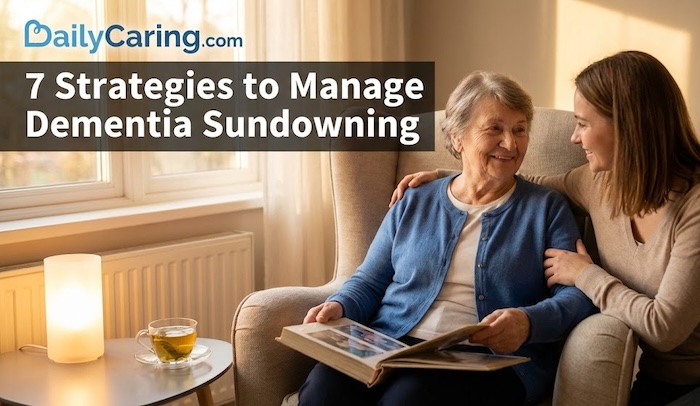
Discover seven compassionate approaches designed to ease sundowning symptoms, helping you create a more peaceful and predictable evening for everyone.
What Is Dementia Sundowning and How Does it Affect the Quality of Life for Seniors?
Someone with Alzheimer’s disease or dementia may become more agitated or anxious starting in the late afternoon and lasting through the evening and night.
They could become aggressive, delusional, paranoid, want to walk, or accidentally wander away.
Some may have disrupted sleep schedules or restlessness at night.
This behavior is called dementia-related sundowning because it typically begins around sundown (late afternoon or evening).
These dementia sundowning symptoms negatively affect your older adult’s quality of life and are challenging for you to manage.
We explain the causes of sundowning and outline seven strategies to manage its symptoms and behaviors. These suggestions make evenings calmer and easier for both you and your older adult.
What Causes Dementia Sundowning?
Some studies show that sundowning affects up to 20% of people with Alzheimer’s. And, it can also affect older adults who don’t have dementia.
Researchers don’t know precisely why sundowning occurs, but they hypothesize that it’s caused by brain changes associated with dementia.
The body clock, which regulates when we’re awake and when we’re asleep, might be affected by those changes.
7 Strategies to Reduce and Manage Sundowning Symptoms
1. Go along with their reality
Sometimes, a person with dementia will experience a different time in their lives, like when they were parents of young children, going to work, waiting for their parents as a child, or something familiar from their past.
If this occurs, do your best to accommodate their reality. Trying to force them back into our reality won’t work and will only cause upset or anger.
It may help to engage them in an activity that’s similar to what’s happening in their mind.
For example, if they’re waiting for someone to come home, they would do something they would have done in that real situation. Maybe they would be making a snack, preparing dinner, or straightening up the house.
Consider their routines and activities when they were younger, and brainstorm activities that fit situations that feel familiar to them.
Later, if needed, you could use a therapeutic fib to transition out of that activity and redirect their attention somewhere else.
For example, if they were waiting for their mom to pick them up from school, you could help them get ready by gathering up their school bag, using the toilet, and putting on their jacket.
If doing that slowly isn’t enough of a distraction to transition to another activity, you could say their mom called and said she would be a bit late, so she asked them to go ahead and have a snack while waiting.
During and after the snack, you’ll have more opportunities to transition to other enjoyable activities.
2. Listen carefully to understand the emotions behind their words
When someone is experiencing sundowning symptoms, they may make unusual requests, such as asking for their mother or to go home.
Even if their words don’t make logical sense, listen for and respond to the emotion behind the words.
In some cases, they could be trying to express fear or loneliness. In other cases, they might be expressing frustration, discomfort, anger, or other emotions.
3. Provide empathy, support, and comfort
If an older adult is experiencing difficult emotions, they may not be ready to change how they feel.
It may be more compassionate and effective to support them in processing their emotions. You can do that by showing that you’re on their side.
Some people might like you to sit with them, hold their hand, or hug them. Others may prefer your company or that you be a sympathetic listener.
Neutral, but supportive, responses could include:
- I understand.
- That’s a lot to deal with.
- Oh, that must be hard.
- Of course, you miss your Mom.
4. Create safe spaces where they can move around
Some people get restless and want to move around. If your older adult wants to walk or pace, create a safe area for them to do so.
This could be a clear path somewhere in the house or a safe area in a secure backyard where you can keep an eye on them.
They may also appreciate your accompanying them so they do not feel alone as they move around.
5. Engage them in calming activities
Engaging someone with dementia in calming, soothing activities is a positive way to direct their energy.
An activity that they enjoy and makes them feel good helps them focus on something other than boredom, fear, anxiety, or frustration.
Create a space in a calming environment for them to focus on this activity.
Some people like repetitive activities like sorting papers, folding laundry (small towels), shuffling cards, etc.
Some may enjoy listening to soothing music, coloring, painting, cuddling a baby doll, or a stuffed animal.
Try different activities to determine which they prefer and which are most calming.
6. Create a pre-bedtime wind-down routine
It can be tough for someone with dementia to go from the normal activities of daily life directly to lying down and quickly falling asleep within 30 minutes. (Many caregivers struggle with this, too.)
To facilitate a smooth transition and make it easier to settle down and go to sleep, implement a pre-bedtime wind-down routine.
This is a time when you make the environment extra calm and soothing to help older adults relax and slow down.
For example, turn off the TV or switch to a non-exciting show played at a low volume. If music is playing, make it soft, soothing, and at a low volume. Consider using aromatherapy to scent the air with a relaxing agent such as lavender.
Some people may enjoy hearing a book read aloud, looking at photos that remind them of happy times, or sitting quietly with an activity.
If there are activities they enjoy and that usually calm them, this is an excellent time to use them.
Lighting can be a bit tricky, so experiment to find out what works best.
Typically, dimming the lights slightly helps transition from activity to sleep. But with sundowning, shadows or dark corners can provoke anxiety or hallucinations.
Please do your best to find a level of lighting that’s dimmer than usual, but not so dim that shadows start playing tricks on their eyes.
7. Consider medication
In some cases of sundowning, especially when these and other non-drug methods of reducing symptoms don’t work, it may be helpful to try medication.
Work with their doctor to experiment carefully with medications.
Some medications may disrupt sleep patterns and energy levels in a way that exacerbates sundowning rather than alleviating it.
Final Thoughts on Dementia Sundowning
Managing sundowning is a journey of patience, observation, and deep compassion. By implementing these seven strategies (ranging from entering their reality to creating soothing routines), you are not only addressing behaviors but also providing comfort and security to your loved one during a confusing time.
Remember, there is no one-size-fits-all solution; the key is finding what uniquely brings peace to your family member. Each small success in creating a calmer evening is a significant victory for their well-being and your resilience as a caregiver. You have the power to transform sunset from a time of tension into a period of connection and gentle transition.
Next Steps: Find out about 7 additional ways to reduce dementia sundowning symptoms
Recommended for you:
- 7 Ways to Reduce Dementia Sundowning Symptoms
- 3 Top Benefits of a Daily Routine for Seniors
- Keeping a Dementia Journal Makes Caregiving Easier: 7 Things to Track
About the Author

Connie is the founder of DailyCaring.com and was a hands-on caregiver for her grandmother for 20 years. (Grandma made it to 101 years old!) She knows how challenging, overwhelming, and all-consuming caring for an older adult can be. She also understands the importance of support, especially in the form of practical solutions, valuable resources, and self-care tips.



Yes, every evening I leave my loved one a checklist something like this, even if I’m staying home— and he actually checks the boxes! Good night, Sweetheart. I’ll be home after midnight [ ] dinner is beef and broccoli [ ] dessert is tapioca and blueberries [ ] Rebecca will be here from 6 to 10 [ ] take your Tuesday night pills before you go to bed [ ] virtual hug and kiss good night! PS: we picked up all the newspapers and mail already.
This is great! Thanks for sharing what’s been working for you both.
Has anyone used a visual schedule that shows the bedtime routine so your loved one know what to expect that evening? These kinds of visuals are used successfully with students who have cognitive challenges to manage behaviors.
I personally experienced something like “sundowning” when my second child was born. I became anxious in early evenings because I did not know what my night would be like!
A visual schedule is a good idea to try! Thanks for the suggestion.