












When you notice a loved one forgetting names, repeating questions, or making uncharacteristically poor decisions, your first instinct might be to ask their doctor for a “dementia test.” In many cases, that initial test is the Mini-Mental Status Exam (MMSE); a quick, widely used screening tool that can feel like the definitive answer.
But what if a score on this standard test told only a tiny part of the story? Relying on the MMSE alone is like diagnosing a car’s engine trouble by checking only the fuel gauge; it may provide one piece of data, but it misses the complex reality under the hood.
Understanding that this standard screening is only a first step and that a deeper investigation is crucial can protect your loved one from misdiagnosis and guide you toward the accurate answers and appropriate care they truly need.
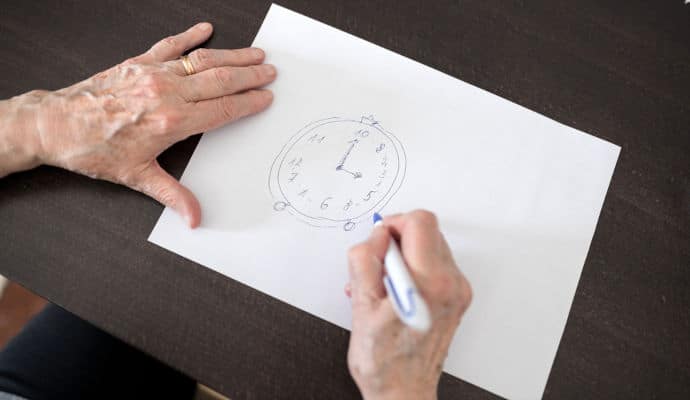
The Mini-Mental Status Exam is Only a First Step
If you’re worried that your older adult could be showing signs of Alzheimer’s disease or dementia, it’s important not to jump to any conclusions.
That’s because other medical conditions, medication side effects, or psychiatric issues could be causing dementia-like symptoms.
The first step is to have their primary care doctor conduct a comprehensive physical and mental exam.
To look for possible cognitive issues, many doctors use a standard screening test called the Mini Mental Status Exam (MMSE).
The Mini-Mental Status Exam is a valuable tool because it’s quick and straightforward, and any doctor can use it without specialized training.
But it has significant limitations and cannot be used alone to make a diagnosis of Alzheimer’s or dementia.
We explain what the MMSE doesn’t test and why a too-quick diagnosis could harm your older adult’s health.
The MMSE Won’t Catch All of the Dementia Symptoms
The MMSE can’t be used alone to diagnose Alzheimer’s disease or dementia because most questions assess only memory and recall.
Someone who knows what day it is, what a particular object is, or who can remember a short list of random things could do well on the test.
But that doesn’t mean they don’t have dementia. Some types, like Lewy body dementia, affect judgment far more than memory.
Some dementia symptoms the MMSE would miss include:
- Freely giving out bank account information to strangers
- Suddenly spending money like crazy when they’re always frugal
- Making risky investment decisions when they’ve always been conservative investors
MMSE Results Don’t Provide Enough Information for an Accurate Dementia Diagnosis
Non-geriatric doctors often aren’t experienced in diagnosing Alzheimer’s or dementia.
As a result, they may not be aware of the recommended testing and may jump to conclusions based solely on MMSE results.
As a caregiver, it’s essential to know that it’s simply not possible to get an accurate dementia diagnosis in just one office visit.
A basic physical exam and MMSE screening don’t give enough information to declare a case of Alzheimer’s and prescribe medications like Namenda or Aricept.
Jumping to conclusions could lead to your older adult receiving the wrong treatment, which could harm their health.
For example:
- A treatable medical condition like heart disease, vitamin deficiency, or kidney failure could cause their dementia-like symptoms.
- A medication side effect or drug interaction could cause their symptoms.
- They could have signs of depression or another psychiatric issue.
Different types of dementia can require different treatment.
Even if an older adult does have a form of dementia, how would the doctor know whether they have vascular dementia, Alzheimer’s, or another type based solely on the MMSE? The answer is that they cannot, which is why further testing and evaluation are needed to reach an accurate diagnosis.
Final Thoughts About the Mini-Mental Status Exam (MMSE)
Pursuing a cognitive evaluation is a journey, not a single stop. While the Mini-Mental Status Exam is a valuable starting point, it is the beginning of the conversation, not the end. True clarity comes from a comprehensive assessment that looks beyond memory to evaluate judgment, rules out treatable conditions, and pinpoints specific types of dementia.
As a caregiver, your advocacy for this thorough process is one of the most powerful ways to safeguard your loved one’s health. It ensures that any treatment plan is tailored correctly and that reversible causes are never overlooked.
Let the MMSE open the door, but insist on the whole investigation that leads to understanding, proper care, and absolute peace of mind.
Recommended for you:
- Testing for Dementia: The Mini Mental Status Exam
- How Is Dementia Diagnosed? A Geriatric Doctor Explains
- 7 Treatable Health Conditions with Symptoms Similar to Dementia
About the Author

Connie is the founder of DailyCaring.com and was a hands-on caregiver for her grandmother for 20 years. (Grandma made it to 101 years old!) She knows how challenging, overwhelming, and all-consuming caring for an older adult can be. She also understands the importance of support, especially in the form of practical solutions, valuable resources, and self-care tips.


you don’t mention UTIs as a trigger for many dementia-like symptoms or the symptoms quickly worsening. I understood UTI would be among the top suspects for investigation.
My 93year old mother was diagnosed with MCI in 2014 after this MMSE test. She is now at stage 4-5 Alzheimers and her weekly deterioration is evident. Mother has carers twice a day but has no recollection of them, or anything they do. She insists that she is capable of looking after herself and her bungalow, refuses to wear hearing aids , glasses, slippers and use a walking stick. Her outlook on life is severely limited. My brother is her POA and I have arranged all her benefits to assist her living requirements. Mother has no idea of time,day, season or year. She thinks that she is in her 50’s and still wants to drive. Mother’s reality diminishes rapidly and we, her family, watch her struggle to understand her limitations. She will be 94 in January and despite being under the care of Adult Social Care Services, she refuses to go into a Care Home because mother still retains some ” capacity” to make her own decisions.
This is a challenging situation. Unfortunately, if she’s still determined to have capacity to make her own decisions, you cannot take over as Power of Attorney to make changes that will improve her health and safety. You may want to talk with the Adult Social Care Services agency and her doctor to let them know about her behavior and your concerns for her safety.