













Both choices have significant emotional and practical implications, from cost and safety to independence and social connection.
In this article, we break down the key factors to consider, including health needs, budget, and personal preferences, so that you can make an informed decision with confidence.
Whether you're planning or navigating an urgent situation, understanding these options will help you find the right balance of care, comfort, and peace of mind for both you and your loved one.
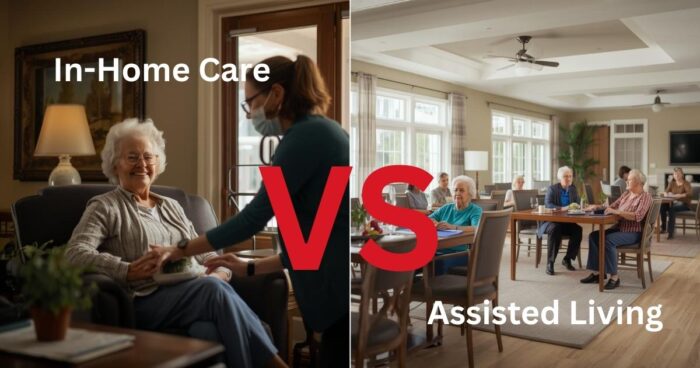
In-Home Care vs Assisted Living
When your parent or spouse needs assistance in their daily life, many families face a tough choice – assisted living vs in-home care.
Choosing between assisted living and home care involves many personal and financial factors.
It’s a complex decision, and the answer depends on your older adult’s specific situation.
We share what you need to know about the three essential factors to consider: the level of assistance they need, key differences between assisted living and home care, and their financial situation.
Knowing the facts helps you make the best choice for an older adult.
70% of seniors will eventually need long-term care, yet most families aren’t prepared to choose between in-home and facility care (AARP)
1. How Much Help Does Your Loved One Need?
Before making any decisions, it’s essential to determine how much support your older adult needs and compare that with the support already available.
Previously, we discussed understanding their needs across 8 key areas of life and being realistic about the level of support the family will provide.
First, make a list of everything your older adult needs help with on a daily, weekly, and monthly basis. Seeing the whole picture helps you choose the appropriate level of care.
Next, be realistic about how much help you, your family, your friends, and your neighbors will provide. It’s essential to think about this in terms of long-term, ongoing help – a few weeks or months won’t be enough.
After comparing those two lists, you’ll have a better sense of the tasks your older adult will need additional help with – anything that isn’t already covered.
In some cases, this list makes it clear that in-home care is the best option. In other instances, assisted living might be the clear choice.
2. Understand the Differences Between In-Home Care and Assisted Living
Before you choose between in-home care and assisted living, it’s essential to understand how each works.
Here are the basics and key pros and cons for each.
In-home care: Pros and Cons
In-home care is when a caregiver is hired to come into the home to help seniors with activities of daily living. This enables your older adult to continue living safely at home.
The specific assistance provided depends on the older adult’s needs and may include meal preparation, navigating the house, transportation, bathing, dressing, toileting, and more.
Pros
- Seniors get one-on-one care tailored to their needs and preferences.
- Seniors can stay in their home or a relative’s home as they age.
- Costs can vary based on the number of hours of care required and the caregiver's skill level.
- The family gets to choose the caregiver.
- Seniors receive care from a single caregiver rather than from multiple people.
- Flexibility in care arrangements: different types of care could be combined to lower costs, increase social interaction, or provide medical-type care – family help, adult day programs, privately-hired caregivers, agency caregivers, and home health care
Cons
- High costs if 24/7 care is needed
- Ongoing family involvement is needed for hiring and managing caregivers, as well as planning backup care options.
- Potential for social isolation, which can contribute to depression, cognitive decline, or health problems
- The home may need modifications for safety or wheelchair accessibility
- Housekeeping and home maintenance need to be done, and groceries, personal care, and household supplies need to be bought
Assisted living: Pros and Cons
An assisted living community is a place where many seniors live, in rooms or small apartments.
Most communities offer a wide range of care options, from seniors who are mostly independent to those who need a high level of care.
Services like meals, transportation, group activities, and housekeeping are typically included in the monthly fee.
Pros
- A more affordable way to get 24/7 supervision and care
- Family can focus more on the relationship rather than on care needs
- Your loved one has plenty of opportunities for social interaction with other residents
- Family doesn’t need to worry about hiring, scheduling, or managing caregivers
- The level of care can be ramped up as needed because the staff is already in place
Cons
- One-on-one care won’t be as personal or consistent as care at home, and frequent staff turnover is common.
- Quality of care can vary depending on the staff.
- If significant one-on-one care is needed, hiring and paying a private aide out of pocket may become necessary.
- Seniors could be removed from the community for a variety of reasons, with little advance notice.
- Seniors may not enjoy being in a group living environment
Now that you know more about assisted living and in-home care, the choice between them is probably becoming clearer. The following item to consider is the cost of care.
3. Understand the Financial Situation
Before you can choose assisted living or in-home care, you need to know how each option would work with your older adult’s budget.
Figuring out assisted living and in-home care costs isn’t easy and varies based on each person’s needs, location, and the level of family support available.
This takes some work, but it’s worth the effort because it helps you plan for the future and avoid unpleasant scenarios, such as your older adult suddenly running out of money.
The best thing to do is to call around to get actual pricing information from assisted living communities you’d consider and in-home care providers you might use.
That way, you’ll know how much it would cost to get the level of care your older adult needs in the city they live in.
A faster, but less accurate approach is to use averages from an online long term care cost estimating tool.
| Care Type | National Median Monthly Cost | Estimated Annual Cost |
|---|---|---|
| Assisted Living Community | $5,190 – $6,129 | $62,280 – $73,548 |
| In-Home Care (44 hrs/week) | $6,481 | $77,772 |
| 24/7 In-Home Care | $21,800 – $27,000+ | $261,600+ |
| Nursing Home (Private Room) | $10,646 | $127,750 |
According to Genworth, the 2025 national average monthly cost of in-home care was $6,481 for 44 hours per week. The 2025 national average monthly cost for assisted living was $5,190 to $6,129 (depending on location, needs, etc.).
There will be a lot of factors to consider because you’re essentially making financial estimates for the next 5 to 10 years of your loved one's life.
If analyzing and comparing costs becomes overwhelming, ask a trusted relative or friend for help. Or, consult a reputable financial adviser or accountant.
Here’s an overview of the key costs you’ll need to take into account.
Monthly In-Home Care Costs
- Hours of care needed x caregiver hourly rate
- Groceries and meal preparation
- Personal care supplies
- Household supplies
- Housekeeping and laundry
- Transportation
- Rent or mortgage, and property taxes
- Home and yard maintenance
- Utilities, water, and garbage
Assisted Living Costs
Assisted living fees vary by community, so don’t assume that the base monthly rate covers all services.
That’s why it’s essential to request a list of all potential fees, in addition to the monthly rate. Your older adult may need these additional services now or in the future.
Common Fees Include:
- Monthly base rate
- Additional fees for the necessary level of care
- Housekeeping and laundry
- Personal care supplies
- Meals, in-room dining, or snacks
- Overnight visitors
After adding up the costs, you’ll have a good idea of which option fits better in your older adult’s budget, assisted living or in-home care.
VIDEO: Choosing Between Assisted Living and In-Home Care
Key Financial Updates for 2025
Hourly Rate Increases:
The national average for homemaker services is now approximately $33.99 per hour, while a Home Health Aide averages $35.02 per hour.
The “Tipping Point”:
In 2025, if your loved one requires more than 35–40 hours of care per week, assisted living often becomes the more cost-effective option. This is because assisted living fees include housing, utilities, food, and maintenance, which must be paid separately when aging at home.
Geographic Variance:
Costs vary wildly by state. For example, assisted living in Hawaii can exceed $11,650 per month, while the same level of care in Mississippi averages $3,998 per month.
Memory Care Premiums:
If your loved one has dementia or Alzheimer’s, expect to add $1,150 to $2,500 per month to the base assisted living cost for specialized memory care.
Summary of “Hidden Costs” to Consider When Deciding Between In-Home Care and Assisted Living
Home Modifications:
If opting for in-home care, installing walk-in tubs or wheelchair ramps can range from $3,000 to $15,000+.
Community Fees:
Most assisted living facilities now charge a one-time “move-in” or “reservation” fee, typically between $1,000 and $5,000.
Second Person Fees:
For couples moving into a single assisted living unit, the median “second person fee” is now roughly $1,200 per month.
Final Thoughts on In-Home Care vs Assisted Living
Ultimately, choosing between assisted living and in-home care is not about finding a perfect solution, but about identifying the option that best fits your loved one's needs, your family's capacity, and your long-term financial reality.
This decision is a profound act of love. One that prioritizes your loved one's safety, dignity, and quality of life. By using these three essential tips to assess needs honestly, understand the practical pros and cons of each option, and plan a sustainable financial path, you move from overwhelming uncertainty to empowered clarity.
Whichever route you choose, let it be guided by compassion, practicality, and the shared goal of ensuring your loved one feels supported, valued, and at peace in their next chapter.
Recommended for you:
- Moving to Assisted Living: 5 Ways to Know When It’s Needed
- When to Move to Assisted Living? Advice From a Social Worker
- How to Choose an Assisted Living Facility: Helpful Checklist and Tips
A version of this article was originally published on Sixty and Me
About the Author

Connie is the founder of DailyCaring.com and was a hands-on caregiver for her grandmother for 20 years. (Grandma made it to 101 years old!) She knows how challenging, overwhelming, and all-consuming caring for an older adult can be. She also understands the importance of support, especially in the form of practical solutions, valuable resources, and self-care tips.



Great article, however, I do find this statement “Seniors could get kicked out of the community for a variety of reasons with little advanced notice” to be mostly untrue. Yes, seniors can be issued a 30 day written notice (Michigan), but often the assisted living cannot just kick them out. They have to have a place to go. I have been in senior living for nearly a decade, and I have never had a resident be discharged immediately. It can happen, but that is generally only if the senior is a danger to themselves or others, and in that case, they are not appropriate for assisted living.
In my experience, the assisted living communities do everything possible to try and save the move out.
It’s wonderful to hear that, in your experience, assisted living communities work hard to make sure older adults have a safe place to go before they’re asked to move out. Unfortunately, that’s not always the case (discussed here – https://dailycaring.com/it-can-happen-seniors-getting-kicked-out-of-assisted-living/).
Hopefully, these cases aren’t too common. In any case, it’s important for families to know that this can happen and they do have rights in these situations.
nice post
Thank you! So glad it’s helpful
Thank You From The Bottom MY ❤️… You Have Truly Givin Me Hope. I’m 72 and I have no one…I Do have a daughter, but she has cancer and she’s unstable. Big Big Heart… She is in denile about me needing Help . It’s a sad situation.. for us both. This letter has given me some very much needed information and I don’t feel so alone in my search. I’ll be sharing on social media. Even though texting is a way to communicate.. I would like to find a Site that offer’s a phone call or chat . For me the lonleyness is the Worst. Thank You for getting this message to me ! I would dare to say ” I received Devine Intervention ” Today :). God Bless You And All You Love And Help. Sincerely, Sylvia Booth.
We’re so glad our articles have been helpful ❤️ You are certainly not alone. Perhaps you might enjoy activities at a local senior center where you could socialize with others and find out about other supportive services. Your county’s Area Agency on Aging should be able to direct you to local programs. More info at Area Agency on Aging: Local Resources for Seniors https://dailycaring.com/area-agency-on-aging-resources-for-seniors/
In your cost comparison, you don’t mention that the cost of assisted living doesn’t include 24-care for those who may need it. “Care” in an assisted living facility is not trained medical staff. So, when you add the cost of the facility plus care and compare it to a situation where the senior owns their own home, it is far most cost effective to live at home. Socialization is fine but if you don’t want to interact with others all the time, it’s hard to get away from people. It’s like living at camp and there are cliques like camp. If people don’t like you, the social isolation is going to be horrible. If you are home, and you have a network of friends and a senior center you enjoy, being home let’s you hang out with people you like not strangers. Finally, you don’t talk about exposure to viruses and bacterial infections, like Covid, that can be out of control at these facilities and are breeding grounds for illness. If you own your own home and it’s ADA accessible, can hire a reputable firm that manages home health care, and you have a lifestyle that involves visiting people and going out, then the home health care option is cheaper AND safer.
There are many factors to consider when choosing a place to live. What’s most important is to understand what’s important to the person, their care needs, their lifestyle preferences, and their budget. Pricing and available services will also vary based on location and care community.
This is an overview that generally compares different senior housing options so families can get an idea of which options are worth further investigation.
I’m Stuck in Yuma Arizona…I’m From Washington State and I Know It Has way more to offer us Seniors
I got stuck here because of Covid..and came in my moter home to bury my brother. At 72 yrs old I struggle with finding my way back to Washington…and I lost the beautiful piece of land on the river. I kept paying for it at $300 amo for 1 yr. Now I’m stuck in the desert where nothing is Green. It’s a really harsh reality for someone like me who has always lived in the Forest. Finding this site has given me hope and the courage to continue my search finding a place to call home again.
We’re sorry to hear that you got stuck in a place you don’t enjoy and wish you all the best in finding a new home that you love. We’re so glad our site can be helpful.
Good article. However, once again, for many of us, there is no choice due to financial concerns. While there are Long term care Medicaid programs in most states, the facilities which accept that payment, are often not exactly what most of us would choose for Assisted Living/ Memory Care and almost always have a waiting list.
In addition, at least here in AZ, the patient must make no more than $2,000 per month with any overage going into what is called the Miller trust. For a spouse, most of the time the home may be kept, one car – told it can only be used for medical visits! – and that person would receive about $1,400 per month to live on.
With average rents in Tucson, where we live, exceeding $800 per month for a 1/1, $1,200 for a 2/1, plus utilities often, and rents in mobile home parks plus utilities reaching $700+ per month, anyone on Social Security with little else for income are finding it exceedingly hard to fine suitable housing. In addition, rents are raised annually while Social Security really does not go up as the Medicare premium eats up any increase and actually exceeds it.
So, if we can’t find suitable housing with our fixed income, we also can’t afford either home health or Assisted Living/Memory care.
Here in America, only the well-to-do have options. For many of us who retired before 401k and more, we simply do not have the financial resources to get even minimal help. This is why some will hire a person advertising on Craig’s list or worse and then, find themselves at the mercy of that person.
I was an RN Supervisor for 2 Home Health agencies in the late 80’s. Home Health is the best for most as the patient will continue to have some independence and therefore do better for longer.
Unfortunately, each state and local benefits program offers different levels of support and has different requirements for qualification. We wish these programs would provide better long term care options and assistance.
These articles may help you find other programs that offer financial assistance:
– Financial Help for Seniors: 2,500+ Federal, State, & Private Benefits Programs https://dailycaring.com/find-financial-help-for-seniors-federal-state-and-private-benefits-programs/
– Getting Paid as a Family Caregiver: 3 Government Benefits Programs https://dailycaring.com/getting-paid-as-a-family-caregiver-3-government-benefits-programs/
You might also want to contact your local Area Agency on Aging. They may be able to connect you to organizations that can help. More info here – Area Agency on Aging: Resources for Seniors https://dailycaring.com/area-agency-on-aging-resources-for-seniors/
Thank you . This article was very useful.
You’re very welcome! We’re so glad the information was helpful.
Very nice explanation about the home care and assisted living. And all the points are notable such as the pros, cons, and costing.
So glad this article is helpful!
I FOUND THIS VERY INFORMATIVE AND HELPFUL… We all have to start somewhere with being informed and i found this very helpful and i am going on 4 years as caregiver for my spouse.. a proverb from Stud Sterkel : ” Nobody cares how much you know , Until they know how much YOU CARE ” Bill Black
So glad this article is helpful. Thanks for sharing this wonderful quote!