











As we age, a quiet but persistent anxiety often takes root: the fear of a sudden fall or the gradual fading of mental sharpness.
As a strategist who has seen the profound toll a single stumble can take on a family’s independence (my own family), I view Tai Chi not as a simple hobby, but as a great option for aging adults and their longevity.
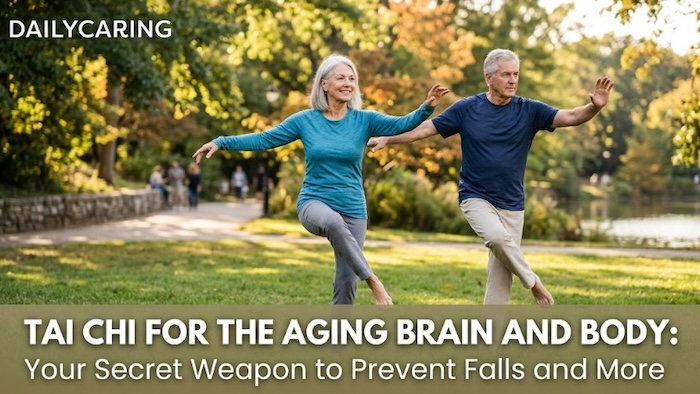
The latest research has elevated the ancient practice of Tai Chi to a top-tier medical recommendation, bridging the gap between traditional health strategies and modern geriatric care.
What is Tai Chi?
The Tai Chi For Health Institute defines Tai Chi as: “an art embracing the mind, body and spirit. Originating in ancient China, tai chi is one of the most effective exercises for health of mind and body. Although an art with great depth of knowledge and skill, it can be easy to learn and soon delivers its health benefits.”
Tai Chi is far more than a slow-motion exercise; it is a “mind-body cultivation system” that seamlessly integrates martial arts, controlled breathing, and philosophical mindfulness. It is a way of moving that trains the brain and body to work in harmony, offering a level of protection that most high-impact gym regimens just cannot match.
The “6-Year” Brain Bonus: Tai Chi May Actually Benefit the Aging Mind
Tai Chi acts as a rigorous cognitive challenge disguised as a gentle flow. Because it requires the practitioner to focus intensely and memorize a complex series of movements, it engages the brain’s executive functions.
Research highlights that this is particularly vital for older adults already showing signs of decline; for these individuals, Tai Chi can significantly slow the progression toward dementia. In fact, clinical scores suggest that regular practice can be equivalent to gaining three to six extra years of cognitive function. By requiring you to use your mind to guide your physical movements, Tai Chi helps keep the brain as resilient as the body.
“If you're able to keep doing this (Tai Chi) two or three days a week on a routine basis, you're going to get a lot of extra years before you hit that decline into dementia.” — Elizabeth Eckstrom, Chief of Geriatrics, Oregon Health & Science University.
Tai Chi for Seniors: Cutting Fall Risk by Half
Falls are the leading cause of injury-related death for older adults, but Tai Chi can offer a solution that's often way more effective than standard aerobics. By requiring slow, deliberate weight shifting, the practice recalibrates the brain-muscle connection, thereby building functional strength.
Studies have shown that Tai Chi can cut the chance of falling by up to 50%. This stability is achieved through several specific biomechanical mechanisms:
- Controlled displacement of body mass: Training the body to remain stable while moving over its base of support.
- Ankle and hip range of motion: Enhancing the joints' ability to respond to uneven surfaces and maintain a steady gait.
- Core stability: Strengthening the “power center” of the body to prevent stumbles from becoming dangerous falls.
Tai Chi Enhances “Slow-Wave” Activity for Better Sleep
For those of you struggling with insomnia, Tai Chi offers a “biological deep dive” into better rest. EEG (electroencephalography) evidence shows that the practice fundamentally alters the structure of your sleep. This means a quieter, more restorative night for your loved one, and perhaps a less interrupted night for you as a caregiver.
VIDEO: The Impact of Tai Chi and Healthy Aging
Better Than Cardio? The Blood Pressure and Pain Breakthroughs via Tai Chi
While high-intensity cardio is often touted for heart health, Tai Chi provides a counterintuitive breakthrough. Inducing a low-arousal, relaxed state can lower blood pressure more effectively than traditional aerobic exercise.
Beyond the heart, Tai Chi is a primary recommendation for managing chronic pain. The American College of Rheumatology strongly recommends it for those with knee and hip osteoarthritis or fibromyalgia, as fluid movement improves joint stability without the physical stress of high-impact exercise.
Start with Five Minutes of Tai Chi: Accessibility for Every Ability Level
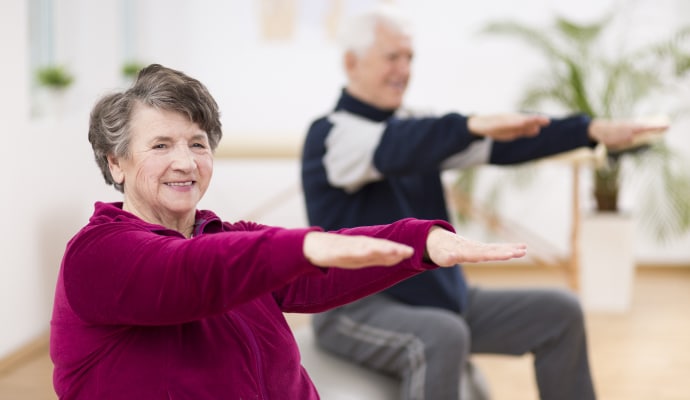
One of the greatest strengths of Tai Chi is its radical accessibility. It requires no equipment and can be adapted for any level (including practicing while seated). The most important rule is to listen to your body and never push through pain. If your loved one is unsteady, starting in a chair is a safe and effective way to begin.
Final Thoughts on Tai Chi for Brain and Body Health
Tai Chi is a preventive strategy whose benefits compound. It is not about mastering a perfect martial arts form; it is about the simple act of participation. Every graceful, flowing movement is a step toward greater security, strength, and a more “grounded” sense of self.
Disclaimer: The health and wellness information provided in this article is for educational and informational purposes only and is not intended as medical advice. Always consult with a qualified physician or licensed physical therapist before beginning any new exercise routine or mobility program, especially if you or your loved one are experiencing severe balance issues or chronic pain. Never disregard professional medical advice or delay seeking it because of something you have read on this (or any other) website.
About the Author

Chris is a seasoned healthcare executive and entrepreneur from the Pacific Northwest. He strongly advocates for older adults and the caregivers who serve them. Chris has personal experience caring for his father, who had dementia. Chris is a technology enthusiast and an avid outdoorsman; if he's not in his office, he can usually be found on a golf course or fly-fishing out west somewhere.