












For decades, creatine was mainly found in the weight room, a staple for athletes chasing explosive power and muscular growth. But as the science of longevity matures, this nitrogen-containing molecule is undergoing a significant rebranding.
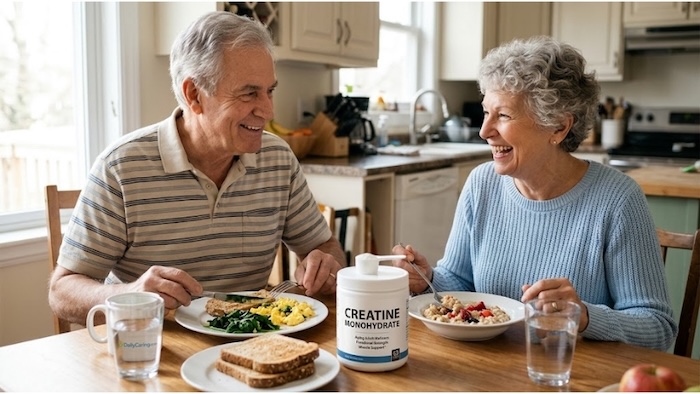
Reimagining Creatine: It's Not a “Bodybuilder Supplement” Anymore
Creatine use for aging adults is becoming a very popular topic in online circles, and we examine the benefits and risks below:
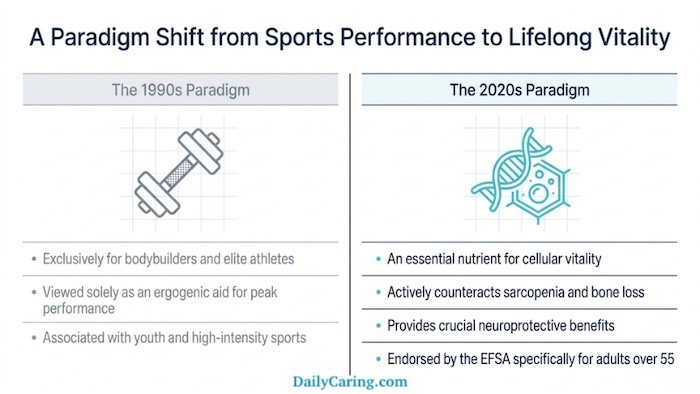
Researchers now characterize creatine as a “conditionally essential nutrient” for the aging population – a shift driven by the discovery that our bodies often cannot keep up with the demands of cellular maintenance as we move into our later years.
The Data on Creatine Use for Aging Adults
The data on creatine for aging adults suggest we are facing a quiet deficiency: approximately 70% of older adults consume less than the recommended 1.0 gram of dietary creatine daily.
While many view the decline in physical vitality and cognitive sharpness as an inevitable part of growing older, the emerging scientific consensus suggests these losses are actually “conditionally reversible.”
By replenishing our internal stores, we may be able to bridge the gap between age-related decline and continued independence. Lots of folks are looking for an edge (myself included), and creatine supplementation might just be one way to get it…
VIDEO: Longevity Experts Discuss Creatine – Dose, Benefits & Safety
Your Brain Craves More Than Just “Brain Food”
While we often think of creatine as a muscle-building supplement, recent data suggests it's equally vital for the brain.
As a highly energetic organ, the brain utilizes 20% of our total energy expenditure even at rest. It relies on adenosine triphosphate (ATP) for every thought and memory, and creatine is the primary engine for resynthesizing that ATP during periods of high demand. ATP is widely viewed as the fundamental “energy currency” of all living cells.
The brain presents a unique challenge: it produces its own creatine but has a very limited capacity to take up creatine across the blood-brain barrier. This explains why recent research indicates that higher doses (often 10 grams or more daily) may be required to observe meaningful cognitive shifts, compared with the lower doses used for muscle maintenance.
The impact of creatine on aging adults is most visible when the brain is under “stress,” such as during sleep deprivation or mental fatigue. In these scenarios, creatine supplementation has been linked to significant improvements in memory, processing speed, and executive function in seniors.
Specifically, creatine supplementation has been shown to improve measures of cognition and memory (primarily in aging adults) and decreases symptoms of sleep deprivation in human and animal populations. – Darren G Candow, Scott C Forbes, et al, Sports Medicine
Creatine: The Secret Weapon Against Sarcopenia
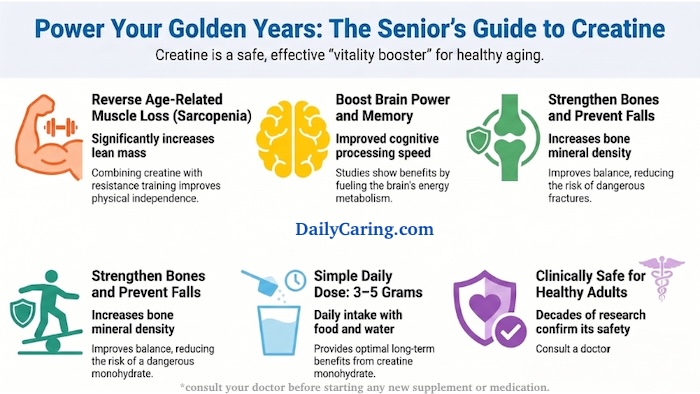
One of the most daunting hurdles of aging is sarcopenia, the progressive loss of muscle mass and strength. This decline is largely fueled by “anabolic resistance,” a condition in which older muscles become less responsive to dietary protein.
Creatine acts as a biological intervention against this resistance. By influencing high-energy phosphate metabolism and improving calcium uptake in muscle cells, creatine provides a metabolic environment necessary to preserve lean tissue mass.
Rather than just adding “bulk,” creatine may help older adults maintain the physical strength needed for daily activities and fall prevention.
Does Creatine Use for Aging Adults Support Bone Health?
The benefits of creatine extend to the skeletal system, offering a dual-action defense against osteoporosis. This action occurs through a biological “pulley and lever” effect: as creatine enhances muscle density, those stronger muscles exert a greater mechanical load on the bones during movement, which signals the body to stimulate more bone formation.
- A key indicator of this effectiveness is the reduction of urinary excretion of cross-linked n-telopeptides (NTx) – a marker of bone loss. Studies have shown that creatine supplementation can reduce NTx by 19% to 33%, effectively slowing the rate of bone mineral density loss and mitigating fracture risk.
- It's important to note, however, that long-term clinical data on aging adults is mixed regarding whether it consistently increases or protects overall Bone Mineral Density (BMD) on its own.
- Many experts believe that creatine reduces markers of bone breakdown and supports bone structure primarily when paired with resistance exercise, rather than serving as a standalone osteoporotic therapy.
The Catch: Creatine is Not a “Couch Potato” Pill
It's important to understand that creatine is not a “magic bullet” that works in isolation. While it provides the cellular energy and mechanisms needed for growth, resistance training significantly amplifies its benefits, especially for muscle and bone health.
This synergistic relationship between creatine use and exercise should be viewed positively. Creatine is a tool that makes your physical efforts more effective, allowing you to train with slightly higher intensity and recover faster. It is a catalyst for a holistic longevity strategy, not a substitute for movement.
VIDEO: Creatine Use for Aging Adults: Is it All Hype?
Takeaway 5: Debunking the Kidney Myth Around Creatine Use
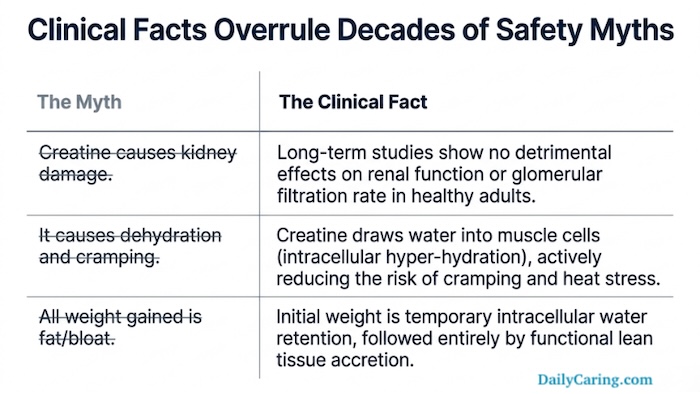
The most persistent concern regarding creatine is its supposed impact on kidney function. This myth stems from the fact that creatine is metabolized into creatinine, a waste product commonly used as a clinical marker of kidney health.
While supplementation can raise serum creatinine, exhaustive research on healthy individuals has shown no detrimental effect on actual glomerular filtration rates (GFR).
Precision and safety are paramount:
- Strict medical supervision is mandatory for individuals with pre-existing kidney conditions.
- Be aware of drug interactions: Creatine may interact with medications that affect renal function, including diuretics and nonsteroidal anti-inflammatory drugs (NSAIDs) such as ibuprofen or naproxen.
Mild potential side effects are typically managed through proper dosing and include:
- Temporary water retention: Creatine is osmotically active, drawing water into muscle cells.
- Digestive discomfort: This can usually be mitigated by taking the supplement with meals.
- Increased hydration needs: It is vital to increase fluid intake to accommodate the redistribution of water into skeletal muscle.
The Creatine Strategy: How to Start (Dosage & Purity)
To optimize the benefits of creatine, the strategy should be as scientific as the supplement itself.
- The Gold Standard: Use Creatine Monohydrate. It is the most extensively studied, safe, and bioavailable form.
- Creatine Dosing for Results (consult with your physician):
- Consistent Maintenance: 3–5g daily. This reaches the same saturation level over a 3–4-week period, with a lower risk of digestive upset.
- Brain Dosing: Note that for cognitive benefits, consistent daily doses of 10-20g or more may be necessary due to the blood-brain barrier’s limited uptake.
- Your physician may suggest that you undertake a “loading phase” – a period of a week or two of higher-than-normal doses, but this is debated among longevity experts (as you can hear in the video shared above).
- Optimize Absorption: Take your dose with a meal containing high-glycemic carbohydrates or protein. This stimulates insulin release, which helps drive creatine into the cells more efficiently.
- Prioritize Purity: Choose brands that are third-party tested and carry certifications from NSF International or Informed-Sport to ensure they are free of contaminants.
My Experience Using Creatine for the Past 6 Months
I've been using creatine from “Orgain” since early January. I buy it at Costco and stock up when it's on sale. I almost always mix it into a fruit-and-yogurt smoothie I make between breakfast and lunch, and I feel great afterward. (*Note, I also add collagen and nuts to my smoothie if you're curious.)
My personal dosage fluctuates between 5 and 10 grams per day, depending on my prior night's sleep. (If I don't sleep well, I bump my dose up to compensate for sharpness throughout the day.) It's working for me, as I feel sharper during the day.
For me, creatine serves as just one tool in my longevity arsenal. I usually add creatine, collagen, and a protein in a smoothie. I have a supplement stack of around 5-6 vitamins that I also take daily. I combine my supplement strategy with daily exercise to complete my own health strategy.
Conclusion: The Narrative For Creatine Use in Aging Adults is Exploding Online
The scientific narrative surrounding creatine has evolved from “sport performance” to functional longevity. By supporting brain health, slowing the tide of sarcopenia, and protecting bone mineral density, creatine offers a supplement option for those determined to age with balance and vitality.
Ultimately, we must ask ourselves: do we view aging as a slow withdrawal from the world, or as a proactive phase of life where we maintain our mental and physical sovereignty? With the right evidence-based interventions, the later years can be defined by continued strength and independence rather than decline.
Medical Disclaimer
The information provided in this article, including text, graphics, images, and other materials, is for informational and educational purposes only. It is not intended to be a substitute for professional medical advice, diagnosis, or treatment. Always seek the advice of your physician or another qualified healthcare provider with any questions you may have regarding a medical condition, dietary supplement regimen, or physical training program. Never disregard professional medical advice or delay seeking it because of something you have read on this or any other website.
About the Author

Chris is a seasoned healthcare executive and entrepreneur from the Pacific Northwest. He strongly advocates for older adults and the caregivers who serve them. Chris has personal experience caring for his father, who had dementia. Chris is a technology enthusiast and an avid outdoorsman; if he's not in his office, he can usually be found on a golf course or fly-fishing out west somewhere.