












Managing an older adult's medications is a persistent financial drain. Historically, caregivers have been forced to navigate convoluted coverage phases that made budgeting nearly impossible. The Medicare Part D changes 2026 eliminate much of that volatility, bringing forced financial predictability to the prescription drug market.

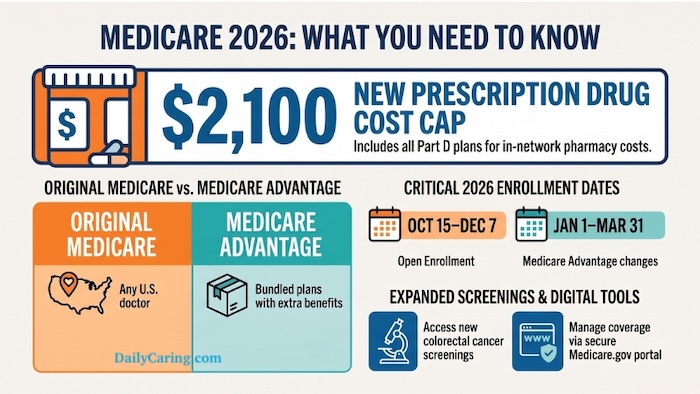
Thanks to the final implementation phases of the Inflation Reduction Act, out-of-pocket costs for covered prescription drugs are now strictly capped at $2,100 annually. The maximum standard deductible is legally set at $615.
Medicare Part D Changes 2026: The End of the Donut Hole
For over a decade, the most destructive element of Medicare Part D for seniors was the coverage gap, widely known as the donut hole. In this phase, seniors who reached a specific spending threshold suddenly became responsible for a massive percentage of their drug costs until they hit catastrophic coverage.
As of 2026, the donut hole is permanently dead. It no longer exists.
Understanding the Medicare Part D changes and associated prescription caps is a mandatory component of eldercare financial planning. Once an enrollee spends exactly $2,100 out of pocket in a single calendar year, their Part D plan or Medicare Advantage plan pays 100% of the cost of covered medications for the rest of the year.
There are no exceptions, and there is no catastrophic phase where the patient owes 5% coinsurance. The cost drops to zero.
The Real Threat: Formulary Manipulation
Do not assume your current coverage is safe. Insurance companies are not absorbing these new costs out of the goodness of their hearts. They are aggressively manipulating their covered drug lists (formularies) and shifting medications into higher pricing tiers to offset these mandated caps.
A drug that was fully covered in 2025 may be dropped entirely in 2026. You must meticulously verify that your loved one's specific medications remain on their plan's formulary during the Annual Enrollment Period. If a drug is not on the formulary, the money spent on it does not count toward the $2,100 cap.
How the Medicare Prescription Payment Plan Works
To prevent seniors from facing immediate $615 deductible hits in January, 2026 mandates the continuation of the Medicare Prescription Payment Plan. This opt-in program allows enrollees to smooth their out-of-pocket costs over the calendar year.
Instead of paying a large lump sum at the pharmacy counter, a caregiver can opt their loved one into this program. The pharmacy bills the insurance plan, and the insurance plan sends the enrollee a monthly bill.
- The Math: If an aging adult takes expensive specialty medications and is guaranteed to hit the $2,100 cap, opting in before January 1st means their maximum monthly pharmacy bill will never exceed $175 ($2,100 divided by 12 months).
Premium Stabilization
Another critical, but less publicized, Medicare Part D change is the premium stabilization program. To prevent insurers from simply jacking up monthly premiums to cover the new out-of-pocket caps, the law caps base premium increases at 6% per year.
However, this only applies to the base premium. Individual plan premiums will still fluctuate, making annual comparison shopping absolutely critical.
Reviewing your coverage options early gives you a distinct advantage. For a deeper dive into managing your loved one's assets, explore our eldercare financial planning guides. You can also verify specific drug coverage and learn more about the payment plan directly through the official Medicare Part D portal.
VIDEO: Understanding the 2026 Medicare Part D Caps
What the New $2,100 Limit Means for You
Understanding these Medicare prescription caps is vital for your eldercare financial planning. The days of the dreaded coverage gap are officially over. Once your loved one spends $2,100 out of pocket in 2026, their plan pays 100% of the cost of covered medications for the rest of the year.
Do not assume your current coverage is safe. Insurance companies frequently alter their covered drug lists to offset these new caps. You must verify that your loved one's specific medications remain on their plan's formulary.
| Medicare Policy Area | 2026 Update Details |
|---|---|
| Out-of-Pocket Cap | Strictly capped at $2,100 maximum per year. |
| Standard Deductible | Set at $615 for the 2026 plan year. |
Frequently Asked Questions: 2026 Medicare Part D
Does the $2,100 out-of-pocket cap apply to all medications?
Is the Medicare Prescription Payment Plan mandatory?
What happened to the Medicare donut hole?
About the Author

Chris is a seasoned healthcare executive and entrepreneur from the Pacific Northwest. He strongly advocates for older adults and the caregivers who serve them. Chris has personal experience caring for his father, who had dementia. Chris is a technology enthusiast and an avid outdoorsman; if he's not in his office, he can usually be found on a golf course or fly-fishing out west somewhere.