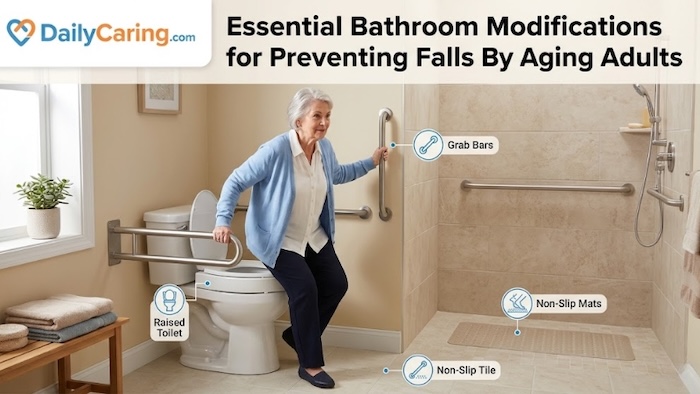













As a caregiver, you are intimately familiar with the persistent anxiety that follows your aging parent throughout their day. This worry peaks when they enter the bathroom, a space where privacy is valued but safety is severely compromised.
Discover 5 proven strategies to reduce the risk of falling in one of the most dangerous rooms of your home – The bathroom!
Why the Bathroom is the Most Dangerous Room
The bathroom presents a perfect storm for accidents. It is an environment defined by hard surfaces, water, and soap, naturally obliterating traction. When combined with the physical realities of aging, such as muscle weakness, stiff joints, and decreased vision, the risk of a catastrophic fall increases exponentially.
Addressing these risks requires more than a trip to the hardware store. It requires clinical precision.
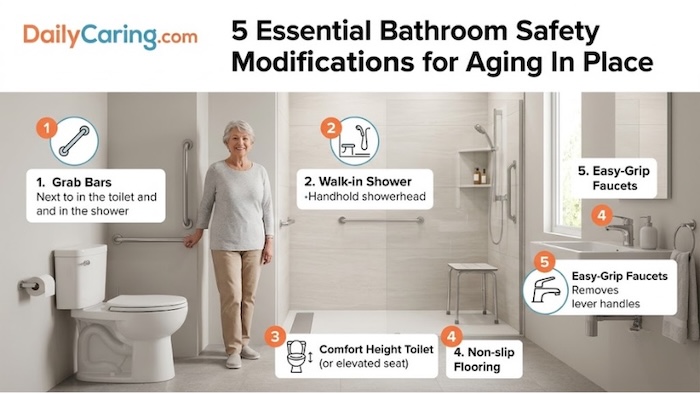
1. Grab Bars Are Clinical Tools, Not DIY Accessories
Treat grab bars as clinical tools mapped to the user’s specific functional reach. A clinical expert, such as an Occupational Therapist, does not just find a wall stud; they evaluate how specific mobility limitations dictate bar placement to arrest a fall effectively.
Professional installation is mandatory. Suction-cup bars will fail under the sudden kinetic energy of a falling adult, transforming a safety device into a secondary hazard. Learn more about aging-in-place safety from the National Institute on Aging.
When shopping for grab bars, look for sizes around 1.25 to 1.5 inches; this will be best for aging hands. Also request ADA-compliant knurled finishes for grip rather than smooth chrome.
Key ADA Requirements for Grab Bars in the Bathroom
- Bar Diameter: Tube sizes should measure between 1.25″ and 1.5″ so aging hands can wrap around the (textured) grip.
- Clearance From Wall: 1.5″ of clear space must exist between the wall and the grab bar to prevent aging knuckles from scraping the wall.
- Texture Purpose: The cross-hatched knurled pattern prevents slipping for wet or soapy hands without interrupting a continuous grip.
2. The Formula for the Perfect Toilet Height
Standard 15-inch toilets are a hazard for an aging body. They demand excessive joint flexion and quadricep power to transition to a standing position. While the ADA recommends 17 to 19 inches for wheelchair access, a custom fit is required for residential safety.
Calculate the exact height to reduce joint stress:
- Measure from the floor to the back of the user’s thigh, directly behind the knee.
- Measure the current height of the toilet seat.
- Subtract the seat height from the floor-to-thigh measurement.
The result dictates the specific raise required for safe transitions.
3. Lighting Requires High Contrast
Aging eyes suffer from decreased pupil size and lens clouding, demanding significantly more ambient light. However, installing excessively bright bulbs creates harsh glare, which obscures depth perception and is infinitely more dangerous than a dim room.
The objective is uniform illumination and high contrast. Utilize bulbs with a Color Rendering Index (CRI) of 80 or higher and a color temperature in the 2700K to 3000K range. Create stark visual boundaries so the edge of the tub is entirely distinguishable from the floor.
4. Flooring Must Cushion the Impact
Ceramic tile is water-resistant but offers zero shock absorption. If a fall occurs, the floor provides no energy dissipation, resulting in shattered hips and severe trauma. Shift your perspective to prevent slips while planning for impact. For comprehensive guidance on senior care, review our complete fall prevention checklist.
| Flooring Material | Slip Resistance | Impact Absorption | Cost Factor |
|---|---|---|---|
| Rubber Flooring | Excellent (High Traction) | Maximum (Protects Joints/Bones) | $$$ |
| Textured Cork | High (Natural Grip) | High (Air-filled cells) | $$ |
| Slip-Resistant Vinyl | Moderate to High | Low to Moderate | $ |
| Ceramic Tile (Hazard Warning) | Low (Extreme Fall Risk) | Zero (High Fracture Risk) | $$ |
5. Eliminate the Door Saddle
The threshold is the most frequently overlooked tripping hazard. A standard saddle creates a sudden height variation where carpet meets tile. For seniors with a shuffle gait, this transition guarantees a trip-and-fall incident. Replace standard thresholds with a graded door saddle to create a smooth, zero-edge transition.
VIDEO: Essential Bathroom Modifications for Safely Aging-In-Place
How to Hire the Right Professional (CAPS)
You must not rely on a standard handyman or general contractor to execute clinical safety modifications. You need a Certified Aging in Place Specialist (CAPS). Administered by the National Association of Home Builders (NAHB), the CAPS designation indicates that a professional has undergone specific training regarding the unique biomechanical needs of older adults, mobility barrier solutions, and structural load-bearing requirements for safety devices.
You can locate a vetted contractor in your specific area by searching the official NAHB Directory of Professionals with Home Building Designations.
Final Thoughts: Bathroom Safety Modifications for Aging In Place
Do not view these five modifications as optional home improvements. They are mandatory clinical interventions required to neutralize the highest-risk zone in your house.
Delaying these changes leaves the environment hostile to an aging body and significantly increases the probability of a catastrophic fall. Such an event will immediately terminate an aging-in-place strategy and force a transition to a skilled nursing facility.
Execute these structural changes promptly using certified professionals to secure the bathroom and ensure the physical safety of an older adult.
Frequently Asked Questions About Bathroom Safety
The safest bathroom flooring for seniors is rubber flooring. It provides maximum slip resistance and exceptional impact absorption to protect joints and bones during a fall. Textured cork and slip-resistant vinyl are also highly effective alternatives compared to hazardous ceramic tile.
While the ADA recommends 17 to 19 inches, the exact toilet height should be customized. Measure from the floor to the back of the senior's thigh behind the knee, and raise the toilet seat to match that specific height to reduce joint stress when sitting and standing.
Grab bars must be anchored directly into wall studs and placed based on the individual's specific functional reach and mobility limitations. An Occupational Therapist should evaluate the senior to determine exact placement near the toilet, shower entry, and tub wall.
About the Author

Chris is a seasoned healthcare executive and entrepreneur from the Pacific Northwest. He strongly advocates for older adults and the caregivers who serve them. Chris has personal experience caring for his father, who had dementia. Chris is a technology enthusiast and an avid outdoorsman; if he's not in his office, he can usually be found on a golf course or fly-fishing out west somewhere.