












Social media gives people more opportunities to connect and socialize, something that’s especially important for preventing senior isolation. But there are risks and challenges.
Laurel McLaughlin explains why social media can be dangerous for people with Alzheimer’s or dementia and shares 4 tips to keep them safe while supporting their independence.
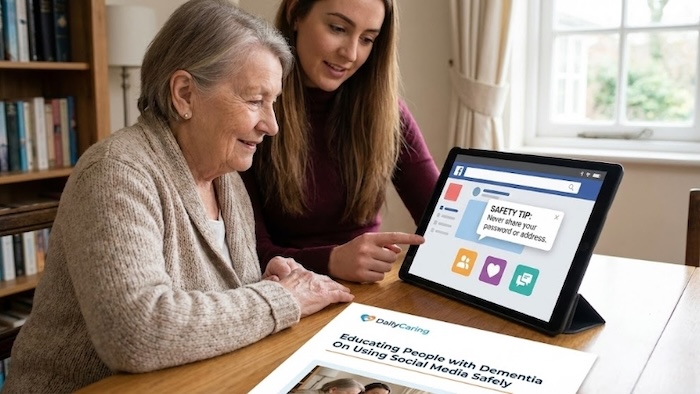
Social Media Provides Connection, but it Also Carries Risks
Social media networks like Facebook, Twitter, and Instagram are an ever-increasing presence in our lives.
They allow us to connect with those far away, reconnect with old friends and distant relatives, and even make new friends through common-interest groups.
While this ability to stay connected has many benefits, there is also a dark side to social media.
It’s challenging for anyone to protect themselves from the dangers of the internet, but especially tough for people who are living with Alzheimer’s or dementia.
Unfortunately, accounts are often hacked, data shared, and viruses spread.
Also, it’s common to see an overwhelming amount of upsetting or fabricated news, since those stories spread rapidly on social media.
Many Seniors Use Social Media to Increase Socialization and Connection
Social media has the power to create community.
According to a 2019 study by the Pew Research Center, the percentage of people over age 65 who use Facebook more than doubled from 20% in 2012 to 46% in 2019.
This is important because social media can reduce isolation and increase connection for people who otherwise may have few opportunities to socialize.
But now there’s an increasing need to make social media safer for everyone, especially people with Alzheimer’s, dementia, or other cognitive impairments.
Dementia and Social Media Use
As a person ages, so does their risk of developing some form of dementia or cognitive impairment.
On the internet, someone with dementia may be at a higher risk of falling for a scam, sharing private information, or viewing potentially upsetting information.
While supporting someone living with dementia, the goal is always to promote independence in every way possible, while also ensuring safety.
But it can be challenging for any care partner to consistently monitor social media accounts.
Difficulties include not knowing account passwords and not being able to track down all posts and interactions.
So, how can we protect our loved ones with a memory impairment on the internet, while also allowing for socialization with true friends and family members?
4 Tips to Give Family Caregivers More Insight into Social Media Use
1. Learn your loved one's passwords
Early on, talk with the person with dementia to see if they’re willing to share the account’s password.
You might explain that you won’t interfere with their online activity and that having the password would allow you to help them if they misplace it or watch out for online fraudsters.
Then, if they’re willing to share it, keep the password stored in a safe offline location and use it to periodically check on their account.
2. Ensure that privacy settings are strong
Go through the account’s privacy settings and make sure all settings are set to their strongest, so that only accepted friends can see posted information.
3. Monitor your loved one's list of “friends”
Regularly check on their friends or accepted contacts list to keep tabs on any unrecognizable “friends.”
4. Connect with trusted friends and family and ask them to help monitor your loved one
Identify a few trusted family members or friends who are also on the social media site and aware of the dementia diagnosis, and ask them to serve as an extra set of eyes.
Often, a post or comment can be made and then be nearly impossible to find later. Having a few people looking out for unusual activity would increase the chances of spotting it.
Recommended for you:
- 3 Stages of Dementia: What to Expect as the Disease Progresses
- What’s the Difference Between Alzheimer’s and Dementia?
- What is Lewy Body Dementia? 5 Main Symptoms
Guest contributor: Laurel McLaughlin is a recent graduate with a Master's in Gerontology. She has a decade of experience supporting seniors in aging well, whether at home or in senior living. She is passionate about teaching seniors and their families about care options and safety. (The tips compiled in this article are not necessarily reflective of the author's employer.)
About the Author
Laurel McLaughlin is a recent graduate with a Masters in Gerontology. She has a decades worth of experience in supporting seniors age well, whether at home or in senior living. She is passionate about teaching seniors and their families about care options and safety.
We did something right. August 2020, my wife, Nicki, was branded: Alzheimer’s. Our home became shame and guilt free. We sang the Popeye jingle whenever she apologized for something she has no control over. At “toot toot”, we laughed. She stopped apologizing. Early on, she suffered nightmares. Once she accepted the truth I wasn’t going anywhere, the nightmares stopped.
We’ve been together 40 years. Social media was an important part of our life and business. Now, it’s not. It can distress and confuse, it’s better not to risk that.
I hope my sharing helps someone, we’ve done something right.
Thank you for sharing your story Mark. I guarantee you that shining a light on your experience will resonate with our readers. Facing this disease head-on and guilt-free is the way to go. Kudos to you and Nicki!