













The SAGE test for Alzheimer's Disease is a brief, self-administered cognitive assessment tool to detect early signs of Alzheimer's disease and other cognitive impairments. SAGE stands for “Self-Administered Gerocognitive Exam” and can be an excellent tool for early-stage detection.
The SAGE Test evaluates memory, reasoning, language, and problem-solving skills through a series of questions and tasks. While it is not a diagnostic tool, it helps identify individuals who may need further evaluation by healthcare professionals. Below, we'll examine the SAGE test in detail.
Simple Home Test Detects Early Signs of Dementia and Cognitive Decline
If you suspect that a family member or friend is having a problem with memory loss, thinking clearly, or judgment, you may want them to take the SAGE test for dementia.
This at-home pen-and-paper test is free, takes just 15 minutes, and accurately identifies early symptoms of Alzheimer’s disease or dementia.
And if the stress and exhaustion of caregiving make you feel like your brain isn’t working anymore, this quick test can reassure you that there’s no problem with your cognitive function.
We explain how the test works, how to take it at home, and why discussing the results with a doctor is extremely important. We also share 12 dementia care tips that caregivers wish they’d known sooner.
How Does the SAGE Test For Dementia Work?
SAGE stands for Self-Administered Gerocognitive Examination and was developed by researchers at The Ohio State University Wexner Medical Center.
The SAGE test comprises 12 questions that cover all cognitive aspects, including memory, problem-solving, and language.
There are four different versions of the test. They’re similar enough, but having multiple versions means someone could take the test once a year and not improve their score just from taking it again.
This way, the test is slightly different each time.
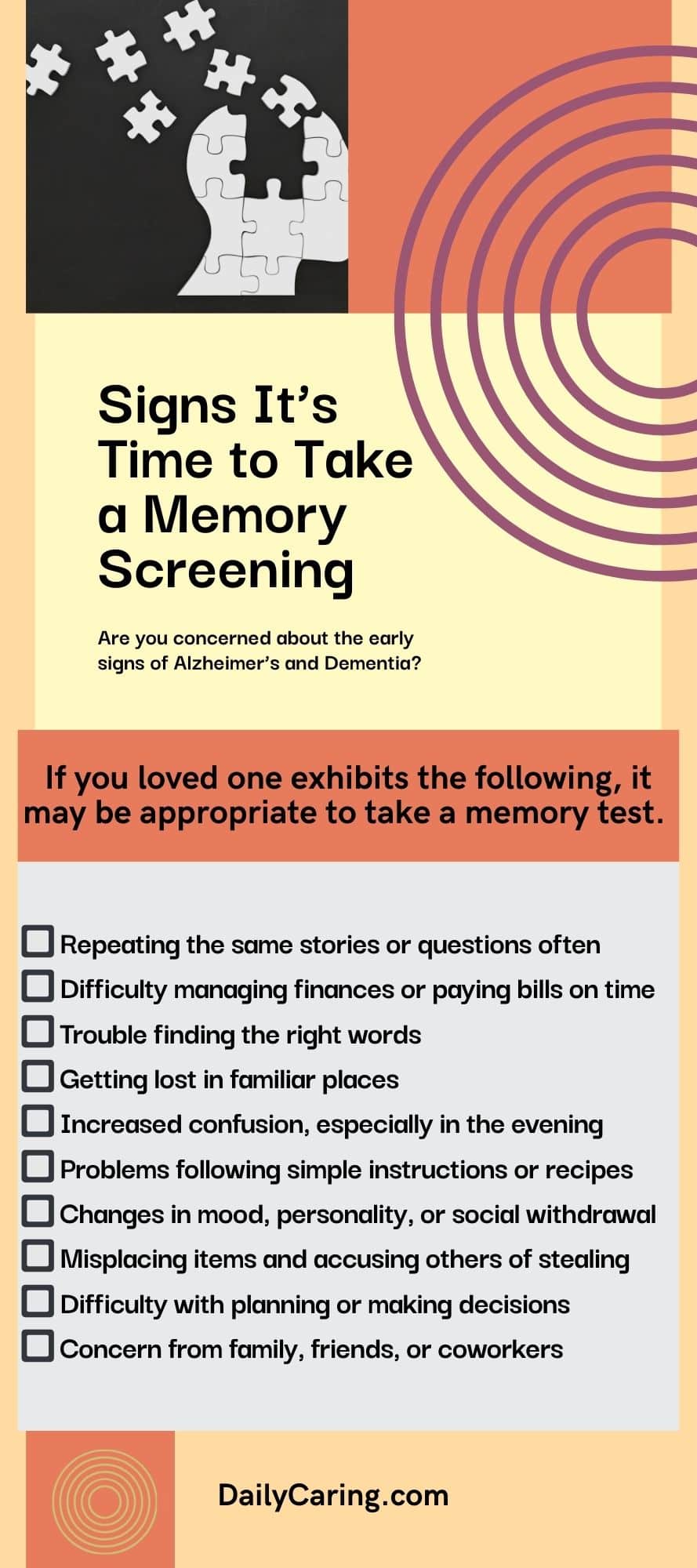
Signs That It's Time for a Cognitive Screening
The infographic below highlights several signs that it may be time for a loved one to undergo a cognitive screening.
Detect Early Cognitive Decline: Take the SAGE Test At Home
Anyone can take the SAGE test. It’s free, and you can get it on the Ohio State University website. –> Download the official SAGE test
Click the “Download the Test” button, agree to the terms, and choose one of the 4 test versions in your older adult’s primary language to download (or save all four versions to your computer for future use).
Print the test and take it with a pen or pencil. There is no time limit, but most people finish in approximately 15 minutes.
Sample questions from the quiz:
- How many nickels are in 60 cents?
- You are buying $13.45 worth of groceries. How much change would you receive back from a $20 bill?
- Write down the names of 12 different animals or pets.
- The clock drawing test: draw a large clock face and write the numbers. Position the hands for 10 minutes after 11 o'clock. On your clock, label “L” for the long hand and “S” for the short hand.

Discuss Test Results With Your Primary Care Physician
Don’t assume that the test results are equal to any formal diagnosis of dementia.
The SAGE test is a screening tool that helps doctors detect early signs of cognitive impairment that are typically not noticeable during a regular office visit.
When the test is repeated over time, doctors can monitor changes in cognitive ability. This helps them detect and treat health conditions early.
That’s why bringing the completed test to your physician for review is essential. If there are signs of cognitive impairment, they may recommend further testing.
What Happens After Taking the SAGE Test?
Once the SAGE test is complete, it is essential to share the results with a healthcare provider. While this cognitive screening tool can highlight potential concerns, only a doctor can interpret the results and determine the next steps.
Start with your primary care doctor. They may recommend further evaluation or refer you to a specialist, such as a neurologist, geriatrician, or neuropsychologist, who has experience in detecting early-stage Alzheimer’s.
Follow-up evaluations may include:
- A more detailed cognitive screening, like the MoCA (Montreal Cognitive Assessment)
- Lab and blood tests to check for treatable causes of memory problems, such as a vitamin deficiency or thyroid issues
- Neuroimaging (such as an MRI or CT scan) to look for structural brain changes or other medical conditions
Getting an early diagnosis—whether it confirms Alzheimer’s, another type of dementia, or a different health issue—can help with treatment planning, support services, and starting medications or lifestyle changes that may help slow progression or improve quality of life.
VIDEO: What is the SAGE Test for Dementia Screening?
5 Things to Do If Your Loved One Fails the SAGE Test
- Schedule a doctor’s appointment. Please bring the completed test and request a medical evaluation, starting with their primary care provider.
- Request a referral to a specialist. A neurologist, geriatrician, or memory clinic can complete a cognitive assessment and recommend next steps.
- Ask about further testing. This may include blood work, the MoCA test, and neuroimaging (MRI or CT scan) to look for underlying conditions.
Begin organizing legal and care planning documents. Start early by establishing a power of attorney, a living will, and a financial plan while your loved one is still able to participate.
- Look into caregiver support and resources. Contact the Alzheimer’s Association or your local Area Agency on Aging for guidance, community-based services, and/or help.
Why is an Early Alzheimer’s Diagnosis Beneficial?
The SAGE test is helpful because it helps you determine whether your concerns warrant concern.
If the results seem to indicate that there could be a problem, you might think there’s no point in talking with the doctor because there’s no cure for dementia.
However, an early Alzheimer’s or dementia diagnosis has significant benefits.
The most important thing is that a treatable condition could be causing cognitive impairment. Discovering the issue sooner means receiving treatment as early as possible to alleviate cognitive symptoms.
Suppose the cognitive impairment is caused by Alzheimer’s or dementia. In that case, a significant benefit is that early treatment is far more effective at managing symptoms and delaying disease progression.
Final Thoughts on the Sage Test for Alzheimer's Disease
Taking the SAGE test is more than just answering a few questions on paper; it’s a proactive step toward clarity in a situation often shrouded in uncertainty and fear. While the test itself doesn’t provide a diagnosis, it gives you something equally valuable: a clear starting point for a crucial conversation with a healthcare professional.
Whether the results offer reassurance or indicate a need for further evaluation, you are moving from a place of worry into a space of empowered action. This simple act of awareness allows you to plan for the future with greater confidence, access support and potential treatments sooner, and ultimately, ensure the best possible care for your loved one.
Remember, the goal isn't to predict the future, but to meet it prepared.
Frequently Asked Questions About the SAGE Test
The SAGE test assesses cognitive functions, including memory, problem-solving, language skills, and reasoning. It helps identify early signs of Alzheimer’s and other types of dementia.
No. The SAGE test is a screening tool. It can’t diagnose Alzheimer’s or other forms of dementia, but it can signal that further medical evaluation is needed.
While answer keys are available online, it's better to have a doctor interpret the results. They can identify patterns and determine if additional tests are necessary.
It’s most useful for adults experiencing memory issues or other signs of cognitive decline. It can also create a cognitive baseline and track changes over time.
Because there are four versions of the test, it can be taken once a year without “practicing” the same questions. This makes it useful for ongoing monitoring.
The test is self-administered and taken at home. You can print it from the Ohio State University Wexner Medical Center website.
Please bring the completed test to a doctor. They may recommend further testing, such as MoCA or MRI scans, or refer you to a neurologist or geriatric specialist.
Recommended for you:
- 7 Treatable Diseases That Mimic Alzheimer’s
- Testing for Dementia: The Montreal Cognitive Assessment (MoCA)
- Mild Cognitive Impairment: Not Dementia, But More Than Normal Forgetfulness
About the Author

Connie is the founder of DailyCaring.com and was a hands-on caregiver for her grandmother for 20 years. (Grandma made it to 101 years old!) She knows how challenging, overwhelming, and all-consuming caring for an older adult can be. She also understands the importance of support, especially in the form of practical solutions, valuable resources, and self-care tips.


This is such a helpful overview of the SAGE test. Memory loss can make day-to-day tasks overwhelming, especially when it comes to managing medications. For anyone caring for a loved one with dementia or Alzheimer’s, using the right tools really matters.
My 93 year old mother has stage 4 Alzheimers and has lived on her own for 31 years. Mother has carers twice a day and has no recollection of them whatsoever. Mother is deaf, has an arthritic knee and is becoming increasingly incontinent. She refuses to wear hearing aids, glasses, slippers , incontinence underwear or use a walking stick. Mother is obsessed with her finances and constantly asks where her cheque book is and who has got her bank card. My brother and I are her POA’s but this is beyond her understanding. She has managed to render her electric fire useless due to her obsession with the height of the flame which is barely visible when in use. The fire has been serviced and repaired 5 times this year so far. Mother’s diet is frugal and she seems to exist on packets of biscuits. Her senseless shopping lists which she writes daily are a reflection of her troubled mind. Mother has been assessed by a registered authority and deemed to have ” capacity” which means she cannot be placed into a Care Home yet. Meanwhile, she is a constant source of worry and concern. We await her further demise as she exists in her comfort bubble of ignorance and contentment.
If you and your brother are your Mother’s POAs, it seems like you would be able to make decisions on her behalf. But if the authorities won’t let you make a change in your Mother’s living situation, perhaps you could increase the hours for her in-home caregivers to increase her health and safety. You may also want to take safety precautions like disabling the electric fire and fibbing and telling her that it can no longer be fixed.
If she enjoys activities like writing lists, there’s no harm in doing it even if what she writes doesn’t make sense to you. You can think of someone with cognitive impairment as experiencing a reality that’s different from ours. As long as it’s not dangerous or upsetting to her, there’s no harm in it. It may provide them the sense of comfort and control that they need.
These articles may also be helpful:
– Solve Challenging Alzheimer’s Behaviors with Expert Communication Tips https://dailycaring.com/video-difficult-alzheimers-behaviors-solved-with-expert-communication-tips/
– Responding to 4 Common Dementia Accusations: Stealing, Poisoning, Being Held Prisoner https://dailycaring.com/responding-to-4-common-dementia-accusations-stealing-poisoning-being-held-prisoner/
– Therapeutic Fibbing: Why Experts Recommend Lying to Someone with Dementia https://dailycaring.com/why-experts-recommend-lying-to-someone-with-dementia/