












Getting older requires facing uncomfortable medical realities. One of the most critical is understanding the established link between falls and dementia risk.
A simple fall is rarely just a momentary loss of balance. For middle-aged adults, it serves as a blinking red warning light. These incidents are not merely clumsy moments; they are often early signs of dementia that demand immediate attention before further cognitive decline occurs.
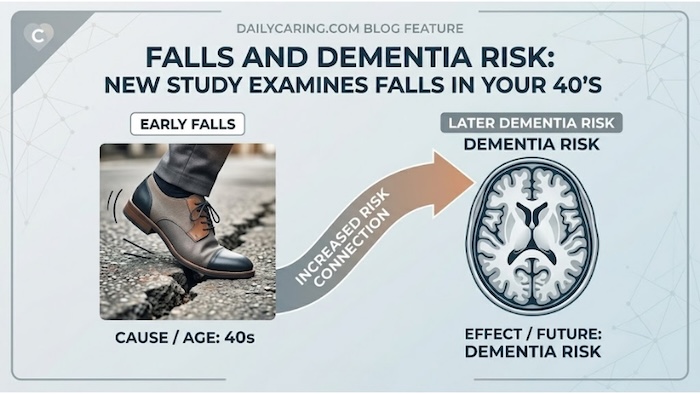
For years, the medical establishment viewed physical injuries and cognitive decline as completely separate issues. The latest data proves this assumption is entirely wrong. If you are experiencing unexplained falls in your 40s or 50s, your brain is already sending you a critical message about its neurological health.
New Review Exposes the Hard Truth About Falls and Dementia Risk in Middle-Aged Adults
A systematic review published in the Journal of Post-Acute and Long-Term Care Medicine analyzed data from nearly 3 million participants. The results are undeniable. A single fall after the age of 40 increases future dementia risk by 20 percent. If a patient experiences multiple falls, that risk skyrockets by 74 percent.
These numbers highlight a grim reality for dementia in middle-aged adults experiencing physical instability. Researchers concluded that these falls act as a robust clinical marker of accelerating neurodegenerative decline, revealing underlying neurological decay long before memory loss becomes obvious.
Early Signs of Dementia: What Recent Studies Confirm
The Changchun University review is not an isolated finding. Independent research fully supports this disturbing trend.
Researchers from the Washington University School of Public Health recently discovered that falls are tightly linked to Alzheimer's disease. Their data shows falls signal faster cognitive decline and are a risk factor on par with the presence of Alzheimer's brain proteins.
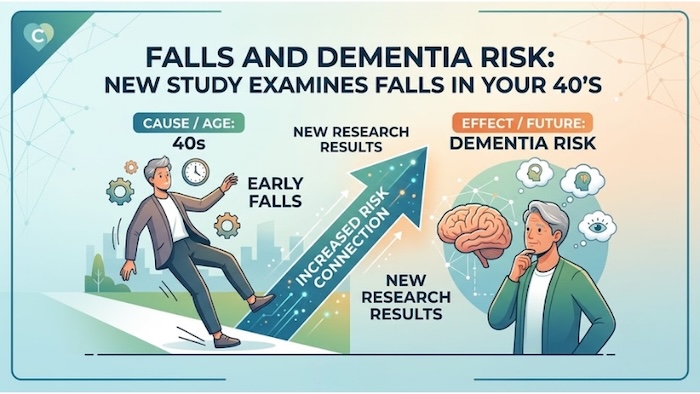
Furthermore, a massive study out of Brigham and Women's Hospital analyzing two million Medicare patients found that 10.6 percent of older adults who suffered a traumatic fall were diagnosed with Alzheimer's disease or a related dementia within just one year. The connection between falls and dementia risk is an established medical reality. Ignoring it is reckless.
Recognizing Early Signs of Dementia Through Physical Trauma
The physical trauma of a fall is deeply connected to the progression of Alzheimer's disease and other forms of cognitive decline. Medical professionals confirm that neurodegeneration begins years before a formal diagnosis. This quietly erodes balance, judgment, and spatial awareness.
When this underlying brain atrophy results in a fall, the physical trauma to the brain and body aggressively accelerates the progression of the disease. Adults who fall often develop a profound fear of walking. This leads to immediate social isolation and drastically reduced physical activity, creating a vicious cycle that further speeds up cognitive decay.
DailyCaring VIDEO: Falls In Middle Age Are A Warning Sign
Taking Action: Preventing Falls to Protect Cognitive Health
Hope is not a viable strategy. Action is required. Preventing falls must be the primary focus for anyone wanting to maintain their cognitive health as they age.
The Bottom Line: Do Not Ignore the Warning Signs
The medical consensus is clear. A fall in middle age is not a normal part of aging or a simple moment of clumsiness. It is a potential early warning system for your brain. Data from leading research institutions confirms that falls act as robust clinical markers for cognitive decline, sharing the same risk profile as established Alzheimer's biomarkers.
If you or your loved one are experiencing unexplained falls, you must immediately address the possibility of physical and neurological risks. Schedule a clinical assessment, audit your living space for hazards, and prioritize physical stability to break the cycle of neurodegenerative decay. Waiting for the next fall is a direct gamble with your long-term cognitive health.
About the Author

Chris is a seasoned healthcare executive and entrepreneur from the Pacific Northwest. He strongly advocates for older adults and the caregivers who serve them. Chris has personal experience caring for his father, who had dementia. Chris is a technology enthusiast and an avid outdoorsman; if he's not in his office, he can usually be found on a golf course or fly-fishing out west somewhere.