











Squats and lunges will not save your aging parent's independence. If a standard walk to the grocery store leaves them exhausted, you are likely blaming general aging or weak knees. The actual culprit is sitting right at their feet.
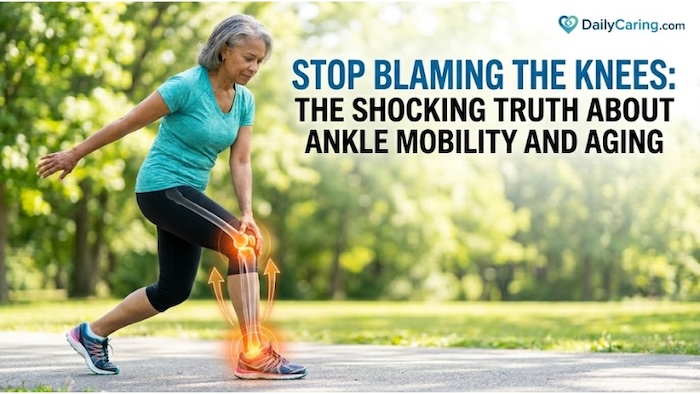
The link between ankle mobility and aging is a critical yet often overlooked factor in eldercare. New research reveals that aging completely rewires the ankles.
The older nervous system silently sacrifices mechanical efficiency to prevent falls. It is a biological trade-off that ultimately limits a senior's mobility and independence.
The Science of Wasted Effort: Ankle Mechanics in Older Adults
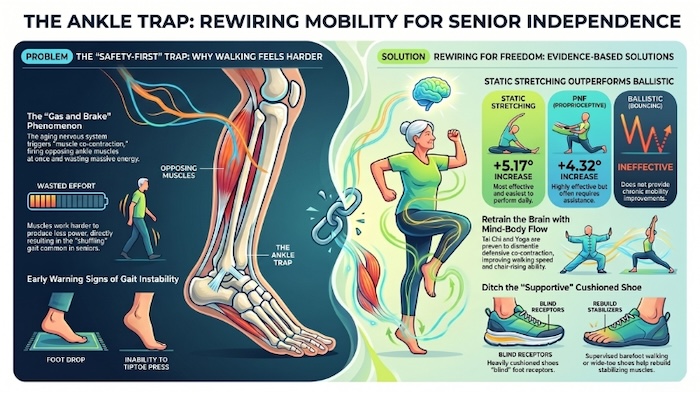
According to a 2026 study published in the Journal Gait & Posture, the aging nervous system adopts a rigid, “safety-first” strategy. It triggers a phenomenon called muscle co-contraction. Instead of firing smoothly, opposing muscles around the ankle activate simultaneously. They are effectively pressing the gas and the brake at the exact same time.
This stiffens the joint to improve balance when the foot strikes the ground. The result is massive wasted effort. Their muscles work significantly harder, yet they generate a fraction of the push-off power. Their strides shorten, and their walking speed drops.
This is exactly why older adults experience disproportionate fatigue during routine walks or develop a higher risk of falling as they age. They are burning energy fighting their own muscle contractions.
Dr. Kristie Leong on Ankle Mobility and Aging
Dr. Kristie Leong says that hiking is excellent for mobility training. “Uneven terrain asks your ankles, hips, feet, and balance system to constantly adapt, so you're optimizing real-world movement capacity. It's relaxing too!”
She also touts the benefit of barefoot shoes or just walking barefoot. “Barefoot shoes offer a similar benefit in a different way. They give your feet more room to spread, and they recruit the small stabilizing muscles in your feet.”
Identifying the Warning Signs of Gait Instability
You cannot wait for a catastrophic accident to initiate a formal fall risk assessment. The nervous system provides clear, physical warning signs that defensive ankle co-contraction is taking over.
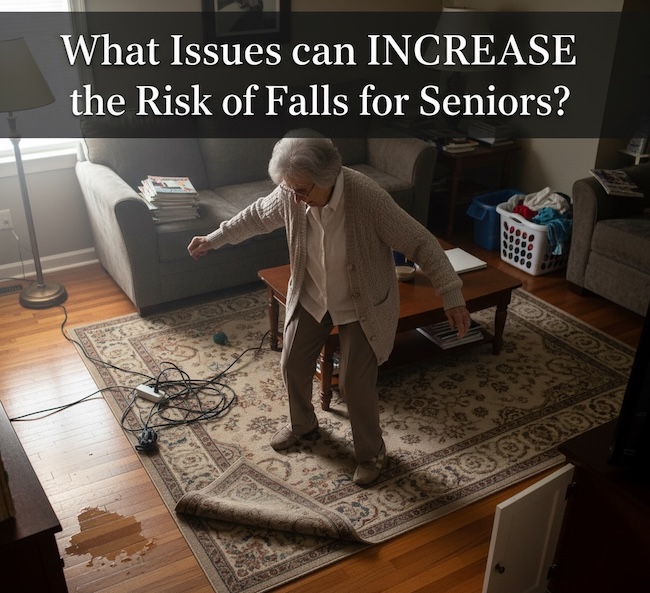
Watch your loved one closely during routine movements. Are they shuffling their feet across the floor instead of lifting them cleanly? Do they exhibit “foot drop,” frequently catching their toes on rugs or low thresholds? Ask them to reach for an item on a high shelf. If they cannot smoothly press up onto their tiptoes, they have already lost critical push-off power.
Recognizing these early signs of gait instability is the only way to intervene before an emergency room visit becomes inevitable.
VIDEO: Optimizing Ankle Flexibility to Minimize Fall Risk
Fall Prevention for Seniors Requires Rewiring the Nervous System
Standard strength training routines entirely miss this problem. If you want to optimize fall prevention for seniors and support their long-term independence, you must help them train their nervous system to drop this defensive co-contraction habit.
Here is the exact framework to restore ankle efficiency based on the latest clinical biomechanics data:
| Exercise | Target Mechanism | Caregiver Guidance |
|---|---|---|
| Single-Leg Balance Holds | Proprioception & Timing | Have them hold a sturdy chair for safety. Aim for 30 seconds per leg. Progress to eyes closed only when highly stable. |
| Eccentric Calf Raises | Tendon Strength & Push-Off Power | Instruct them to raise up normally on both toes, then lower their heels to the ground as slowly as humanly possible. |
| Ankle ABCs | Joint Mobility | While seated, have them trace the alphabet in the air with their big toe. Excellent for breaking joint stiffness. |
| Tai Chi | Coordination & Efficiency | Find a local or online senior-focused class. The fluid, continuous movements are proven to reduce ankle co-contraction. |
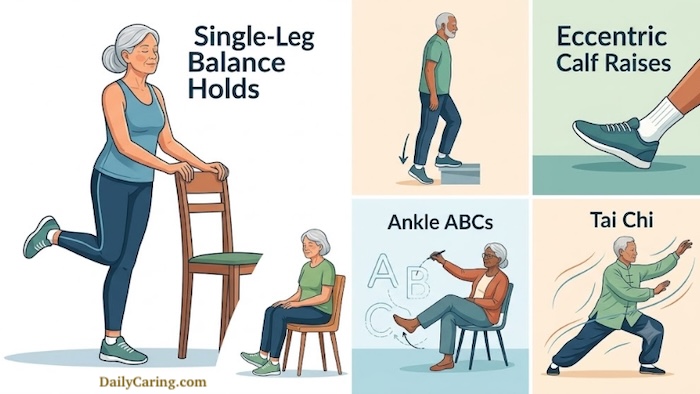
These specific movements directly dismantle the nervous system's habit of defensive co-contraction. Rather than simply building raw muscle, they retrain the brain to release joint stiffness and trust the ankle's natural range of motion.
Eccentric calf raises and targeted balance drills rebuild the critical “push-off power” lost to aging, while dynamic movements like Tai Chi force opposing muscles to fire sequentially instead of simultaneously. This exercise routine restores mechanical efficiency and preserves active mobility.
Ditch the Clunky Sneakers: The Case for Barefoot Walking
Aging adults are likely compounding their mobility loss by wearing those heavily cushioned, “supportive” orthopedic shoes. Modern thick-soled shoes act like a cast. They completely blind the foot's sensory receptors, destroying proprioception (the body's ability to sense its location in space).
As Dr. Leong mentions, to properly execute dorsiflexion stretches and rebuild real mobility, the foot needs to feel the ground. Whenever safe and practical, encourage supervised barefoot walking inside the house, but observe them closely to ensure they're stable enough. The last thing you want is to risk a fall while working on mobility issues!
If they must wear shoes, explore wide-toe, zero-drop barefoot shoes. These allow the foot to spread and naturally recruit the small, stabilizing muscles that clunky orthopedics shut down entirely.
Prioritizing Ankle Mobility and Aging Workouts Today
Aging forces an involuntary compromise between speed and stability. If caregivers ignore targeted balance training, their loved one's nervous system might lock down their ankles and strip away their mobility and freedom.
Stop wasting time encouraging generic leg days. Start actively helping them rewire their ankle mechanics to preserve their independence.
Prioritize Safety While Practicing Ankle Stability
Rewiring ankle mechanics and rebuilding mobility takes consistent time and effort. You need an immediate safety net right now. Ensure your loved one is protected while they work to regain their independence.
Use Our Medical Alert Recommendation QuizAbout the Author

Chris is a seasoned healthcare executive and entrepreneur from the Pacific Northwest. He strongly advocates for older adults and the caregivers who serve them. Chris has personal experience caring for his father, who had dementia. Chris is a technology enthusiast and an avid outdoorsman; if he's not in his office, he can usually be found on a golf course or fly-fishing out west somewhere.