













Caring for an older adult is a consistently tough job. We’ve all been there: that sudden, heart-pounding moment where the to-do list feels like a mountain and your chest starts to tighten. It’s called a ‘caregiver reset' moment, and you don’t have to just ‘tough it out.'
You could be filled with anxiety, fear, or nausea. You might even feel like you’re having an out-of-body experience.
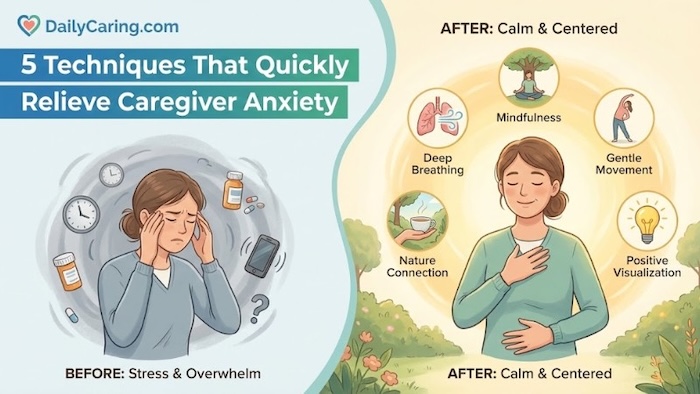
To quickly break out of those panicked negative spirals, we found a great article from Confident Life with 5 ways to stop caregiver anxiety in its tracks. We share the techniques from the article and explain how to use them.
VIDEO: How to Manage Caregiver Anxiety
5 Ways to Get Fast Relief From Caregiver Anxiety
These are called grounding techniques because they plant you firmly in reality, in the present moment. The simple exercises take you out of your mind and force you to focus on concrete things in the real world.
Taking your mind out of anxiety mode gives you the ability to refocus and find your reservoir of strength and calm.
Do as many of these exercises as you need, as many times as you need, until the anxiety subsides and you feel better.
1. Use the 54321 technique
- Name 5 things you can see (table, towel, cushion, etc.)
- Name 4 things you can feel (my feet on the floor, my back against the chair, the sun on my face, etc.)
- Name 3 things you can hear right now (the radio playing, birds chirping outside, etc.)
- Name 2 things you can smell right now (trees and flowers from outside, soup cooking on the stove)
- Name 1 good thing about yourself (I’m generous with my kindness)
🧘 Quick Grounding Cheat Sheet: The 5-4-3-2-1 Method
When anxiety hits, stop and name the following out loud:
2. Touch and describe an object
- Find an object around you (a mug of tea)
- Describe it in detail as if you’re explaining it to someone who has never seen it before
- For example: This is a mug of tea. It’s a ceramic column that’s hollowed out so it can hold liquid. It’s a pale blue color, and there is a handle that fits four fingers. It has tea inside, a hot liquid made out of leaves…
- Repeat with various objects until you feel calmer.
3. Play a Memory Game
Ask yourself questions that involve memory or concentrated thinking.
For example:
- Sing (or say) as much of your favorite song as you can without the music
- Name as many types of dog breeds as you can (or cat, bird, etc.)
- How many places have you visited in your lifetime?
- Say the alphabet backward
- Name as many sports teams in a specific league as you can (all NFL teams)
4. Repeat a Mantra
During a calm, relaxed time, make a list of positive sayings or mantras that help you calm down and return to the present moment when anxiety makes you feel panicked.
Keep this list close to you so you can pull it out as soon as you feel the need.
Examples:
- This moment will pass, and I will be OK
- I am safe and well
- These feelings will pass, and things will be OK
- I know I can handle this because I’ve overcome many tough challenges
- Everyone is safe, and we will all be OK
5. Practice Square Breathing
When you’re stressed or having a panicked moment, you may instinctively change your breathing.
You might take rapid, shallow breaths or hold your breath instead of taking the slow, deep breaths your body needs to get plenty of oxygen and kick-start the relaxation process.
Square breathing helps you focus on breathing in a way that calms your body. Draw your breath in all the way down to your toes and push all the air out when you exhale.
With your finger, slowly trace the shape of a square in front of you. Keep your eyes on that finger as it moves.
- As you draw the first side, breathe in deeply for 3 seconds
- With the second side, hold your breath for 1 second
- With the third side, breathe out for 3 seconds
- With the fourth side, hold for 1 second
Feel free to vary the timing of the square’s sides to make it comfortable and relaxing for you – the breaths just need to be slow and deep.
Repeat the square and the breaths for as long as it takes to slow your heart rate and calm your mind.
It’s easy to feel like you should just ‘power through' the panic, but your health matters just as much as the person you’re caring for.
Recommended Resource
Technology can be a powerful ally in managing stress. We've curated a list of the most effective, user-friendly apps designed specifically to help caregivers find a moment of peace.
See the Top 5 Anxiety Relief Apps →Final Thoughts About Managing Caregiver Anxiety
Managing caregiver anxiety isn't about eliminating every worry, it's about finding your footing when the world feels like it’s spinning.
Whether you’re using the 5-4-3-2-1 method or simply taking a few square breaths, these grounding techniques are your way of telling your nervous system that you are safe in this moment.
Be patient with yourself as you practice these tools; some days they will work instantly, and other days you might need to try a few different approaches.
Most importantly, remember that reaching for a “reset” isn't a sign of weakness; it's a sign of strength that lets you keep showing up with the love and support your family relies on.
Disclaimer: This content is for informational purposes only and is not intended as professional legal, financial, or healthcare advice. Always seek the advice of a qualified healthcare provider, attorney, or financial advisor with any questions you may have regarding a specific medical condition, legal issue, or financial plan.
Recommended for you:
- 5 Coping Tips for the Overwhelmed Caregiver
- 25 Quick Journal Prompts That Reduce Caregiver Stress and Improve Health
- 5 Mobile Apps That Instantly Relieve Caregiver Anxiety
About the Author

Amie Clark is a senior care expert with over 25 years of experience in aging services, caregiving, and senior housing. She combines her professional expertise and personal caregiving insight to help families navigate aging, long-term care, and end-of-life decisions with clarity and compassion.

Was looking for grounding techniques for anxiety and caregiving anxiety. I have PTSD and other anxiety issues. The info was perfect.
So glad these suggestions are helpful!
I accidentally stumbled upon this site just when I needed some of the tips. I signed up at once. Thanks
We’re so glad our articles are helpful! Thanks for signing up for our free daily emails, we hope you’ll find them useful and supportive.