











If you woke up today feeling like a human rubber band stretched between a toddler’s school project and a parent’s cardiology appointment, you aren’t alone. In 2026, the “Sandwich Generation” has reached a tipping point.
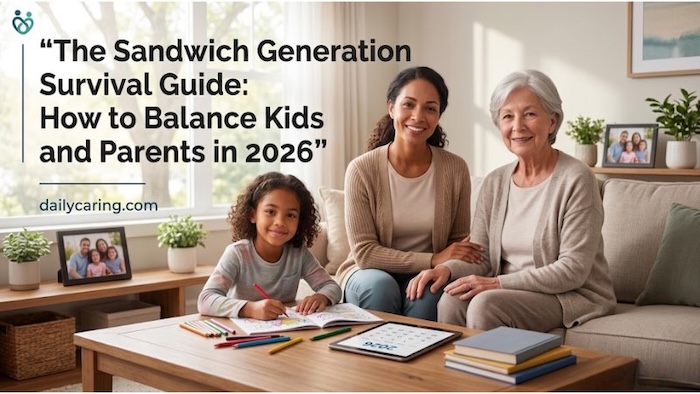
With nearly 16 million Americans simultaneously managing minor children and aging relatives, the “squeeze” is no longer a personal challenge; it’s a national epidemic.
According to the latest Pew Research Center data on the Sandwich Generation, more than half of adults in their 40s are currently providing support to both a parent and a child. But survival in 2026 isn't about “trying harder”; it’s about building a better system.
The Financial “Double-Squeeze”
The biggest stressor for the sandwich generation is the “money leak” of paying for childcare and senior care simultaneously. This places a huge burden on family caregivers and those around them.
- Action: Leverage the new 2026 tax landscape. As we covered in our guide on why caregiving is worth $1 trillion, you may be eligible for expanded state tax credits or the federal Credit for Caring Act.
- System Hack: Don't just pay bills; audit them. Check for overlapping benefits, such as dependent care FSAs that can sometimes be used for elderly parents if they meet IRS dependency criteria.
Deploying “Micro-Respite” Systems
You likely don't have a week to go to a spa, but you do have 10 minutes. The 2026 survival model relies on “Micro-Respite”, short, scheduled breaks that are non-negotiable.
- The System: Use a shared digital calendar for the whole family. If it isn't on the calendar, it doesn't exist. This includes your 15-minute “transition time” between work and caregiving.
- Internal Link: To make your home environment easier to manage, ensure you've performed a 2026 Home Safety Audit to reduce the risk of “crisis mode” falls.
The Sandwich Generation Survival Matrix
The Survival Strategy Matrix
Three Systems to Automate Your Dual-Caregiving Day
| The Challenge | The “System” Fix | Essential Tool |
|---|---|---|
| Decision Fatigue | Automate Move from “mental lists” to a shared digital Medication SOP. Stop memorizing doses for two generations. | Meds Management Guide |
| Emergency Friction | Centralize Store every Healthcare POA and school emergency form in one encrypted “Digital Vault” accessible by your spouse or sibling. | The 5 Legal Must-Haves |
| Emotional Burnout | Protect Set “Digital Office Hours.” No non-emergency family texts are answered between 8 PM and 8 AM to protect your sleep. | MHA Burnout Resources |
Setting “Radical Boundaries”
In 2026, the blurred line between “work from home” and “care from home” has created a 24-hour cycle of labor. You must set boundaries that feel radical at first.
- The “No” List: Make a list of three things you will stop doing this week (e.g., being the “room parent” or hosting every Sunday dinner).
- Physical Resilience: Stress relief doesn't have to be long. Try 30-second exercise snacks during the “in-between” moments of your day.
Conclusion
The Sandwich Generation isn't just a group of people; it’s a group of heroes doing the impossible. As we move through 2026, the key to survival is shifting from “doing it all” to “building a system that does some of it for you.”
By automating your finances, securing your legal documents, and fiercely protecting your time, you can provide the care your family needs without losing the person you are.
This information is for educational and informational purposes only and does not constitute professional financial, legal, or mental health advice. Caregiving for multiple generations is an intense physical and emotional undertaking. If you are experiencing symptoms of clinical depression or severe burnout, please consult a licensed healthcare professional or mental health counselor immediately.
Featured Resources: Strengthening Your Survival Plan
Accepting help isn't a weakness; it's a strategic move to stay healthy for your family. Learn how to let go of guilt.
Sandwich generation life is easier with a team. Learn how to transform sibling tension into a partnership.
Avoid being pulled in too many directions by establishing firm boundaries between care, kids, and career.
Find free local resources, respite programs, and meal services that take the administrative load off your plate.
About the Author

Chris is a seasoned healthcare executive and entrepreneur from the Pacific Northwest. He strongly advocates for older adults and the caregivers who serve them. Chris has personal experience caring for his father, who had dementia. Chris is a technology enthusiast and an avid outdoorsman; if he's not in his office, he can usually be found on a golf course or fly-fishing out west somewhere.