












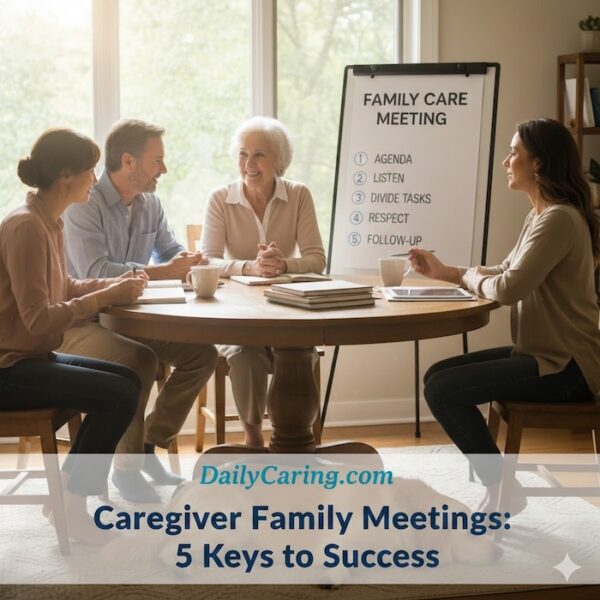
Trying to coordinate care for an aging parent between siblings and family members can feel like herding cats. Without a clear plan, conversations about responsibilities and decisions can quickly spiral into misunderstandings, resentment, and unresolved tension.
But what if you could transform that chaos into a productive, collaborative strategy? The secret lies in a structured family meeting. By focusing on five key elements, you can turn a potentially stressful conversation into a powerful tool for unity and effective care.
Caring for Aging Loved Ones is a Group Effort
When an older adult needs care, it affects everyone in the family. That’s why caregiver family meetings are so important.
Without participating in a meeting, people who aren’t directly involved in caregiving are less likely to help out or do their share.
They might not understand the seriousness of the situation or realize how much time, energy, and money are needed.
But having a successful family meeting is a lot easier said than done.
You’re bringing together a group of people with diverse points of view, emotional histories, and communication styles.
This means that a successful meeting requires preparation.
We found excellent advice on holding caregiver family meetings from Family Caregiver Alliance (FCA), a leading nonprofit organization.
Here, we walk through and explain the 5 essential parts they recommend for a productive family meeting. We’ve also included links to additional information and resources.
5 Key Recommendations for a Successful Family Caregiving Meeting
1. Who Should Attend a Family Caregiving Meeting?
Choose your “family members” wisely
Every family is different and has a different idea of who is included in their “family.”
In general, it’s good to include the people who will be part of the caregiving team. That could mean including extended family, close friends, or paid caregivers.
The family members could change depending on the discussion topics
When choosing a group, consider the issues you’re discussing.
For example, if you’ll be discussing family finances, you may want to limit the meeting to the immediate family.
But if you’re talking about coordinating tasks like meals, housework, and doctor’s appointments, you may want to have a larger group at the meeting.
Get external help if communication is a challenge
If family communications are already strained or the group doesn’t work well together, you may want to include an outside facilitator.
A social worker, religious leader, or elder mediator could help the group work through complex subjects.
Including Your Loved One is Optional
Whether or not you include your loved one depends on your situation.
It could make some seniors feel like they’re a terrible burden, while others may feel more comfortable knowing that everyone is working together and their wishes will be respected.
However, not having your older adult at the meeting may encourage people to express their concerns without worrying about hurting their feelings.
Also, if they have Alzheimer's disease or dementia, they may not be able to understand that you’re all working together to look out for their best interests. In that case, you may want to exclude them to avoid causing concern or paranoia.
2. How to Begin the Family Caregiver Meeting
Technology means that everyone can join
Good communication is essential for a positive and productive family caregiving meeting.
Use video chat or phone conference calls so everyone can participate, no matter where they live.
Skype, Zoom, Google Meet, and Apple FaceTime are good free video chat options.
And there are dozens of options for free telephone conference calling – search “free conference call” on Google to find options.
Using a smartphone, you could also record the meeting for those who can’t make it and email the recording.
Preparing an agenda is essential
Before you hold caregiver family meetings, prepare an agenda and send it out in advance.
That way, nobody will be surprised by the topics, and you can get suggestions for additional discussion items.
The FCA article also includes a useful sample agenda in this section. Use theirs to get started and modify to fit your specific needs.
3. Family Caregiver Meeting Essentials
Location: Where to have the meeting
Choose a location where most people will feel comfortable.
For some, that might mean a family member’s house.
For other groups, a neutral location, such as a coffee shop or public meeting room, works better.
Try to minimize noise and distractions (like leaving young children at home) as much as possible.
Create a safe space for an open discussion
A successful meeting means everyone has a chance to say what they feel without being judged.
If people can share what they honestly think, it will help the group resolve conflicts and find better solutions.
FCA shares some great examples: “…the brother who is never present may reveal that he is unable to stand seeing someone sick, and the sister who is doing all the work may not realize how she pushes others away when they offer to help. Another sibling may be having marital problems which he or she has not yet shared with the family, and yet another sibling might be worried about losing a job.”
Don’t jump into problem-solving right away
It’s best to see the whole picture before trying to solve the problem.
Make sure to hear everyone’s thoughts and concerns before jumping into problem-solving mode.
Keep a list of what's discussed as it happens, so nothing is forgotten.
Use respectful language
Speaking respectfully helps the group stay calm and keep the discussion productive.
For example, it’s best to say “I feel…” rather than “you always…” or “you never…”
When disagreements come up, try to find parts that you could agree with rather than dismissing the entire concept outright.
Remember that the goal of the meeting is to work together to provide the best care and quality of life for your older adult.
Make sure agreements and responsibilities are clearly spelled out
Before ending the meeting, make sure everyone understands what was discussed and what was decided.
If responsibilities or tasks were assigned, ensure each person is clear about what they have agreed to do.
Meet regularly: Establish a cadence
Caring for an older adult is complex and an ongoing responsibility.
That’s why it’s important to continue meeting regularly. This also takes the pressure off resolving every issue in just one meeting.
After all, major decisions are best made after taking time to absorb the information and do research.
It’s also helpful to establish a regular date, like 10 am on the 2nd Saturday of each month, so everyone knows to plan around it.
But if a monthly meeting isn’t possible, consider meeting every 2 or 3 months instead. The goal is to meet often enough to coordinate and keep everyone informed of significant changes.
4. Potential Challenges
Family meetings won’t necessarily be easy.
Everyone has emotional baggage and history with each other.
And it’s not just the interpersonal relationships that matter; each person also has a different ability to cope with complex subjects like illness, decline, and death.
The FCA article includes helpful examples of the types of family conflicts that can get in the way of a productive meeting.
Understanding these dynamics will help you figure out what will be needed to move forward.
But if the meetings keep breaking down into conflict, it may be necessary to bring in a third party to mediate the group discussion.
An important insight FCA shared was that it's helpful to acknowledge there’s probably no fair distribution of work and that it’s not possible to make everything even.
To make meetings more successful:
- Keep focused on specific issues and tasks
- Remind everyone that the goal is to care for your older adult as a team – not to fix family issues
5. Strive for the Win/Win Solutions
Work toward generally agreeing
Not all caregiving issues can be fully solved. Instead of trying to find a perfect solution, work toward a general agreement.
Even if the meetings are a bit painful and progress seems slow, this regular work will be worth it.
When there’s a health crisis, the discussions that have happened will help all of you to make those tough choices together.
Be open to creative solutions rather than rigidly dividing work. FCA’s examples show how this might look:
- “Carol finds it difficult to be around sick people, so when her brother got lung cancer, she knew she couldn't take care of him. However, she was more than willing to make the pastas of their native Italy and take them to him to comfort him during his illness.”
- “Jesse lives a thousand miles away, but can get time off from work to be with her mother while her brother and his family take a vacation.”
- “When Ed's mother had surgery, Ed arranged to take care of his father with Alzheimer's, while his sister worked full time and helped with the expenses.”
- “Gina takes her parents to medical appointments while her sister makes sure they get their medicines properly every night.”
Accept compromises and appreciate the cooperation
There is no perfect solution, especially in caregiving. Everyone will need to be willing to compromise, especially the primary caregiver.
Assuming that’s you, you might be feeling a little resentful that you’re doing all this work and not getting what you’re asking for.
Remind yourself that both you and your older adult will benefit when you ask for and accept help.
If you show appreciation and make someone feel good about helping, even if it wasn’t exactly the help you wanted, they’re much more likely to pitch in again.
Put agreements in writing
The group will be discussing a wide range of complex topics. Keep things clear and organized by taking written notes of all decisions and agreements made.
A caregiving calendar helps schedule tasks and helps each person remember their responsibilities and commitments.
Final Thoughts for Organizing a Successful Family Caregiver Meeting
A successful family meeting does more than assign tasks – it builds a foundation of shared responsibility and mutual support, ensuring your parent gets the best possible care from a united team. Remember, the goal isn't perfection, but progress.
By approaching these conversations with clarity and compassion, you're not just managing care; you're strengthening family bonds and creating a sustainable plan that honors everyone's role. Your collective effort is the greatest gift you can give your parent, and for each other.
Next Steps: See the full article about how to hold a successful family meeting at Family Caregiver Alliance
Recommended for you:
- 4 Ways to Get Family to Help with Aging Parents
- How to Talk with Parents About Aging: 5 Tips and Conversation Starters
- Elder Mediation Helps Siblings Resolve Conflicts and Care for Aging Parents
About the Author

Connie is the founder of DailyCaring.com and was a hands-on caregiver for her grandmother for 20 years. (Grandma made it to 101 years old!) She knows how challenging, overwhelming, and all-consuming caring for an older adult can be. She also understands the importance of support, especially in the form of practical solutions, valuable resources, and self-care tips.