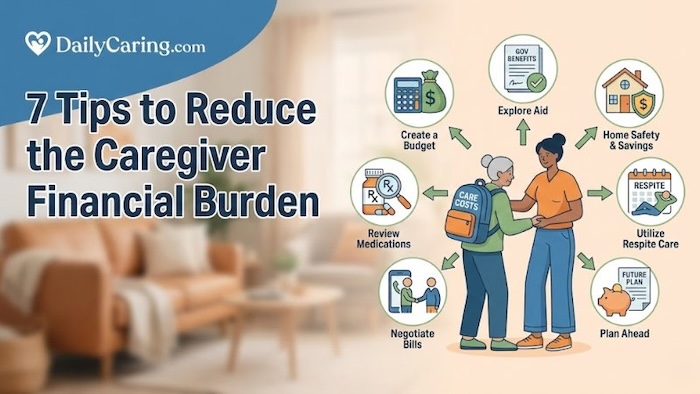













Not only does caregiving impact you physically, mentally, and emotionally, but it can also negatively affect your financial health. LendingTree shares seven ways to protect your finances when you’re a caregiver.
Becoming a family caregiver often doesn't just impact you physically, mentally, and emotionally – it can drain your finances too.

A 2018 survey from Northwestern Mutual found that 68% of family caregivers provided their loved one with financial support in addition to their other duties, and another 67% of caregivers who took on these costs cut back on their own expenses to do so.
If you’re currently a caregiver or anticipate becoming one in the near future, it's essential to understand that your financial health can be at risk.
Here, we'll cover seven ways you can protect your finances as you take on this responsibility.
7 Proactive Steps to Help Secure Your Finances While Caregiving
1. Broaden your definition of an emergency expense
You shouldn't have to dig yourself into a hole – financial or otherwise – while caring for a loved one.
“Many folks see their own financial situations flipped upside down by being a caregiver,” says Matt Schulz, chief credit analyst at LendingTree. “That’s especially true when there’s an unexpected medical emergency that transitions into a long-term caregiving situation.”
Having an emergency fund can help you avoid taking on debt when the unexpected occurs.
Although traditional advice recommends three to six months of funds to cover your basic expenses, as a caregiver, you’ll want to pad the account to cover your family member's needs as well.
“In some cases, time can be an ally,” says Schulz. “If you envision yourself as a likely caregiver in the future, putting money aside to prepare for that can help greatly.”
If you want to keep your finances separate, consider opening up a new account (bonus points if it's a high-yield savings account) to act as a slush fund to help cover the costs of unexpected medical bills, specialty food to meet dietary requirements, and cash for home improvements that can make living at home more accessible.
2. Build your credit score
A high credit score can help you raise your credit card limit, qualify for better lending programs with better terms, and more.
“A good credit score gives you options,” says Schulz. “When you’re a caregiver, that is so important. Being a caregiver can already be a costly proposition, but having good credit can help you keep those costs down a little bit if you need to borrow to cover some expenses.”
Additionally, improving your credit score will help ensure your financial prospects aren't significantly affected when your caregiving responsibilities end.
The two significant factors that impact your credit score are your payment history and account balances, so focus on them when trying to boost your score.
Set up automatic payments to ensure you’re never late on a payment again.
Also, focus on paying down and staying out of debt, which has the added benefit of freeing up more funds for yourself and your loved one.
Consider using free credit monitoring services to track your score as it improves; some even offer personalized tips based on your financial profile to help you boost it further.
3. Make your retirement fund a priority
Once you've reached your goal for your emergency fund and given your credit score a boost, you'll want to start contributing as much as you can to your retirement fund, even if it's only a little bit here and there.
If you're working full-time and your employer offers matching contributions, take advantage of it – especially if caregiving means you might need to reduce your hours or eventually quit.
If you're not working or are on a part-time schedule, open an individual retirement account (IRA) and regularly contribute funds as you would with a 401(k).
Withdraw money from this account only as a last resort, as you will lose out on the benefits of compounding interest over time.
Just as with your emergency savings, if you do need to use these funds, work on contributing as much as you can in the months afterward.
4. Consider your investments
If you have any cash left over after maxing out your retirement fund contributions, consider investing it in other assets to help it grow.
But remember: Investing carries risk, and profits aren't guaranteed.
Minimize your risk with the following tips:
- Diversify your investments by allocating your money across a variety of assets and industries. That way, if one of them loses value, your losses are limited because your other assets likely haven't also dropped in value.
- Contribute a specific dollar amount to your assets regularly, a practice called dollar-cost averaging. Over time, this strategy helps balance short-term growth periods and market dips while avoiding emotion-based investment decisions.
5. Look for passive income opportunities
Taking care of someone else can often feel like a full-time job in itself, so you might not have time for an actual side hustle.
In this case, passive streams of income can increase your available funds with little to no work.
Some simple ways to make extra money include:
- Rent out an extra room in your home or list it on Airbnb.
- Rent out your car or household items, like a stroller or leaf blower.
- Start a blog about your caregiving work and focus on getting some affiliate marketing links.
- Sell unwanted items on Facebook or eBay.
- Put advertising on your car.
- Sell stock photos.
6. Look into paid family leave
Although the federal government hasn't mandated paid family leave for private employers, certain states have.
Keep in mind that some states offer job protection, where you're able to return to your job after your leave, but others don't.
The federal government offers up to 12 weeks of unpaid leave under the Family and Medical Leave Act (FMLA).
This legislation has some caveats, but it's worth considering if you need an alternative to paid leave.
7. Discover how to get paid as a caregiver
A 2020 report from the National Alliance for Caregiving and AARP found that 19% of caregivers in the U.S. are providing unpaid care to an adult with health or functional needs.
However, this doesn't necessarily mean you need to sacrifice your financial health, too.
Look into programs offered by Medicare, the Department of Veterans Affairs (if your loved one is a veteran), and other government agencies to see whether they can provide financial support.
If your family member has long-term care or life insurance, you may be able to use the policy to pay for your caregiving expenses, too.
If you're at a dead end, consider asking your loved one or other relatives to compensate you for the care you're providing.
This may make you uncomfortable, especially if you feel obligated to help. But if you're helping care for your family, you shouldn't have to sacrifice your funds or financial stability to do so.
Recommended for you:
- Getting Paid as a Family Caregiver: 3 Government Benefits Programs
- Financial Help for Seniors: 2,500+ Federal, State, & Private Benefits Programs
- The Ultimate Guide to Senior Veterans Benefits
Guest contributor: Joshira Maduro is a market research analyst at LendingTree, where she writes insightful pieces that empower people to make better financial decisions. She lives in Charlotte, NC, navigating care for her elderly parents.