












Imagine your loved one needs hospital-level care for a flare-up of heart failure or a severe infection. In the past, this meant a week in a sterile room with beeping monitors and limited visiting hours. But in 2026, there is a new option: Hospital at Home.
Thanks to the Consolidated Appropriations Act of 2026, which extended the federal “Acute Hospital Care at Home” waiver through 2030, this model is no longer a “pilot program”—it’s becoming a standard of care. But for a family caregiver, it’s a major shift that brings both relief and new responsibilities.
What Exactly is “Hospital at Home”?
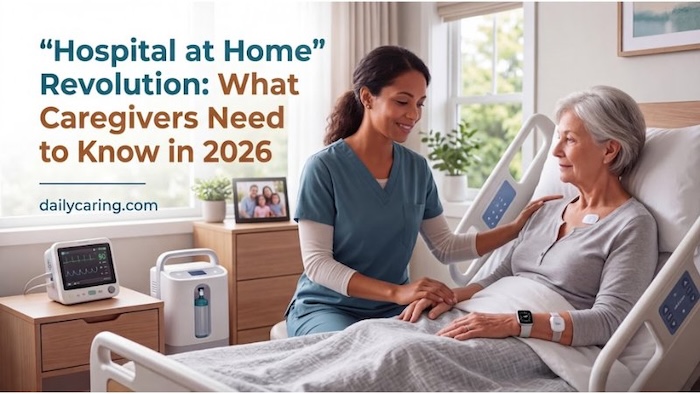
In simple terms, it means the hospital comes to you. If your loved one is stable enough, they are “admitted” to the hospital but sleep in their own bed. The hospital provides:
- Twice-daily in-person nursing visits.
- Daily virtual “rounding” with a doctor via a tablet.
- 24/7 remote monitoring of vitals like heart rate and oxygen levels.
- In-home delivery of medications, IV fluids, and even X-rays.
As we discussed in our recent look at why Caregiving is Worth $1 Trillion in the USA, the economic value of this unpaid labor is massive. While studies show that patients recover faster and have fewer infections at home, it effectively turns you into a “co-nurse” for the duration of the admission.
The “Hidden” Caregiver Role
Recent data from the AARP 2025/2026 Caregiving report shows that 55% of caregivers are now performing “high-intensity” medical tasks. In a Hospital at Home setting, you aren't expected to be a doctor, but you are the “eyes and ears” on the ground.
You might be asked to help manage an IV line, monitor for confusion, or coordinate with the food delivery team.
Before you agree to a home admission, use this checklist to ensure your “home hospital” is ready for success.
The “Home Hospital” Readiness Checklist
Before you agree to a home admission, use this checklist to ensure your “home hospital” is ready for success.
Is your internet stable enough for 24/7 vital monitoring and daily video calls with the medical team? Consider a battery backup for the router.
Do you have your critical legal documents ready? You'll need a Healthcare Power of Attorney if decisions need to be made quickly.
Are you comfortable using AI Caregiver Assistants or apps to track symptoms and log medications between nurse visits?
Is the recovery area on the ground floor? Ensure there is enough space for a nurse to work and for equipment like oxygen concentrators or IV poles.
Do you know exactly who to call at 2:00 AM if their condition changes? Verify the hospital's 24/7 rapid-response protocol before admission.
Embracing Your Role as the Lead Advocate
Once the monitors are beeping and the first nurse departs, the reality of “Hospital at Home” truly sets in. You aren’t just “hosting” a recovery; you are the eyes and ears of the medical team. This transition can feel overwhelming, but remember: you have a “superpower” the doctors don't have. You know your loved one.
To manage this new dynamic without burning out, you need to establish clear boundaries and communication rules from Day 1.
The Advocate’s 3 Golden Rules
Doctors see data; you see the person. If something “feels off”—even if the monitors look fine—speak up. Your intuition is a clinical data point. Learn more about effective medical advocacy.
Designate one room in the house as a “No-Medical Zone.” Whether it's your kitchen or a sunroom, ensure there is a space where you can be a family member again, not just a caregiver. See our essential tips for self-care.
Since you don't have a hospital chart, keep a simple notebook by the bed. Track sleep, appetite, and mood. It makes the daily virtual “rounding” calls much faster and more productive.
Final Thoughts About The Hospital At Home Revolution
The “Hospital at Home” revolution is a double-edged sword. It offers the comfort and faster healing of a familiar environment, but it places a heavy burden on family caregivers.
As this model becomes the standard of care through 2030, the most successful recoveries will be those where caregivers feel empowered, informed, and supported. By setting up your “home hospital” with the right tools and maintaining your role as a fierce advocate, you can help your loved one heal in the place they love most, without losing yourself in the process.
When the hospital moves home, meds get complex. Learn how to manage high-intensity drug schedules safely using 2026 safety tools.
A home hospital requires a safe environment. Use our audit to clear high-risk zones and prepare your space for medical recovery.
“Hospital at Home” is physically demanding. Learn micro-workouts and stress-relief hacks designed for caregivers in high-needs settings.
If you're transitioning a parent to home care, start with this manageable 7-step plan to coordinate medical needs and family support.
About the Author

Amie Clark is a senior care expert with over 25 years of experience in aging services, caregiving, and senior housing. She combines her professional expertise and personal caregiving insight to help families navigate aging, long-term care, and end-of-life decisions with clarity and compassion.