













Picture this: you're so busy caring for someone else that you don't notice the exhaustion weighing down your own shoulders. You tell yourself, “I'm fine,” or “Others have it worse,” while the quiet toll of caregiving – the sleepless nights, the constant worry, the slow surrender of your own needs – builds like a rising tide.
For many dedicated caregivers, stress isn't a dramatic event but a silent companion that creeps in, often going unrecognized until its effects are profound. This article is your invitation to pause, take an honest look inward, and equip yourself with a simple, free tool to measure the unseen load you carry.
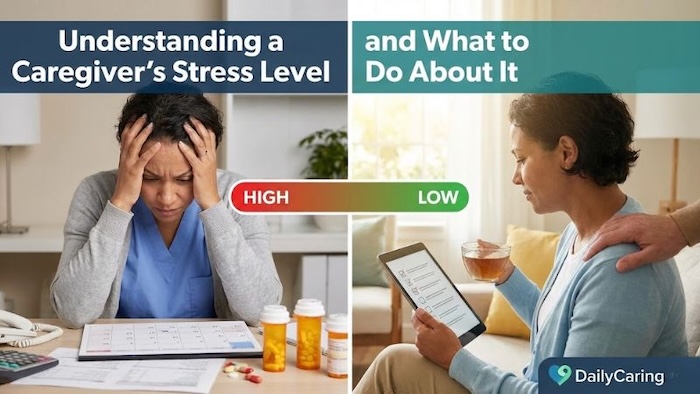
By understanding your true stress level, you take the first, most powerful step toward reclaiming your well-being and ensuring you can continue to give care from a place of strength, not depletion.
Caregiver Stress Can Sneak Up On You
Caring for an older adult is a tough job that naturally causes significant stress. But a big problem with caregiver stress is that many caregivers don’t realize how stressed they truly are.
That’s because stress is sneaky and often creeps up on you. It can do significant damage to your body and mind before you even notice.
To prevent stress from building up unnoticed, we found a quick, free quiz from Health in Aging that helps you understand your stress levels.
We explain why knowing your stress level is important, how to take the quiz, and how to use the quiz results to reduce stress.
You Need to Be Aware of Your Stress Levels When Caregiving
Caregivers often say, “It’s ok, I’m fine, I can handle it,” or “My friend Joan is in a much more difficult situation.” Most of us are in denial about how much stress really affects us.
There’s a story that says if you put a frog into a boiling pot of water, it will jump out immediately. But, if you put the frog in a pot of cold water and slowly raise the temperature, it won’t even notice the heat until it’s cooked.
Many caregivers are like the frog in the story.
Caregiving tasks, responsibilities, and stress levels increase over time. You don’t even notice until you’re completely overwhelmed, burned out, and suffering physically.
To avoid being boiled alive like a frog, it’s important to be aware of stress levels and how they change over time.
That way, if you notice that your stress is higher than it used to be or it’s already off the charts, you’ll know when it’s critical to arrange a respite break or find additional caregiving help.
This Quiz Measures Your Stress Level
Health in Aging’s 18-question stress quiz is a simple, quick way to monitor stress levels.
The quiz has 16 simple Yes / No questions about your situation and 2 basic questions about your current stress level and health.
It’s important to answer these questions honestly. This is for your eyes only and helps you understand the reality of your situation.
How to Use Your Quiz Results to Reduce Your Stress Levels
Your answers to the quiz questions help you figure out which issues you need help with or what’s bothering you most.
For example, if you notice that many of your “Yes” answers are related to things like loneliness, overwhelm, irritability, and struggling with decisions, you might decide to join a caregiver support group, read books about coping with caregiver stress, and make it a point to call a supportive friend at least twice a week.
Taking this test regularly helps you monitor stress and is a concrete way to see how helpful recent changes have been.
Keep your tests so you can compare your scores over time to see if your stress levels are increasing, decreasing, or staying the same.
Final Thoughts on Understanding Caregiver Stress
Acknowledging your stress is not a sign of failure; it is the ultimate act of care for yourself and for the person you love. This journey is not about achieving perfection, but about gaining awareness and taking small, consistent steps toward balance.
Use the insights from the quiz not as a verdict, but as a roadmap to seek support, whether through a caregiver group, a trusted friend, or by delegating tasks. As you move forward, remember that your health is the foundation upon which all your caregiving rests.
By making your well-being a priority, you are not stepping away from your role; you are ensuring you can stay in it, with compassion and resilience, for the long road ahead.
Next Steps: Take the fast, free Caregiver Stress quiz from Health in Aging (PDF)
Recommended for you:
- Caring for the Caregiver: 6 Ways to Get Help and Improve Your Health
- 5 Coping Tips for the Overwhelmed Caregiver
- 3 Sources of Affordable Counseling Services to Reduce Caregiver Stress
About the Author

Connie is the founder of DailyCaring.com and was a hands-on caregiver for her grandmother for 20 years. (Grandma made it to 101 years old!) She knows how challenging, overwhelming, and all-consuming caring for an older adult can be. She also understands the importance of support, especially in the form of practical solutions, valuable resources, and self-care tips.


I have been taking care of my mil who has mid stage LBD. What makes it tougher is she always has a scowl on her face. Plus, she speaks 10% English so taking care of her is quite difficult. I take care of her 60 hrs a week when it should only be 37 hrs a week. I ask the other siblings for help. They either ignore me, yell or say I am complaining. If it is suppose to be an obligation, I do not view such a task as this as something I will have to do when I get older. It is when you do the task because you want to not because you have to. I believe the quality of treatment will be excellent than just being minimal. To lose your former self physically and mentally to this task should never be expected. I will not give part of my life when the other person has already led a full life before getting LBD. In a religious aspect, “I am not God and I am very Fallible where God is not. If I make mistakes let them be on myself, not an 83 yr old woman who has LBD.
It’s wonderful that you’re caring for your mother in law. I’m so sorry that her other children aren’t helpful. Perhaps it would help to have your spouse speak with them? If they’re not willing to contribute hands-on care, they could contribute in other ways, maybe pay for hiring in-home caregiving help to take the pressure off of you.
You’re absolutely right that you also deserve to have a life and to care for yourself as well.
I have been taking care of my mil who has mid stage LBD. What makes it tougher is she always has a scowl on her face. Plus, she speaks 10% English so taking care of her is quite difficult. I take care of her 60 hrs a week when it should only be 37 hrs a week. I ask the other siblings for help. They either ignore me, yell or say I am complaining. If it is suppose to be an obligation, I do not view such a task as this as something I will have to do when I get older. It is when you do the task because you want to not because you have to. I believe the quality of treatment will be excellent than just being minimal. To lose your former self physically and mentally to this task should never be expected. I will not give part of my life when the other person has already led a full life before getting LBD.
I think I’m stressed out but I Don’t care it s about taking care of my mom who s got late stage Alzheimer s Disease
From your comments it does sound like you’re stressed out and burned out. That doesn’t mean that you should stop being a caregiver. It just means that it’s time to get help with both physical tasks (get in-home help, try an adult day program, get help with chores / meals / cleaning, etc) and the emotional side (support groups, counseling, therapy).