













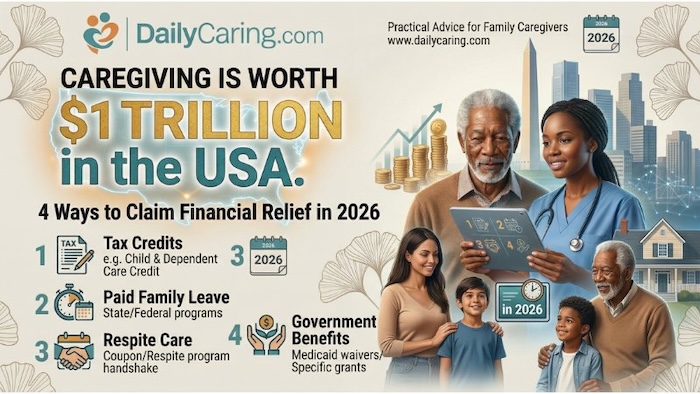
The numbers are finally in, and they are staggering. According to the newly released AARP Valuing the Invaluable 2026 report, unpaid family caregiving in the United States is now valued at $1.01 trillion annually.
If you feel like you’re working a full-time job for free, you’re right – and the economy literally couldn't function without you. But while your labor is “invaluable,” your bank account is likely feeling the strain. As we navigate 2026, new legislative initiatives and state programs are finally putting real money back into caregivers' pockets.
Here are four ways caregivers can claim financial relief this year:
4 Ways Caregivers Can Claim Financial Relief in 2026
1. The Federal “Credit for Caring Act” Push
The bipartisan Credit for Caring Act remains a top priority in 2026. If passed, this would provide a non-refundable federal tax credit of up to $5,000 for working family caregivers.
- Who it’s for: Caregivers with an earned income of at least $7,500 who are paying for home modifications, respite care, or technology to help a loved one.
- Pro Tip: Keep every receipt for care-related expenses now. Even if the federal bill is pending, many of these expenses can be used for state credits or medical deductions.
2. State-Level Success: Oklahoma and Nebraska Lead the Way
While the federal government deliberates, states are taking action. Oklahoma and Nebraska have pioneered dedicated Caregiver Tax Credits.
- Oklahoma: The “Caring for Caregivers Tax Credit” was expanded in early 2026 via House Bill 4118, removing age restrictions and adding mileage for medical appointments as a qualifying expense.
- Nebraska: The Caregiver Tax Credit in Nebraska provides a 50% credit on eligible expenditures, up to $2,000 (or $3,000 if your loved one is a veteran or has dementia).
- Check Your State Below: At least 12 other states are considering similar legislation in the 2026 session.
2026 Caregiver Tax Relief Tracker
A State-by-State Look at Active and Proposed Financial Support
| State | Status | Max Relief | Details & Legislation |
|---|---|---|---|
| Oklahoma | Active | $3,000 | Includes medical mileage for all ages. HB 4118 |
| Nebraska | Active | $3,000 | 50% reimbursement of care expenses. Tax Table |
| North Dakota | Active | $4,000 | For family members 65+ with lower income. ND Credits |
| Minnesota | Pending | $2,400 | Proposed $200/mo “Home Caregiver Credit.” SF 1114 |
| New Jersey | Pending | $2,500 | Gross income tax credit for qualified caregivers. S1199 |
| Massachusetts | Pending | $1,500 | Refundable tax credit for uncompensated care. H 3159 |
| New York | Pending | $6,000 | Major credit for home modifications/care. A 09587 |
| West Virginia | Pending | $3,000 | Focuses on medical equipment and respite. SB 465 |
| South Carolina | Pending | $1,000 | Credit for intensive care needs (per dependent). Bill 825 |
| Georgia | Active | $750 | Existing credit with expansion goals for 2026. GA Legis |
| Maryland | Pending | $3,000 | Targeted “Caring for Aging Parents” bill. MD Tracker |
| Michigan | Pending | TBD | Newly introduced individual income tax credit. HB 5214 |
3. Medicaid Self-Directed Services (Getting Paid to Care)
One of the most effective ways to find relief is to get paid for the hours you already spend caregiving. Through Medicaid Self-Directed Services, your loved one can choose to hire you as their personal care assistant.
- The “One Big Beautiful Bill” Act: New 2026 federal rules have streamlined how families apply for these “consumer-directed” programs, making it easier to bypass traditional home-care agencies and keep the funding within the family.
4. 2026 HSA Expansion and Medical Deductions
Starting January 1, 2026, new IRS rules have made bronze and catastrophic health plans HSA-compatible. This allows more families to use pre-tax dollars for caregiving expenses.
Additionally, if you provide more than half of a loved one's support, you may be able to claim them as a dependent, unlocking further deductions for medical expenses that exceed 7.5% of your adjusted gross income.
Financial Relief For Caregivers: Comparison Table
| Program/Pathway | Potential Relief | Key Requirement | Next Step |
|---|---|---|---|
| Federal Credit for Caring | Up to $5,000 | Working caregivers earning >$7,500/year | Track the Bill |
| State Caregiver Credits (OK & NE) | Up to $3,000 | Residents of OK or NE with care expenses | View Details |
| Medicaid Self-Directed Care | Hourly Wage | Care recipient must be Medicaid eligible | Find Your State |
| HSA & Tax Deductions | Pre-Tax Savings | IRS “One Big Beautiful Bill” compliance | IRS 2026 Rules |
2026 Financial Action Plan for Caregivers
Here is your 2026 Action Plan to transition from providing unpaid labor to receiving at least some of the financial support you deserve.
From Recognition to Relief: Your 2026 Action Plan
To bridge the gap between understanding the $1 trillion impact of caregiving and actually seeing that money in your own bank account, you need a concrete plan. While new legislation is a massive win, these benefits don't arrive automatically—they require documentation and proactive local connections. Use this plan to transition from providing unpaid labor to receiving the support you deserve.
1. Build Your Caregiver Paper Trail
Tax credits like the Credit for Caring Act require proof of out-of-pocket expenses. Start a dedicated folder (digital or physical) to track these immediately:
- Medical Mileage: Every mile driven for doctor visits, therapy, or pharmacy pickups.
- Home Modifications: Receipts for grab bars, ramps, or safety equipment.
- Assistive Tech: Costs for medical alert systems or monitoring tools.
- Respite Care: Invoices from temporary home health aides or adult day centers.
2. Connect with Your Local Agency (AAA)
Your local Area Agency on Aging (AAA) often manages local grants for respite vouchers or emergency repairs that don't make national headlines.
3. Check for “High-Intensity” Eligibility
Specific situations often unlock higher tiers of financial relief. For example:
- Veterans: Many state credits, like those in Oklahoma, offer $1,000 more in relief for veteran care.
- Dementia Care: Check if your state's credit (like Oklahoma HB4118) has higher limits for cognitive impairment diagnoses.
Final Thoughts on Caregiver Financial Compensation
The $1 trillion milestone is bittersweet. It proves that family caregivers are the backbone of the American healthcare system, yet it also highlights just how much financial weight you’ve been carrying alone.
By using these four strategies and staying organized with your “paper trail,” you can ensure that 2026 is the year your invaluable work finally receives the tangible support it deserves. You aren't just “helping out” – you are performing essential work, and it's time you were compensated for it.
Explore the three primary government pathways—Medicaid, VA, and State programs—that allow family members to receive a wage.
Beyond tax credits, learn about supplemental programs for nutrition, utilities, and household expenses that ease your budget.
Find local and federal support programs for medicine and food using the National Council on Aging's free screening tool.
Practical money-saving strategies, from negotiating medical costs to leveraging senior discounts to lower out-of-pocket spending.
About the Author

Chris is a seasoned healthcare executive and entrepreneur from the Pacific Northwest. He strongly advocates for older adults and the caregivers who serve them. Chris has personal experience caring for his father, who had dementia. Chris is a technology enthusiast and an avid outdoorsman; if he's not in his office, he can usually be found on a golf course or fly-fishing out west somewhere.