













Simple kitchen updates can help older adults stay more independent and safer. Plus, being able to handle everyday tasks independently boosts their mood and self-esteem.
Remodeling a kitchen can be expensive and slow. Chuck Winkles from New Life Bath & Kitchen shares six simple kitchen updates you can do yourself.
In this article, we share six practical ways to adapt a kitchen for aging in place, from more innovative storage solutions to safety upgrades, so your loved one can enjoy meal prep with confidence and convenience.
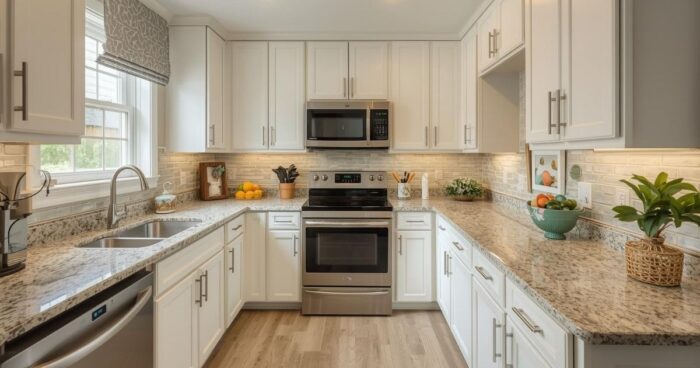
The kitchen is the center of the home, but when someone cannot safely or easily move through this critical hub, life becomes difficult. If you have an unlimited budget, you can do a lot to fully customize the kitchen to meet the needs of an older adult.
But as you can see, a senior-friendly kitchen doesn't have to be complicated or expensive. Minor adjustments can often make huge differences.
When you think about the areas of the kitchen that are the biggest problem for your loved one, you’ll be able to adapt the work area in ways that can make independent living easier and safer.
Most of us don’t have a magical, endless budget, so we need to make the kitchen more accessible using affordable DIY methods. Read on for 6 DIY tips to make your older adult’s kitchen more senior-friendly.
6 DIY Tips To Make a Senior-Friendly Kitchen
1. Update Lighting
Insufficient lighting can be dangerous in the kitchen for seniors.
First, make it easy to turn on and off by replacing regular light switches with rocker switches. These work for the whole hand and take less effort than traditional switches.
Then, take inventory of the current light bulbs in the room. Replace old bulbs with LED lights to remove the harsh light that can be hard on the eyes. Install task lighting above workstations, below upper cabinets, and in storage spaces.
2. Make Storage More Accessible
A no-cost accessible upgrade to a senior-friendly kitchen is to reassess the placement of items.
Keep daily-use items, such as cookware, in lower cabinets that are easily accessible from a wheelchair. Even if a wheelchair isn’t being used, place these items between waist and shoulder height. Adding pullout landing boards of spring-assisted shelving can also help with heavy items for your senior-friendly kitchen.
Think outside the stack, and store dishes and baking sheets on end by adding dowels in your existing cabinets. You can also find ready-made inserts at various home stores. Consider lazy susan trays, full-extension slide shelving, sliding wire organizers, and pull-down shelves as well.
It’s much safer for older adults to pull shelves toward them instead of having to crouch down to reach items in lower cabinets or use a step stool to reach items in higher cabinets.
3. Replace Drawer Handles So They're Easier to Use
Round pull knobs can be difficult for an arthritic hand to handle. Replace any pull knobs with wide drawer pulls (also called D-shaped pulls) to enhance your senior-friendly kitchen project.
You may also want to consider a touch drawer system, where the door opens when you push it.
4. Make the Kitchen Faucet More Accessible
At the sink, make faucet use easier by updating to lever-style fixtures instead of twist knobs.
Motion-sensor faucets are even better. Not only do these faucets eliminate the need to grip, but they also prevent forgetting to turn the water off. A simpler and less expensive option is to add a motion sensor adapter.
5. Use Contrasting Colors to Make Things Easier to See
For those with limited vision or dementia, colors and labels can be incredibly helpful.
You could add non-slip tape on the floor to create a contrasting border that makes it easier to see where the floor ends and the wall begins.
A simple way to make sure the stove knob isn’t left in the on position is to put red nail polish on the “off” position. This also makes it easier for your older adult to check that it’s off without having to walk across the room.
You can also use colored tapes, glue, or puffy paint to make raised markings on key points of frequently used appliances in your senior-friendly kitchen.
6. Add a Work Table to Your Senior-Friendly Kitchen
Lowering countertops is helpful, especially for older adults who are in wheelchairs or have lost height due to osteoporosis. An inexpensive solution is to buy a 30-inch-high corner table or kitchen island. It should fit a wheelchair underneath and still be at the right height for food preparation.
Beyond DIY: 2026 “Ambient” Safety Technology for the Modern Kitchen
While physical changes like lighting and handles are essential, 2026 has introduced “invisible” safety layers that protect seniors without requiring them to learn new habits. These technologies monitor the kitchen environment and act automatically if a risk is detected.
AI Fall Detection (No Cameras Required)
One of the most significant breakthroughs for kitchen safety is radar-based fall detection. Unlike cameras, which many seniors find invasive, wall-mounted sensors (like those from Pontosense or SafelyYou) use radio waves to detect a “hard fall” or even a slow topple.
These devices can distinguish between a person sitting down in a chair and a person collapsing on the floor. If a fall is detected, the system automatically alerts family members or emergency services through a central hub, ensuring help is on the way even if your loved one is unconscious.
Smart Stove Shut-offs
Cooking is the leading cause of home fires for older adults. New “Predict and Prevent” devices like the iGuardStove or Innohome Stove Guard act as an extra set of eyes. These systems use motion sensors to track activity:
- The “Step-Away” Timer: If the stove is on but no motion is detected in the kitchen for 5 minutes, the device automatically cuts power to the heating elements.
- Caregiver Alerts: You can receive a notification on your phone if the stove has been auto-shut off multiple times, which can be an early indicator of memory changes.
Quick-Look: Modern Kitchen Safety Upgrades
If you are looking to invest in a specific piece of hardware rather than a full remodel, these four technologies offer the highest safety “return on investment” for aging-in-place in 2026.
✨ 2026 Safety Spotlight: Adaptive Technology
These 2026 updates provide safety without requiring your loved one to learn a single new “app” or remote control.
Induction surfaces remain cool to the touch even while cooking, virtually eliminating the risk of accidental burns or grease fires.
Convert existing sinks with motion-sensor adapters. They prevent overflow and help those with arthritis who struggle with knobs.
Lighting that adjusts color temperature (Tunable White) throughout the day to help seniors with sundowning or vision clarity.
Smart scales and fridges can now suggest recipes based on specific dietary needs, helping manage diabetes or heart health automatically.
Simple “Low-Tech” Reminders for 2026
While high-tech is great, a few timeless layout changes remain essential:
- The 15-Inch Rule: Always ensure there is at least 15 inches of clear “landing space” next to the refrigerator and microwave so heavy items can be set down immediately.
- High-CRI Lighting: When replacing bulbs, look for those with a Color Rendering Index (CRI) of 90 or higher. This helps seniors better distinguish between food colors, making it easier to see if meat is fully cooked or if produce is fresh.
Recommended for you:
- 10 Kitchen Aids for Seniors to Safely Increase Independence
- Home Safety for Seniors: 10 Quick Fixes for Bathroom, Bedroom, and Kitchen
- 10 Simple Arthritis Aids Help Seniors with Everyday Tasks
Guest contributor: Chuck Winkles is the president of New Life Bath & Kitchen. Chuck was born in Southern California and currently resides in Santa Maria. He's been married to his wife, Shelley, for thirty-eight years and has two sons, Nathan and Noah.
This article contains affiliate links. We never link to products or services for the sole purpose of making a commission. For more information, see How We Make Money.
About the Author

Chris is a seasoned healthcare executive and entrepreneur from the Pacific Northwest. He strongly advocates for older adults and the caregivers who serve them. Chris has personal experience caring for his father, who had dementia. Chris is a technology enthusiast and an avid outdoorsman; if he's not in his office, he can usually be found on a golf course or fly-fishing out west somewhere.