












Managing medical bills is a necessary part of caregiving. In 2026, the complexity of healthcare billing has only increased, with new Medicare codes, remote monitoring fees, and fragmenting insurance networks.
Unfortunately, these bills are often complicated, filled with errors, and sometimes beyond your older adult’s budget. Recent data suggests that up to 80% of medical bills contain at least one error, a statistic that can cost seniors thousands of dollars annually if gone unchecked.

We’ve updated our comprehensive 2026 guide to help you navigate this financial maze. Below are 10 clear, actionable steps to audit, organize, and negotiate your older adult’s medical expenses.
2026 At A Glance: What's New?
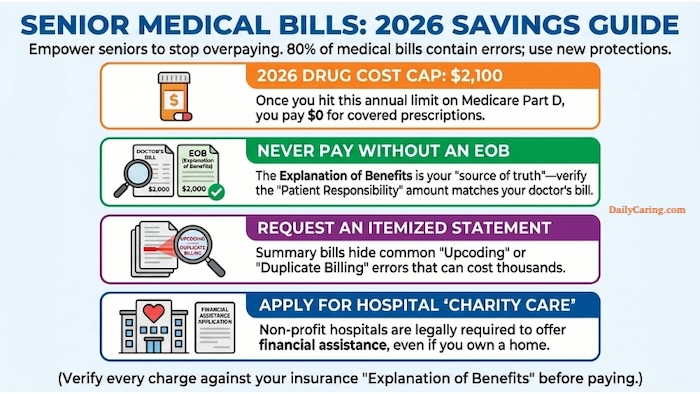
- New Cap on Drug Costs: Starting in 2026, the Medicare Part D annual out-of-pocket maximum is $2,100. Once you hit this limit, you pay $0 for covered prescriptions.
- Top Billing Error: “Duplicate Billing” is rising due to AI automation. Always check if a single service was scanned or entered twice.
- Golden Rule: Never pay a medical bill until you receive the Explanation of Benefits (EOB) from your insurer to verify what you actually owe.
10 Actionable Steps to Manage Medical Bills for Seniors
1. Get Organized Immediately
Don't let mail pile up. Create a dedicated physical binder or a secure digital folder for all medical correspondence. In 2026, many providers have moved to “paperless by default” billing. Ensure you have proxy access to your loved one's patient portals so you don't miss notifications that only arrive via email or app alerts.
2. Verify the “Date of Service”
Before paying a cent, match the bill to the actual appointment date. Did your older adult actually see Dr. Smith on that Tuesday? If they were in the hospital, ensure they weren't billed for a full day on the day of discharge.
3. Wait for the EOB (Explanation of Benefits)
Never pay a bill until you receive the Explanation of Benefits (EOB) from Medicare or the private insurer. The EOB is the “source of truth”; it tells you exactly what the insurance covered and what you actually owe. If the bill from the doctor is higher than what the EOB says is “Patient Responsibility,” you may be looking at a balance billing error.
4. Check for Duplicate Billings
Duplicate billing is one of the most common errors in 2026, especially with automated billing systems.
- The Double-Scan: Being charged twice for the same X-ray or lab test.
- The Room Charge: Being charged for a hospital room and a “procedure room” for the same hour.
5. Understand the “Codes” (and Spot Upcoding)
You don't need to be a medical coder, but you should look for “Upcoding.” This happens when a provider bills for a higher level of service than was received.
- Example: If a doctor spent 10 minutes with an aging adult, but billed for a “Level 5 Complex Visit” (which requires 40+ minutes), that is an error you can contest.
6. Review for Canceled Work
Did your loved one refuse a test? Was a scheduled physical therapy session canceled because they were too tired? Make sure those “ordered” but “not performed” services didn't sneak onto the final invoice.
7. Negotiate “Self-Pay” Rates
If a specific treatment isn't covered by insurance, ask for the “cash price” or “self-pay rate.” Hospitals and clinics often have two price lists: an inflated one for insurance companies and a significantly lower one for cash payments. You can cross-reference fair prices using tools like Healthcare Bluebook or Fair Health Consumer.
8. Ask for an Itemized Bill
Summary bills often hide mistakes. Always request an itemized statement that lists every single pill, tissue, and minute of care.
- Pro Tip: “Unbundling” is a common practice in which providers charge for individual steps of a procedure rather than charging a package rate. An itemized bill will reveal if you are being nickel-and-dimed.
9. Know Your Rights (No Surprises Act)
The No Surprises Act, passed a few years ago, is your shield against unexpected out-of-network bills during emergencies. If your senior received emergency care at an in-network hospital but was treated by an out-of-network anesthesiologist, you are legally protected from paying the difference. Learn more about these protections at CMS.gov.
10. Apply for Financial Assistance (Charity Care)
Non-profit hospitals are required by law to offer financial assistance programs (often called Charity Care). Even if your loved one owns a home, their income might still qualify them for significantly reduced bills. You typically have up to 240 days to apply for this aid, even if the bill has already gone to collections.
VIDEO: Make Sure You're Not Overpaying Your Medical Bills
Common Medical Billing Errors to Watch For
Use this quick reference guide to spot red flags in your loved one's billing statements.
| Error Type | What It Looks Like | Action to Take |
|---|---|---|
| Duplicate Billing | Same charge listed twice (e.g., two “Day 1 Room Fees”). | Call billing dept. and ask for the duplicate to be removed. |
| Upcoding | Billing for “Complex Care” when the visit was routine. | Request provider notes to justify the code level. |
| Unbundling | Separate charges for incision, closure, and bandages. | Ask why these weren't billed under the single procedure code. |
| Mismatched Codes | Denied claim due to “Medical Necessity.” | Check if the diagnosis code matches the procedure (e.g., simple typo). |
Recommended Resources When It Comes to Medical Billing for Seniors
Medicare.gov: The Procedure Price Look-up Tool shows you exactly what Medicare pays for a service vs. what someone pays in a hospital or ambulatory surgery center setting.
Patient Advocate Foundation: If you hit a wall, this non-profit provides case management services to help with arbitration and negotiation.
Check Fair Prices: Use the FAIR Health Consumer tool to find the ‘Fair Price' for a procedure in your zip code before negotiating.
INFOGRAPHIC: Top Tips on Dealing with Medical Bills
Final Thoughts On Medical Billing Help for Seniors
Managing an older adult’s medical bills is more than just administration; it’s a crucial form of advocacy. By taking the time to verify dates, request itemized statements, and challenge errors, you aren't just saving money; you are protecting your seniors’ financial dignity.
Remember, you don't have to tackle the entire pile at once. Start with the most recent bill, follow these steps, and don't hesitate to ask hospital patient advocates for help. You have the right to question charges, and in 2026, you have more tools than ever to ensure you only pay what is fair.
Recommended for you:
— How to Lower Medical Bills: CoPatient Helps Seniors and Caregivers
— What You Need to Know About Medicare Coverage for Hospital Stays
— 5 Steps to Take When Medications Are Not Covered by Medicare
About the Author

Chris is a seasoned healthcare executive and entrepreneur from the Pacific Northwest. He strongly advocates for older adults and the caregivers who serve them. Chris has personal experience caring for his father, who had dementia. Chris is a technology enthusiast and an avid outdoorsman; if he's not in his office, he can usually be found on a golf course or fly-fishing out west somewhere.