













Family meetings about mom's care, intended to be about teamwork, have become tense debates. You say she needs more help at home; your brother insists she's fine. You're worried about her safety; your sister thinks you're overreacting. The same arguments circle without resolution, leaving everyone frustrated, resentful, and, most importantly, unable to present a unified front for your mom's well-being.
When sibling conflicts over elder care reach a stalemate, it's easy to feel stuck in a loop of emotional gridlock. But there is a powerful, professional way forward that can break this cycle: elder mediation. This isn't about winning an argument; it's about transforming conflict into a collaborative plan.
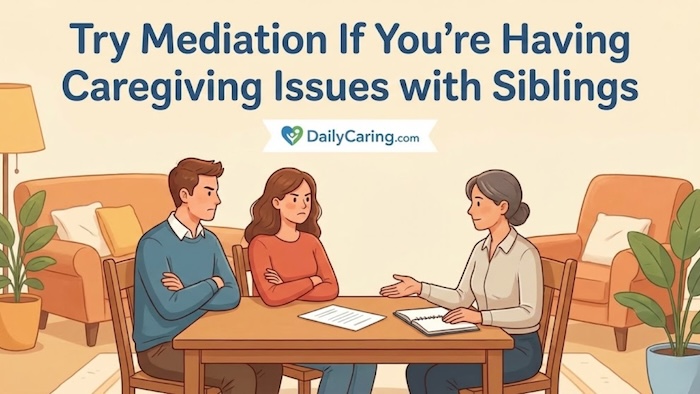
Discover how a neutral third-party mediator can help your family move from destructive arguments to constructive solutions, ensuring your mom receives the best possible care while preserving your family relationships.
Siblings May Struggle to Care for Aging Parents as a Team
For some siblings, working together to care for aging parents can be difficult or seem nearly impossible.
Important and difficult caregiving decisions must be made, but old rivalries can flare up during discussions and prevent progress.
Emotions and past issues can impede practical care decisions and end-of-life planning.
These deep-seated conflicts make life unpleasant for everyone involved.
And when a parent is ailing and may have limited time left, it becomes even more necessary to resolve these disagreements.
One solution is to hire an elder mediator.
Elder mediation does cost money, but it may be well worth it if it helps your family agree on a course of action and work together to care for your older adult.
We explain what elder mediation is, how it can help siblings move past conflicts and work together in their parents’ best interest, and where to find a mediator.
Elder Mediation Helps Adult Children Get on the Same Page
Elder mediators help families resolve conflicts and find solutions that everyone can accept.
Sometimes, having an unbiased 3rd party involved is the only way to reach a decision when siblings have been getting nowhere by talking to (or yelling at) each other for weeks, months, or even years.
An elder mediator is a professional who is trained in conflict resolution. Sometimes they’re also attorneys or therapists.
They meet with adult siblings and the parents (if that’s possible) to help the family sort out unresolved issues relating to caring for Mom and Dad.
The mediator works to defuse the situation and keep everyone focused on the common goal: agreeing on the best possible outcome for their parent and preserving family relationships.
Everyone gets a chance to talk and problem-solve to reach an agreement.
In some situations, an elder law attorney, financial planner, hired caregiver, or geriatric care manager may also attend to provide their expertise.
What Causes Siblings to Argue About Caregiving?
Nearly 40% of adult children who cared for a parent reported a significant conflict with a sibling.
These conflicts can come from issues like:
- Disagreements about money
- Old debates about who Mom liked best
- Different opinions on housing or medical treatments
- Who has taken on the most responsibility
- Why some siblings aren’t doing their fair share of work
Another issue is that each sibling may think their solution is the only “right” solution.
“Most of the time, siblings want what’s best for the parents. They look at it differently,” said Susanne Terry, an elder mediator. “Our goal is to help them figure out what their common interests are, so they can work together to find solutions.”
How Long Does Elder Mediation Take?
Elder mediation isn’t like therapy or counseling, where you discuss and work out deep problems for months or years.
Mediation focuses on what needs to be done now.
The mediator helps keep the conversation moving and ensures everyone is heard. Typically, families only need a few sessions.
“I help them make family decisions they can all live with,” says Janet Mitchell, a lawyer and mediator. “I help to bring out their better selves so they can focus on the parent or the continuation of the family.”
How to Find an Elder Mediator
The Academy of Professional Family Mediators (APFM) recommends that you approach hiring a mediator like you would any other professional, like a lawyer, care manager, or financial planner.
Generally, you should ask about the mediator’s:
- Background, education, and training
- Experience or knowledge in mediating the type of case you have
- How much they charge and how the fees are typically divided among participants
- Membership in APFM and other professional associations
Final Thoughts on Mediation for Caregiving Siblings
Choosing elder mediation is a courageous and proactive step toward healing family divisions and prioritizing your parents' needs. It provides a safe, structured environment to voice concerns, fully hear one another, and move beyond personal grievances to craft a practical, mutually agreed-upon care plan.
By investing in this process, you are not just solving the immediate conflict; you are rebuilding trust, preventing future arguments, and creating a sustainable framework for shared decision-making. Most importantly, you are freeing up the emotional energy previously spent on family battles and redirecting it toward what truly matters: ensuring your mom is safe, supported, and surrounded by a family that works together in her best interest.
Let mediation be the bridge that helps your family turn conflict into cooperation.
Next Steps: Use the APFM’s search tool to find a mediator in your area
Recommended for you:
- 6 Ways to Improve the Situation When Siblings Don’t Help with Aging Parents
- 3 Ways to Deal with Family in Denial About Seniors Needing Help
- Overcome 3 Excuses from Relatives Who Avoid Caregiving
About the Author

Connie is the founder of DailyCaring.com and was a hands-on caregiver for her grandmother for 20 years. (Grandma made it to 101 years old!) She knows how challenging, overwhelming, and all-consuming caring for an older adult can be. She also understands the importance of support, especially in the form of practical solutions, valuable resources, and self-care tips.


I have read several of your articles about siblings not helping out with Caregiving responsibilities, and it can be very guilt ridden. For many family caregivers who have followed the guidelines, it can become frustrating and anxiety ridden. I can only speak for myself, and state that if family members choose not to help out, after trying many of the caregiving tips, it is imperative to let it go and move on. I realize that the articles touches lightly on letting it go, and it was helpful trying to follow the tips, but in my situation it was not helpful. There was even more resentment from family members, thinking that you are being superior. Unless you are going through a non supportive situation it is very hard to expect change. Finding other alternatives and focusing on yourself and the caregiving role is a lot healthier.
Absolutely, every situation is different and there aren’t any suggestions that will work for everyone. In some situations, the best thing to do is to move on, find other ways of getting caregiving help & support, and stop trying to get unhelpful relatives to participate in care.
I don’t believe I’ve ever seen an article on this topic before, but it is such an important one. I’ve seen many siblings torn apart when faced with the responsibility of caring for an aging parent. So many emotions play into this: guilt, fear, sadness, feeling overwhelmed, etc.
Thank you for sharing this valuable resource.
I’m so glad this article is helpful! Managing family issues in caregiving is truly tough 💔