












If you’ve read our initial review of the modern AI caregiver assistant apps, you know that tools like Abridge and Caring Village are already changing the game for administrative tasks. But as we move further into 2026, artificial intelligence technology is getting more specialized and more humanistic.
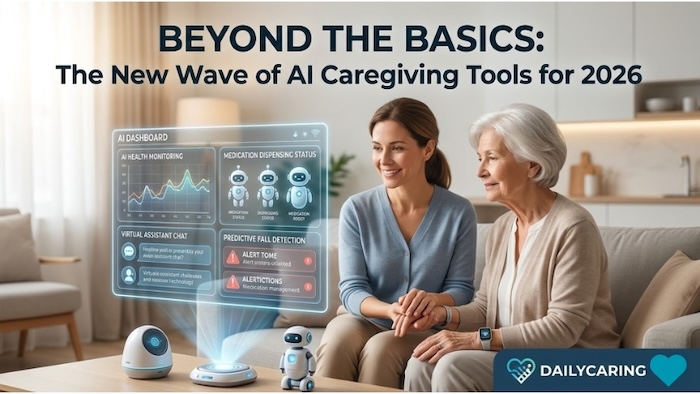
If you’re like most caregivers I talk to, you don’t need a “robot”; you need an extra set of hands. While the first wave of AI was about organizing files, this new generation is about sharing the emotional and clinical load. These are funded, vetted platforms designed to act as your digital co-pilot.
Executive Summary: Artificial Intelligence in Caregiving 2026
As of early 2026, the caregiving landscape has shifted toward specialized, proactive AI tools designed to solve the primary drivers of caregiver burnout: administrative load and behavioral crisis management.
- The Federal Push: The HHS $2 Million Caregiver AI Prize is now funding tools that provide person-centered, home-based support for family caregivers.
- Passive Detection: Open-source AI markers, like the Regenstrief Passive Digital Marker, are now identifying early-stage dementia years before symptoms appear.
- Real-Time Coaching: Grant-backed tools like YayaGuide (a training and coaching platform for student caregivers) provide immediate de-escalation techniques for dementia-related agitation.
DAILYCARING EXPERTS • MARCH 2026
The 2026 Caregiving Landscape: By the Numbers
To understand why these artificial intelligence (AI ) tools are becoming essential, look at the current state of caregiving in the U.S.:
- 63 Million: The number of family caregivers currently providing unpaid care – a record high.
- 40%: The percentage of caregivers now performing complex medical tasks (like wound care) once reserved for nurses.
- 70% Success Rate: The average overturn rate for insurance denials when using AI-powered appeal tools like Counterforce Health.
- 30% Reduction: The average decrease in “decision fatigue” reported by families using AI-enabled coordination apps.
- $3.20 ROI: For every $1 invested in healthcare AI, organizations see over 3 times that value in saved time and reduced errors.
- $2 Million: In November 2025, the U.S. Department of Health and Human Services (HHS) announced a $2 million Caregiver Artificial Intelligence Prize Competition to accelerate AI solutions for supporting family caregivers, which complements additional NIH-funded initiatives.
The AI Resource Guide for Caregivers in 2026
Here is a look at a few more of the latest AI tools that are moving the needle for family caregivers this year.
The 2026 AI Resource Guide
Advanced tools vetted for the DailyCaring community.
| Tool | Best For… | The AI “Superpower” |
|---|---|---|
| YayaGuide | Dementia Coaching | Real-time AI training for managing “sundowning” or agitation as it happens. |
| Counterforce | Insurance Denials | AI agent “Maxwell” drafts expert appeal letters for denied medical claims in seconds. |
| MiSunshine | Mental Health | An emotional support AI providing guided CBT sessions specifically for caregivers. |
| Amicus Brain | Decision Fatigue | HIPAA-compliant AI Advisor that helps navigate complex medical choices at home. |
Deep Dive: Reclaiming Your Time in 2026 with Caregiving Apps
1. The Pocket Coach: YayaGuide
One of the most exciting developments is YayaGuide (developed by CareYaya with support from Johns Hopkins and the NIH). Rather than a static manual, it uses AI-powered micro-learning to teach you how to handle “sundowning” or agitation as it happens. It’s a specialized AI for dementia caregivers that acts like a coach in your pocket, tailoring its advice to your level of experience and your loved one’s unique behaviors.
The platform is backed by a $505,042 grant from the National Institute on Aging (NIA), specifically aimed at bridging the gap between clinical care plans and the messy reality of home care.
Because it’s built around a “spaced-repetition” model (much like the language-learning app Duolingo), it helps you build “muscle memory” for de-escalation techniques. This ensures that when a crisis hits at 2 a.m., you aren't searching for a textbook; you're following a proven, evidence-based script that prioritizes the dignity and safety of your loved one.
2. The Insurance Warrior: Counterforce Health
One of the biggest sources of caregiver burnout isn't the physical care, it’s the financial stress. Counterforce Health uses high-level AI to analyze insurance denial letters. It then identifies the exact legal or clinical framework needed to overturn the decision and drafts a professional appeal letter for you in seconds. It’s a specialized technology for caregivers that levels the playing field.
This free platform, featured on CBS News, recently helped a family successfully overturn a $2,000 bill from Anthem that had been tied up in collections for years. Driven by an AI agent named Maxwell, the system boasts a 70% success rate – a staggering figure when you consider that fewer than 1% of insurance denials are ever even appealed by patients.
By automating the dense research and medical coding requirements, Counterforce turns a 10-hour research project into a 2-minute task, allowing you to focus on your family rather than your finances.
3. Your Emotional Safety Net: MiSunshine
Caregiver burnout is real, and MiSunshine is a caregiving AI tool specifically built to catch it before it leads to a crisis. Developed by the Mental Health Association for Chinese Communities (MHACC), this free bilingual app features an AI chatbot, Sunshai, that provides 24/7 emotional support.
It doesn't just offer platitudes; it uses Cognitive Behavioral Therapy (CBT) techniques and “thought reframing” exercises to help you manage the persistent anxiety and guilt that often come with high-stakes caregiving.
Beyond emotional support, the app includes practical “multi-person” tracking tools that let you manage medication schedules and health notes for both you and your loved one. This is particularly helpful for the “Sandwich Generation” (caregivers who are managing the health of aging parents while caring for their own children).
By combining clinical psychology tools with a multilingual interface (supporting English, Mandarin, and Cantonese), MiSunshine ensures that cultural and language barriers don't stand in the way of a caregiver’s mental health.
4. Expert Guidance for Decision Fatigue: Amicus Brain
When you’re managing a progressive condition like Alzheimer’s, it's natural to ask the question, “What should I do next?” Amicus Brain is a HIPAA-compliant AI advisor for dementia care, providing an evidence-based “co-pilot” to help you navigate complex medical and lifestyle decisions.
Instead of scrolling through confusing search results, you can get direct, clinically vetted answers to your specific care questions 24/7. This caregiving AI tool is versatile in its delivery. You can access it through the Amicus Interact app or through specialized hardware, such as the RAZ Memory Phone care app. This ensures that both you and your loved one have a reliable source of support whenever a caregiving question arises.
New AI Ethics and Privacy Standards for 2026
Before integrating any AI assistant into your caregiving journey, it is vital to understand the ethical guardrails and data-security standards that ensure your family’s most sensitive health information remains behind lock and key.
See below for the 2026 HIPAA Pivot, a major regulatory shift that protects caregivers:
Privacy & Ethics: The 2026 “Human-in-the-Loop” Standard
As of early 2026, new state laws (like Texas’ TRAIGA and California’s AB 489) now require explicit disclosure whenever AI is used in your loved one's care. This is a win for caregivers, as it ensures transparency. Before using any tool, check for these three “Safety Essentials”:
- HIPAA Compliance: Ensure the tool uses encrypted internal servers (like Amicus Brain) rather than public models.
- Human-in-the-Loop: AI should suggest, but a licensed professional or the family caregiver must always make the final clinical decision.
- Data Portability: You should always be able to export and delete your data at any time.
The Bottom Line: You are the CEO, AI is the Staff
The goal of technology for caregivers isn't to replace the “human touch”; it's to provide you with the professional staff you can’t afford to hire.
In 2026, these tools have moved past being mere gadgets; they are now digital advocates that can fight your insurance company, clinical coaches that can guide you through dementia crises, and passive monitors that can alert you to health changes before they become emergencies.
By offloading the clinical and administrative noise to these intelligent systems, you aren't just “using an app”, you are reclaiming the time and emotional energy needed to focus on what truly matters: the love and connection you share with your family.
About the Author

Chris is a seasoned healthcare executive and entrepreneur from the Pacific Northwest. He strongly advocates for older adults and the caregivers who serve them. Chris has personal experience caring for his father, who had dementia. Chris is a technology enthusiast and an avid outdoorsman; if he's not in his office, he can usually be found on a golf course or fly-fishing out west somewhere.