












When I started caregiving for my parents and helping my husband care for his mom, the necessity of taking time to care for myself hit me like a ton of bricks.
The three individuals we were caring for all had severe chronic medical conditions that were caused by their poor lifestyle choices.
I knew that if I didn’t start prioritizing my own health and happiness, I risked putting my own two children in a similar caregiving situation in the future.
Getting on track through Happy Healthy Caregiver
To help me get back on the self-care track while caring for others, I founded Happy Healthy Caregiver in 2015.
Even though I knew self-care was necessary, when I think back to that time, I see that I was laser-focused on physical self-care.
Healthy nutrition and exercise are featured in my blog and social media posts. I didn’t even consider sleep quality a critical factor in my self-care until months later.
What has remained true is that I have always considered self-care to be more than a night out, a weekend away, or a day at the spa. These activities feel great, but are frankly too far and few between, especially for family caregivers.
I needed to find little ways in my day to rest and regroup.
While caregiving, I began trying activities others said helped them feel more at peace or more energized.
This exploratory process has served as content for many Happy Healthy Caregiver articles and podcast episodes.
Curiosity may kill a cat, but it can undoubtedly help sustain a family caregiver.
Over the years I’ve spent as a family caregiver and a Certified Caregiving Consultant, I've identified eight categories of self-care for family caregivers.
1. Physical Self-Care
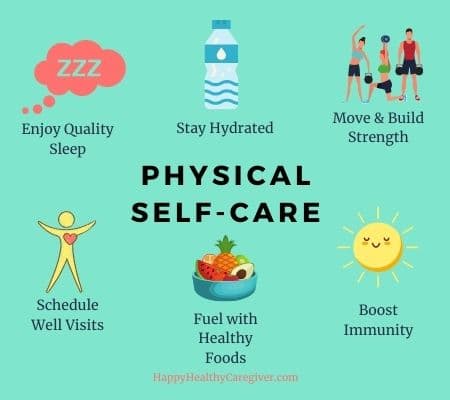
We have only one body to use for a lifetime.
If we were given one car for our entire life, I am confident we’d keep it up to date on all its oil changes, tire rotations, and car washes.
We’d park it out of the sun, avoid overusing it, and repair any parts that break immediately. We might not even let people eat junk food in it.
Just as car maintenance is essential, physical self-care is critical.
Our bodies perform best when we stay active, fuel them with good nutrition, and get quality sleep.
For example, bring a reusable water bottle wherever you go and keep a healthy protein bar for an on-the-go snack.
2. Emotional Self-Care
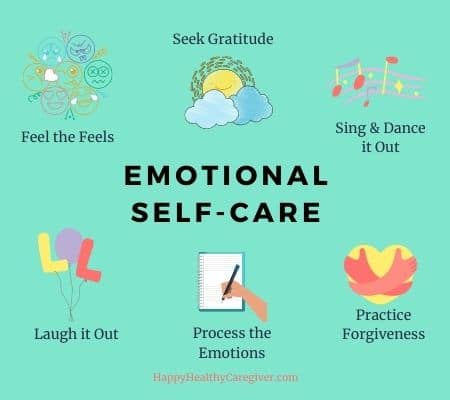
Saying “I’m fine” when someone asks how you are does not convey how you feel. Emotional self-care is about identifying how you truly feel and then processing those emotions.
Practicing emotional self-care involves respecting boundaries, forgiving others, seeking laughter, being vulnerable, having self-compassion, and allowing yourself to feel grief.
For example, if your care recipient repeatedly brings up past mistakes, calmly let them know that this conversation is no longer productive and that you will no longer be present for further discussions on this topic.
Or, if your care recipient has a cognitive disability and this explanation is not helpful, redirect them to another topic or activity to end the conversation.
3. Financial Self-Care
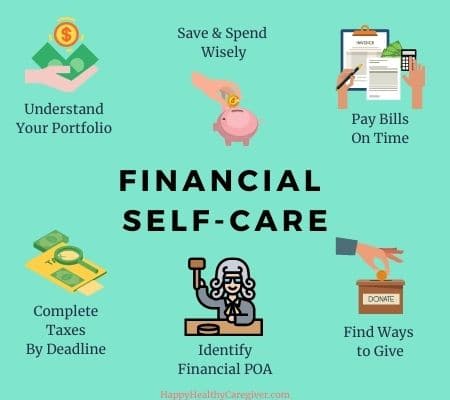
Most of us aim to be as independent as possible. We first consider physical independence and our activities of daily living, but financial security also plays a role.
Financial self-care is about developing spending and saving habits that will set you and your family up for future economic success.
Paying bills on time, periodically reviewing your portfolio, and identifying a financial Power of Attorney are all examples of financial self-care.
For example, schedule a semiannual meeting with either the financial planner or the family member responsible for money matters to review income and expenses and proactively discuss the financial decisions needed.
Invite all financial power-of-attorney decision-makers and the care recipient (unless they are cognitively unable to participate).
4. Spiritual Self-Care
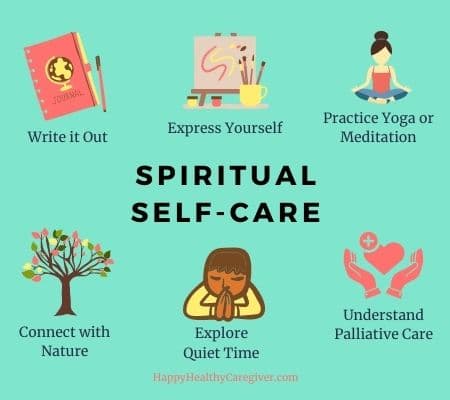
Spiritual self-care is about infusing your personal beliefs and values into your life.
Examples of spiritual self-care for caregivers include soaking up nature, practicing mindfulness, incorporating prayer and journaling, enjoying solitude, discussing end-of-life wishes, expressing gratitude, and attending a retreat.
For example, during my caregiving journey, I found writing to be an effective way to process how my world was changing. I wanted to share this experience with other family caregivers.
I wrote the Just For You: a Daily Self-Care Journal to provide other caregivers with an easy and fun tool to make self-care a daily habit and help regain their sense of self.
5. Intellectual Self-Care
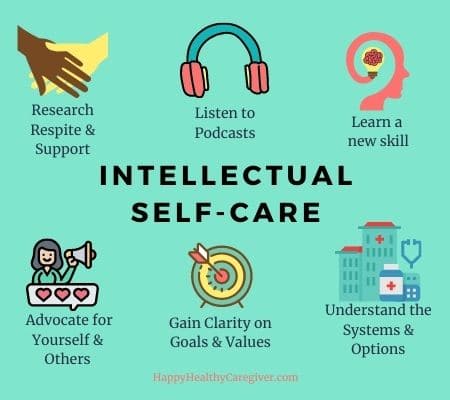
Life would be boring if we weren’t continually learning. Intellectual self-care helps us grow and keeps life interesting.
Some examples include: enriching our minds with books and documentaries, broadening our skills, and trying new things.
For example, caregiving was an overwhelming and brand-new topic for me. I had to learn new skills, understand new vocabulary, and research options.
For me, podcasts became a platform I relied upon. I could search for the topic and access the training I needed at a moment's notice while driving to work or taking a walk.
In 2017, I launched the Happy Healthy Caregiver podcast. This podcast spotlights real family caregivers who share how to stay happy and healthy while caring for others.
Each of the hundred-plus episodes of the Happy Healthy Caregiver podcast includes tried-and-true coping strategies, practical systems, and self-care strategies.
6. Professional Self-Care
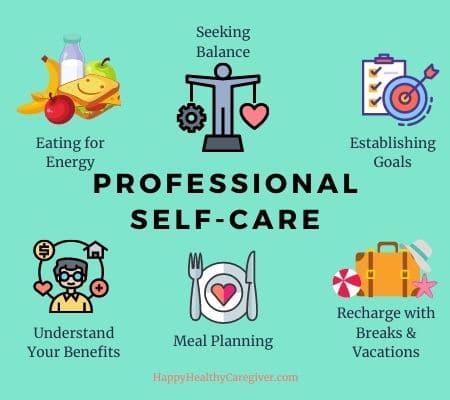
Burnout in our careers is a familiar concept, and burnout in caregiving is similar.
Professional self-care is about sharing your strengths and gifts with the world. It’s also about defining boundaries and developing strategies to minimize stress, so you live a well-rounded life and avoid burnout.
If you are a working caregiver, scheduling time for rest is also part of self-care. There are no awards for not using your lunch breaks or your vacation time.
Using your employee benefits can help you recharge. Many companies offer Employee Assistance Programs that provide counseling and dependent care services.
For example, when my husband and I were squeezed in the sandwich generation, we discussed a system that worked best for us – a dual working family.
There were so many different calendars for school, sports, work, travel, wellness appointments, and our family events. We created a digital family calendar and committed to entering everything on it immediately.
This system helped us collaborate better and gave us confidence that we were exactly where we needed to be.
7. Social Self-Care
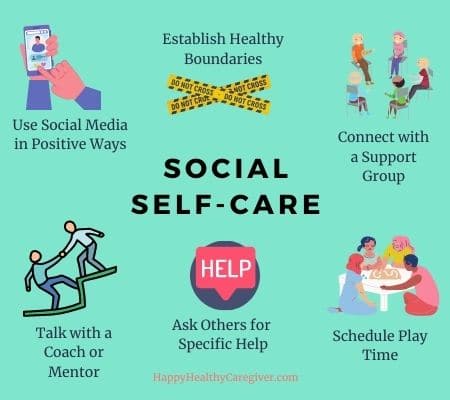
We are all capable of hard things, but we don’t have to do them alone. Social self-care is about surrounding yourself with trusted people who will support and uplift you.
It’s about spending time with those who are important to you and having FUN! For caregivers, this also means building your care team and requesting specific support.
Support for family caregivers can come from traditional caregiver support groups, such as the Daughterhood Circles.
Group support may also come from your golf club, writing group, or book club. Some companies offer affinity or employee resource groups specifically for caregivers.
Social self-care is also available through 1-on-1 caregiving coaching sessions and Facebook Groups like Self Care Support for Caregivers.
For example, at first, I felt so isolated as a family caregiver. None of my friends was going through a similar situation, and I needed to talk to people who understood and could provide sound advice.
Then I saw a flyer at my mom’s assisted living community about a support group meeting for families. During this one-hour meeting, I felt supported and gained valuable tools for setting boundaries with my mother. I also learned about other helpful resources for caregivers in my community.
8. Practical Self-Care
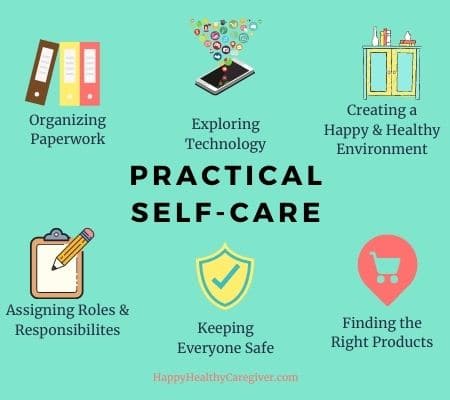
Sometimes, self-care means getting your essential paperwork in order.
Other practical self-care activities that promote peace of mind include keeping our loved ones safe, advocating for ourselves, making caregiving sustainable, and keeping our home cozy and stress-free.
For example, my sister created two binders for my mom—one for her financial information and one for her health information.
Each binder was easy to take to related appointments and to reference during calls when questions came up. This sustainable system saved us time and provided peace of mind.
Customize your self-care for your specific needs
Self-care is not a one-size-fits-all activity. As with cars, each of us has our own taste; we have personal preferences about what satisfies our self-care needs.
Test drive a few ideas from these eight categories and take note of what makes you feel like rolling down the windows and cranking up the tunes.
By Elizabeth Miller, Happy Healthy Caregiver
Happy Healthy Caregiver, LLC is a lifestyle website, podcast, and consulting business that helps family caregivers integrate self-care and caregiving into their busy lives. With the Happy Healthy Caregiver resources and community, caregivers no longer feel isolated or overwhelmed; they are equipped with the tools and support they need to prioritize and optimize their health. Happy Healthy Caregiver was founded in 2015 by Elizabeth Miller. Elizabeth is a family caregiver advocate, speaker, author, and Certified Caregiving Consultant.
Happy Healthy Caregiver sponsors this article. For more information, see How We Make Money.
About the Author

Connie is the founder of DailyCaring.com and was a hands-on caregiver for her grandmother for 20 years. (Grandma made it to 101 years old!) She knows how challenging, overwhelming, and all-consuming caring for an older adult can be. She also understands the importance of support, especially in the form of practical solutions, valuable resources, and self-care tips.