













The landscape of caregiving has shifted significantly. In 2026, with the integration of AI-enabled remote monitoring, you may be spending more time coordinating care, yet the physical reality remains: caregiving is a high-impact role.
According to the National Alliance for Caregiving’s 2025 Report, nearly 45% of caregivers now report high physical strain, a figure that continues to climb as the population ages.
To stay in the game, your exercise routine must shift toward Functional Resilience.
Why “Micro-Workouts” are the 2026 Caregiver Standard
Gone are the days of needing a 60-minute gym block. Current research from Harvard Health suggests that exercise variety, even in small doses, is more effective for longevity and stress reduction than repetitive, long-duration cardio.
For a caregiver, “Micro-workouts”, bursts of 5 to 10 minutes, are easier to integrate into a day filled with appointments and medication schedules.
Customize Your Exercise Goals for Different Care Settings
- The “Home Office” Caregiver: If you spend your day on a laptop monitoring health vitals, use the “20-20-20” rule: Every 20 minutes, stand up, do 2 squats, and look 20 feet away to reset your posture and eyes.
- The “High-Needs” Caregiver: Focus on grip strength. Holding walkers or steadying a person requires forearm endurance. Add “Farmer's Carries” (walking while holding heavy grocery bags) to your routine.
Key Caregiver Health Statistics (2026)
The following data highlights why prioritizing your movement is a necessity, not a luxury:
| Caregiver Health Metric | 2026 Impact Data | Exercise Benefit |
|---|---|---|
| Physical Health Decline | 25% of caregivers report worsening health | Strengthens immune response and stamina |
| Sleep Disturbance | 50% struggle with weekly insomnia | Regulates circadian rhythms and deep sleep |
| Emotional Strain | 2 in 5 report weekly feelings of sadness | Releases endorphins and reduces cortisol |
| Caregiver Burnout Risk | 68% experience financial or time stress | Builds mental resilience and “ready state” |
3 Functional Exercises Every Caregiver Needs
These aren't just movements; they are “clinical simulations” of your daily tasks. Performing these correctly prevents the chronic pain that leads to caregiver burnout.
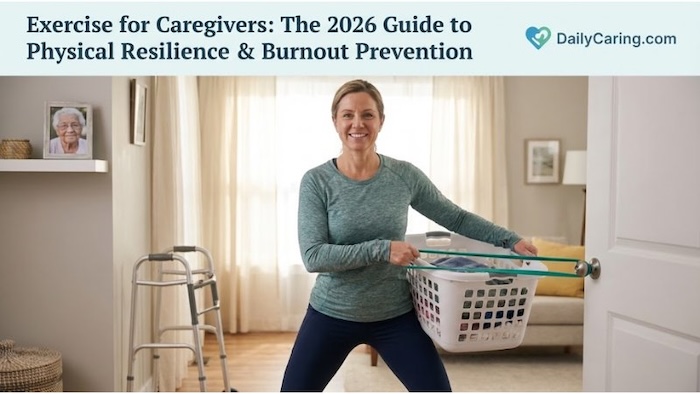
The Pivot Squat (The Transfer Savior)
- The Why: This mimics the exact motion of assisting a loved one from a bed to a wheelchair or chair. Most back injuries happen during the “twist.”
- Step-by-Step:
- Stand with feet slightly wider than shoulder-width.
- Lower into a squat, keeping your chest up and weight in your heels.
- As you stand up, rotate your entire body (hips and feet together) 90 degrees to one side.
- Pro Tip: Never twist your spine independently of your hips. This move trains your “glute-core” connection to handle the weight of a transfer safely.
⚠️ Pivot Squat Safety Checklist
- Nose Over Toes: Lean slightly forward to engage your glutes and take the pressure off your lumbar spine.
- Heel-to-Ground: Keep your weight in your heels. Never initiate a pivot from your toes, as this causes instability.
- The Shoulder-Hip Lock: Ensure your torso and pelvis move as one solid unit. Never twist your waist independently.
- Wide Base: Always keep your feet at least shoulder-width apart to maintain a “power stance.”
- Breathe Out: Exhale forcefully during the stand-and-turn phase to stabilize your core muscles.
Wall Push-Ups (The Stability Builder)
- The Why: Caregivers often need sudden upper-body strength to steady a stumbling loved one. Wall push-ups build the chest and triceps without the strain of floor exercises.
- Step-by-Step:
- Stand at arm’s length from a sturdy wall. Place hands flat at shoulder height.
- Slowly lower your chest toward the wall, keeping your elbows tucked at a 45-degree angle (not flared out).
- Push back to the start.
- Progression: As you get stronger, move your feet further from the wall to increase the resistance.
The “Mindful Minute” Stretch (The Nervous System Reset)
- The Why: Chronic stress keeps your body in “fight or flight,” which tightens the neck and traps.
- Step-by-Step:
- Sit tall and drop your right ear toward your right shoulder.
- Inhale for a count of 4, hold for 4, and exhale for 8. The long exhale is the “kill switch” for cortisol.
- Repeat on the left. This resets the Vagus Nerve, reducing the physical sensation of anxiety.
Video Highlight: Mastering the Art of the Safe Transfer
In this essential video from the Family Caregiver Alliance, you’ll see the clinical principles of the “Pivot Squat” put into practice. While caregiving technology in 2026 helps us monitor health, the physical act of moving a loved one still relies on timeless body mechanics.
This guide teaches you to leverage gravity rather than brute force, protecting your back and maintaining your “caregiver-athlete” stamina.
Key Timestamps for Quick Reference:
- [00:00:37] The Proper Stance: How to align your feet and back before any movement.
- [00:01:42] The Pivot Rule: A visual demonstration of moving as one unit to avoid spinal twisting.
- [00:01:56] Using Transfer Belts: How to use simple tools to increase safety for both you and your loved one.
- [00:05:13] Fall Safety: What to do (and what not to do) if a fall occurs during a transfer.
Leveraging Technology in 2026
Modern caregivers are using Digital Health Physical Activity Coaching. Wearables now track your “Ready State,” telling you when your cortisol levels are high, and a 5-minute walk is more beneficial than another cup of coffee.
Check out our guide to the best tablets for seniors to see which tools can help you automate your health tracking and your family connectivity!
| Caregiver Moment | The 5-Minute Move | Target Benefit |
|---|---|---|
| Morning Prep | Wall Push-Ups 2 Sets of 10 | Upper body readiness for lifting |
| Afternoon Break | Pivot Squats 15 reps | Hip mobility & safe transfer training |
| Evening Handover | Mindful Stretch 3 Rounds | Lowers cortisol for better sleep |
| Anytime Stress | 5-Minute Walk Outdoor/Hallway | Clears mental “fog” and resets focus |
The Bottom Line: You Are a Caregiver-Athlete
In 2026, we’ve moved past the idea that exercise is a “luxury” or a “hobby” for caregivers. It is your preventative maintenance. Think of yourself not just as a provider, but as a “caregiver-athlete.” Your role requires the stamina of a marathoner and the functional strength of a weightlifter.
By integrating these micro-workouts and ergonomic pivots, you aren't just checking a box—you are future-proofing your body against the physical toll of your journey. Small, 5-minute wins today prevent the chronic burnout of tomorrow.
Your Next Step: The “One-Move” Challenge
Don’t wait for a “perfect” hour that will never come. Choose one exercise from the list above, perhaps the Pivot Squat, and commit to doing it just three times tomorrow during a transition (like moving from the kitchen to the living room).
Ready to level up? If you’re feeling energized, try our high-efficiency 4-minute Tabata workout designed specifically for tight schedules.
Recommended for you:
— Quick Workouts for Caregivers: Tabata Style Saves Time
— 3 Ways to Manage Caregiver Stress and Prevent Burnout
— Stress Relief for Caregivers: Free App Helps You Relax in 2 Minutes – Calm.com
About the Author

Chris is a seasoned healthcare executive and entrepreneur from the Pacific Northwest. He strongly advocates for older adults and the caregivers who serve them. Chris has personal experience caring for his father, who had dementia. Chris is a technology enthusiast and an avid outdoorsman; if he's not in his office, he can usually be found on a golf course or fly-fishing out west somewhere.