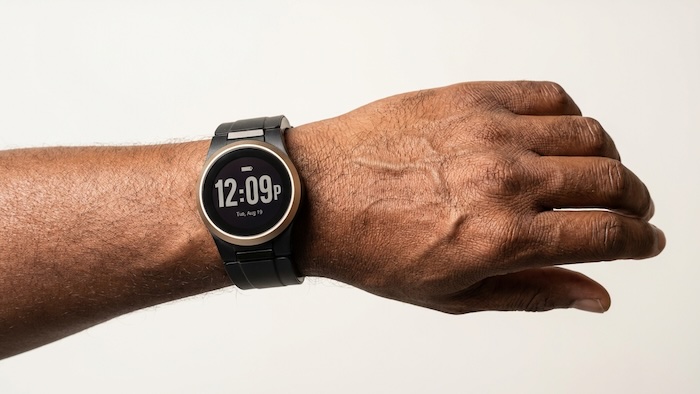












We are currently witnessing a quiet but profound migration. It is not a movement of people, but of shifting of intelligence. Specifically, the transition of sophisticated robotics from the sterile factory floors to the intimate corners of the family home.
As we grapple with the “caregiving crisis in America” (and beyond), we've got to move beyond the doom-and-gloom narratives and recognize that the next five years will be defined by a new teammate in the caregiving journey – the robot.
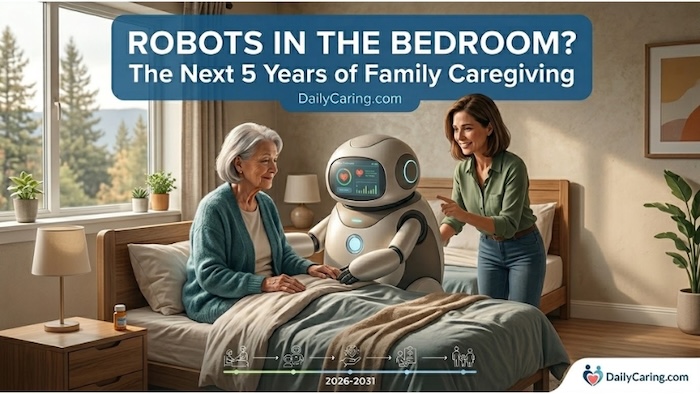
This shift into the field of “gerontechnology” is not about replacing the family bond, but about establishing a “Hybrid Care” model – a symbiotic relationship where machines and AI agents manage the exhausting logistics of aging, liberating humans to reclaim their role as the emotional heart of the family.
Flashback: The Evolution of Age Tech in Caregiving
The Mechanical Era in Caregiving
To understand where we're going, we must look at how far we've come from the “dumb” tools of the past. The history of caregiving technology is a study in increasing intimacy. In the mechanical era (Pre-1980s), we had the Hoyer Lift – a skeletal steel frame that required pure muscle to operate.
Another glaring example of the mechanical era might be the basic mechanical hospital bed. These beds were a far cry from today's “smart hospital beds” which serve as integrated care platforms – featuring intuitive touchscreens, motorized controls, and sophisticated sensors. What a jump in utility and technology!
The Motorized Independence Era
The hoyer lift was just a tool, nothing more. By the 1990s, we saw the introduction of motorized independence through stairlifts, scooters, and the birth of PARO, the robotic seal.
PARO the seal was a pivot point; it suggested that robots could provide more than leverage, they could provide comfort. Flash forward to today, and we have robotic cats, robotic companion dogs, and much, much more!
The Connected Era in Caregiving
The 2000s and 2010s ushered in the Connected Era, which brought us wireless monitoring (via phones, apps, and smarter medical alert systems), more sofisticated “smart systems” that integrated into every corner of healthcare (think smart hospital beds, telemedicine, etc.) and basic robots like Japan’s Robear, a massive, bear-faced machine designed to automate the “lifting and shifting” of patients.
It's this era that spawned the AI explosion that marks the robotic revolution we're seeing in caregiving today.
I worked on developing connected medical devices in a previous life. Our mantra was, connect it all – figure out what to do with the data later. We've come so far since then. Interestingly, today, engineers have a data-first mindset, which is the proper priority in my opinion…
The Socially Assistive Era: The Rise of Cognitive and Relational Support
While previous eras focused on the “heavy lifting” of the body, the socially assistive era focuses on the heavy lifting of the mind and spirit. Today, we're moving from reactive devices that wait for a button press before acting/engaging, to proactive assistants like ElliQ – a proactive “sidekick” that uses AI to initiate small talk, suggest health goals, and facilitate video calls.
These socially-assistive-robots (SAR) don’t wait for an emergency; they initiate conversation, suggest thoughtful interventions, and nudge the user toward social engagement – autonomously.

Vibe Check: Who’s Actually Into This?
The reception of these “robotic roommates” is a tangled web of relief and resistance. It really depends on the crowd you ask. Many aging adults themselves report a preference for robotic assistance when it comes to undignified tasks that might be embarrasing or taxing to a spouse or family caregiver.
There is an understandable level of acceptance found in having a machine help one bathe or use the toilet; it removes the shame of being a “burden” to a loved one, or to one’s children. However, the design-language matters. Seniors are vocal about their disdain for “toy-like” aesthetics that infantilize their experience. That is a non-starter.
I'm not suggesting that humanoid robots are ready to help us with incontinence, bathing or using the bathroom in 2026, but I could see some helpful platforms begin to show promise by 2030.
We're inching closer with smarter bidet systems, better incontinence solutions, and more thoughtful bathroom design for aging-in-place right now. This is how disruption happens. Small, incremental advancements, and then BOOM – Where did that come from?
Robotics in Caregiving Can Be a Time Saver (and a Back Saver)
Family caregivers view the technology through a lens of “administrative noise.” If a robot can handle medication adherence and housekeeping, the caregiver’s time is no longer consumed by a checklist. Yet, a “guilt factor” lingers.
There is a persistent fear that “robotic respite” might evolve into “robotic replacement,” where the machine’s presence becomes an excuse for fewer human visits.
Meanwhile, a many healthcare providers and current caregivers remain skeptical of the “empathy gap.” They value the data and the physical labor relief but argue that care requires a human narrative, a shared understanding of suffering that an algorithm could never understand.
VIDEO: The Robots Are Coming to Caregiving
The Spicy Stuff: Lies, Bossy Bots, and Big Brother
As an intellectual community, we must confront the ethical friction that these machines create. First, there is the Deception Dilemma. In the context of dementia, is it moral to allow a patient to believe a robot is a sentient pet or friend? Does the comfort provided justify the fundamental lie?
In the context of dementia, is it moral to allow a patient to believe a robot is a sentient pet or friend?
Then comes Robotic Paternalism. We are moving toward AI that doesn't just assist, but “nudges.” If an AI, programmed for safety, blocks an aging adult from going for a walk because it’s too cold, who is actually in charge?
When the elderly are treated as passive subjects of an algorithm's whims rather than as part of a human-centered (safe) environment, people start to wonder what the heck is going on. These are the ethical questions we'll be debating for the next few years, but there's no denying the caregiving crisis in our midst. Something's got to give.
Surveillance Beyond the Medical Alert System
Finally, there is the 24/7 Eye. Unlike a human caregiver who eventually leaves the room, a robot can provide constant surveillance. This raises a new category of “psychological privacy.” It isn't just about cameras; it's about the fact that corporate algorithms are now analyzing a person's mood, gait, and cognitive decline in real-time.
The home, once the final bastion of the unobserved life, is now a data set. The dementia tracking algorithms aren't going to happen, they ARE happening. Right NOW.
Coming Soon (2025–2030): Your Future Robotic Roommates
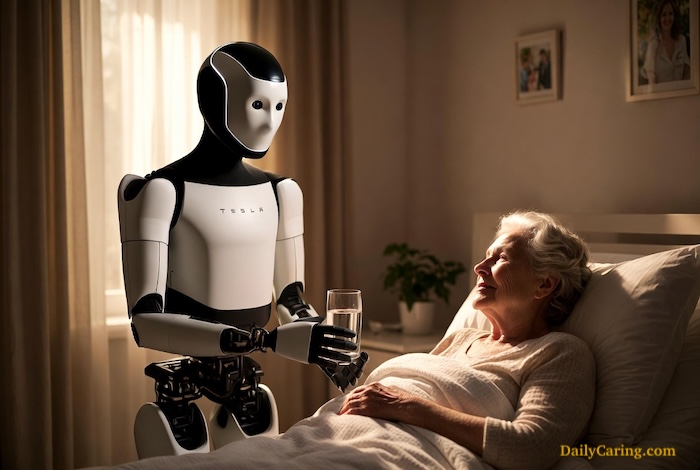
Over the next five years, the “Logistics Squad” will become a standard feature of the aging-at-home experience. Robots like the Labradore Retreiver will handle the micro-logistics of fetching items, while Lemmy will act as a relational hub, managing telehealth and cognitive exercise.
We are also seeing the rise of Soft Robotics – machines constructed from fabrics and rubber that prioritize “huggable” safety and human-like touch, moving away from the cold plastic of the previous decade. (I know this makes some of you want to gag.)
Perhaps the biggest transformation that is right in front of our faces, is the shift from reactive tools, to predictive ones. We are moving from the reactive fall detection devices (“I've fallen and I can't get up”) to “fall prevention” tools. Here are just 2 examples:
- By using multimodal sensors to detect subtle changes in bathroom frequency, or a fall in the middle of the night, AI tools like Sleep Orora can alert families to health risks in real-time, or even days before a crisis occurs.
- Autonomous (AI driven) telephone agents are currently calling seniors on the Amigo App. The Amigo app calls your loved one on a regular basis and detects subtle changes via it's smart contextual algorythm.
- It remembers every conversation and reports back it's findings to key stakeholders. This kind of data is invaluable to families, home care agencies, long-term care facilities, pharma/biotech researchers, and more.
Expect these trends to continue. I speak to founders often, and the uptick in predictive tools cannot be understated. (More on this in future posts.)
By 2030, two-armed general-purpose humanoid robots like Optimus, Apollo and Aeolus will likely begin entering the home to assist with unstructured chores, finally bridging the gap between digital assistance and physical housework.
Conclusion: The Caregiving Co-Pilot
The robotic revolution does not signal the end of human caregiving; rather, it signals its continuing evolution. The caregiver’s role is shifting from “primary laborer” (the person who breaks their back lifting and their spirit reminding) to “care manager and emotional co-pilot.”
The takeaway of this five-year horizon is clear: technology will provide the safety, the data, and the logistical infrastructure. But the human element remains the only source of genuine recognition.
A robot can remind you to take your heart medication, but it cannot understand why your heart is heavy. In the hybrid model of the future, the machine handles the heavy living, so the humans can focus on the emotional caregiving journey.
About the Author

Chris is a seasoned healthcare executive and entrepreneur from the Pacific Northwest. He strongly advocates for older adults and the caregivers who serve them. Chris has personal experience caring for his father, who had dementia. Chris is a technology enthusiast and an avid outdoorsman; if he's not in his office, he can usually be found on a golf course or fly-fishing out west somewhere.