













The mention of hospice often evokes a deep, immediate fear: the fear of giving up, the fear of the unknown, and the overwhelming anxiety that choosing it means accepting a death sentence.
For many families, it’s a topic shrouded in painful misconceptions, causing them to delay or avoid a conversation that could bring profound comfort and peace.
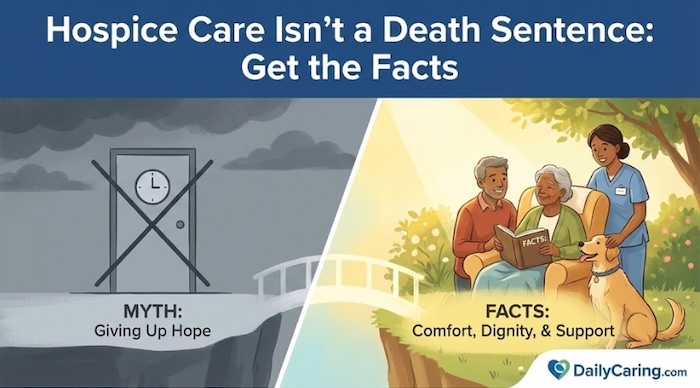
What if hospice wasn’t about dying sooner but about living better for the time that remains? This article cuts through the fear and stigma to reveal the core of hospice: a compassionate, holistic care model designed to enhance quality of life, manage pain, and provide unwavering support for patients and their families.
By understanding what hospice truly offers, you can transform it from a source of dread into a powerful resource for dignity, comfort, and meaningful connection during life’s most challenging transition.
Hospice Care Doesn’t Mean Giving Up
The biggest myth around hospice care is that it means giving up on an aging adult. Many people think that hospice care is only for people who are expected to pass away within days or weeks.
That’s not true.
Hospice is a type of medical care that aims to maintain or improve the quality of life for someone whose illness, disease, or condition cannot be cured.
Hospice addresses all symptoms of a disease but focuses on managing pain and discomfort.
It’s also focused on providing comfort and support to patients and families.
Consider asking your loved one's doctor: ‘Based on their current condition, is now an appropriate time to learn more about hospice services?
We explain why using hospice services shouldn’t be viewed as speeding up death or giving someone a death sentence.
We also describe who might benefit from hospice, how it helps caregivers, and how to speak with your loved one's doctor.
VIDEO: Hospice Care vs Palliative Care – What's the Difference?
Hospice Care Doesn’t Accelerate Timelines for Dying
Knowing that people who use hospice care don’t die faster is essential. Sometimes, hospice patients live longer because their quality of life improves.
The main difference between hospice and “regular” medical care is that the focus is no longer on “curing” your older adult.
But realistically, many curative treatments carry high risks for older adults, aren’t as likely to succeed, and cause unnecessary suffering.
Hospice Care Isn’t a Death Sentence
To be eligible for hospice, a doctor must certify that the patient is expected to live less than 6 months.
That may sound scary, but it’s not the same as the doctor saying they’ll die within 6 months.
Qualifying for hospice is NOT a 6-month death sentence
It just means that every 6 months, an older adult will need to be reevaluated to see if they’re still eligible to continue with hospice care. This is a medical prognosis for insurance purposes, not an exact prediction. Many people live longer than six months in hospice, and the care continues with recertification.
In some cases, seniors aren’t able to continue hospice care because their health improves too much to re-qualify; in fact, patients can leave hospice care if their condition improves or they choose to resume curative treatment. This directly counters the “death sentence” myth and emphasizes patient autonomy.
INFOGRAPHIC: Hospice Care for Aging Adults
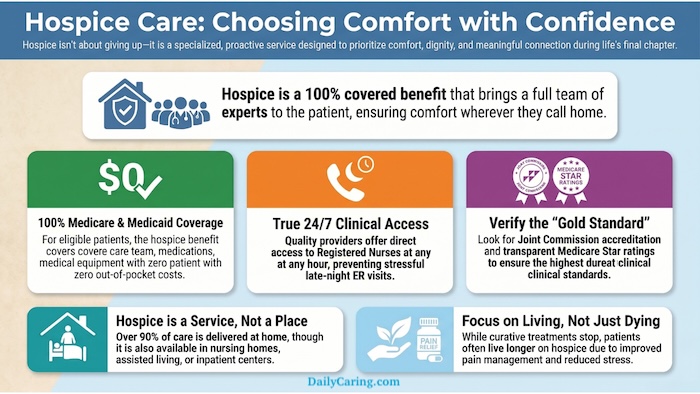
Who Might Benefit From Hospice Care?
Hospice programs are great for seniors in advanced stages of non-curable illness, who are very frail or at an advanced age. For example, someone with advanced dementia might qualify.
Under hospice, medical professionals visit the older adult. This is a massive relief for people who are too frail or ill to go to the doctor’s office.
Doctors also coordinate treatments so your older adult can feel as good as possible.
Hospice Care Helps Families Cope
Many folks don’t know that hospice care offers families much more support than traditional medical care.
Families benefit from:
- Having hospice professionals on call 24 hours a day
- Not needing to go to the doctor’s office because nurses visit the home
- Getting help with bathing and other personal care tasks
- Reduced costs – typically, hospice care is less expensive than hospital stays or ER visits
- Family guidance, support, and grief counseling
The main difference between hospice and ‘regular' medical care is that the focus is no longer on ‘curing' an older adult, but on prioritizing dignity and quality of life.
| Feature | Traditional / Curative Care | Hospice / Palliative Care |
|---|---|---|
| Primary Goal | To cure the disease or prolong life through medical treatment. | To provide comfort, manage symptoms, and maximize quality of life. |
| Focus of Care | Treating the illness. | Caring for the whole person—physical, emotional, and spiritual needs. |
| Treatment Approach | Aggressive interventions like chemotherapy, surgery, or hospitalization. | Pain management, symptom relief (e.g., shortness of breath, anxiety), and comfort measures. |
| Care Setting | Often in hospitals, clinics, or undergoing outpatient procedures. | Typically provided where the patient lives (home, assisted living, nursing home). |
| Role of Family | Family often coordinates logistics and provides support alongside medical teams. | Family is integrated as part of the care team, with extensive support and respite for caregivers. |
| Mindset | “Fighting” the illness. | “Living” as fully and comfortably as possible. |
What Does Hospice Care Cost, and Who Typically Pays for Care?
The cost of hospice care is typically covered by several key sources, with Medicare being the most common.
For eligible seniors (generally those 65+ or with specific disabilities), Medicare Part A provides a comprehensive hospice benefit that covers virtually all expenses related to the terminal illness, including nursing care, medical equipment, medication for pain and symptom management, and bereavement support for the family; all with little to no out-of-pocket cost.
For those not eligible for Medicare, Medicaid provides similar coverage in all 50 states, and most private insurance plans and HMOs also include a hospice benefit. Additionally, hospice services are a covered benefit for eligible veterans through the VA.
Importantly, hospice organizations are mission-driven and often provide care regardless of a person's ability to pay, relying on donations, grants, and other community funding to ensure that no one is denied comfort and dignity at the end of life.
This structure is a primary benefit of hospice; it transforms a potentially overwhelming financial burden into a coordinated service model that allows families to focus entirely on their loved one's comfort and quality of life, rather than on mounting medical bills.
How Families Can Obtain Hospice Care
Please talk with your loved one's doctor to determine whether hospice could benefit them.
If it’s not a good option for your loved one, let the doctor know you’re open to discussing it when the time is right. That way, they’ll see that it’s something you’d like to learn about and consider in the future.
In the meantime, you can conduct further research to determine whether hospice may be helpful in the future.
Final Thoughts About Hospice Care
Ultimately, hospice care is not about surrendering hope; it is about redefining it for a person’s final chapter. It is a proactive choice to prioritize comfort, dignity, and quality of life, and to provide compassionate, professional support to both the patient and their family.
This specialized care alleviates the immense logistical and emotional burdens on families, allowing them to focus on meaningful connection and peace. While the decision is deeply personal, understanding that hospice is a resource for living, not just dying, can transform it from a source of fear into a profound gift of comfort and support during life’s most challenging transition.
Healthcare Disclaimer: The information provided in this article is for educational and informational purposes only and does not constitute professional medical advice, diagnosis, or treatment. Always consult with a qualified healthcare provider or palliative care specialist regarding any medical conditions or end of life care decisions. Never disregard professional medical advice or delay in seeking it because of something you have read on this website.
Recommended for you:
- 9 Top Questions About Palliative Care vs. Hospice Care
- 7 Tips for Helping Seniors at the Doctor: Being a Health Advocate
- 5 Questions to Ask the Doctor About Tests and Treatments for Seniors
About the Author

Connie is the founder of DailyCaring.com and was a hands-on caregiver for her grandmother for 20 years. (Grandma made it to 101 years old!) She knows how challenging, overwhelming, and all-consuming caring for an older adult can be. She also understands the importance of support, especially in the form of practical solutions, valuable resources, and self-care tips.


My dad is in a nursing home due to having sepsis and yeast in his blood that caused a cardiac arrest. His cerebellum was damaged so he has short term memory from it and his motor skills aren’t great. I think that he would have done better if covid didn’t happen where he had to lay around for a year without therapy or my mom and I keeping him fighting and doing therapy. He was on a ventilator for 3 weeks so he is mechanical soft II and nectar thick drinks and he hasn’t walked or even stood up for over a year. His back is bad, but he always fought through the pain and walked with a cane for years. He wants to come home and my mom is 78 who broke her shoulder so she lost full range of motion of it and she won’t be able to change diapers easily. He will use a urinal if she is there with him. He speaks, but not clearly. He was on a ventilator for 3 weeks when this all happened. He isn’t terminal, but he is considered 24 hour care. He does have a g tube for nighttime feedings that has been in since they took out the tpn that caused his yeast and sepsis, but he does eat. This last month he finally gained a few pounds. He was 234 the day of surgery and went down as low as the low 150’s. He is now 164lbs. Does hospice provide care at home that his UHC Medicare would cover. He is currently self pay at the nursing home and it is taking his money fast. My dad was a very active man at 77 when he had surgery for a blocked bile that started all of this. He had a less than 10% chance of living and they told us if he did that he would be a vegetable, but God is stronger than their words and prayers pulled him through. We do want In home PT, OT, and speech therapy. Please let us know if this is something that hospice provides. Thank you.
We’re so sorry to hear about your dad’s health conditions. Hospice isn’t the same as in-home care and each hospice provider may provide different services.
It sounds like what you’d need is to hire in-home care as well as the additional therapy at home. Depending on the specific situation, Medicare may cover some of it, but you’d need to speak with the insurance provider and the doctor.
These articles provide more information:
– Choosing a Hospice Provider: Top Questions to Ask https://dailycaring.com/choosing-a-hospice-provider-important-questions-to-ask/
– Home Health Care and In Home Care: What Do They Do? https://dailycaring.com/home-health-care-and-in-home-care-what-do-they-do/
– 3 Tips to Choose Between Assisted Living vs In-Home Care https://dailycaring.com/3-tips-to-help-you-choose-between-assisted-living-vs-in-home-care/
– Medicare PACE Program Pays for In Home Care https://dailycaring.com/medicare-pays-for-in-home-care-under-the-pace-program/
– 4 Questions to Ask When Choosing a Home Care Agency https://dailycaring.com/4-questions-to-ask-when-choosing-a-home-care-agency/
– What Does Medicare Cover? Find Out Before the Bills Arrive https://dailycaring.com/what-does-medicare-cover/
Are you able to ask for assistance for someone who will be receiving hospice care at home for more than once a week?
To find out about specific services, it’s best to speak with the hospice company.
We share suggested questions to ask when looking for a hospice company here – Choosing a Hospice Provider: Top Questions to Ask https://dailycaring.com/choosing-a-hospice-provider-important-questions-to-ask/
Hospice can be offered even if the patient is in a nursing home and is part of my dad’s VA care. But there needs to be good coordination and communication between the nursing home, the hospice company, and the family. Everyone needs to know which entity is responsible for what kind of care, and to what extent that care will be given.
Great points! Hospice can be offered wherever the person is living and clear communication and coordination are essential for good care.
Absolutely. Hospice is a soul saver for patient, caregivers and family. I’ve experienced their wonderful philosophy and care with a couple of family members and friends.
They can tell you about the resources you don’t even know are options.
We’re so glad to hear that you had great experiences with hospice care! It can be such a wonderful source of support and information.