













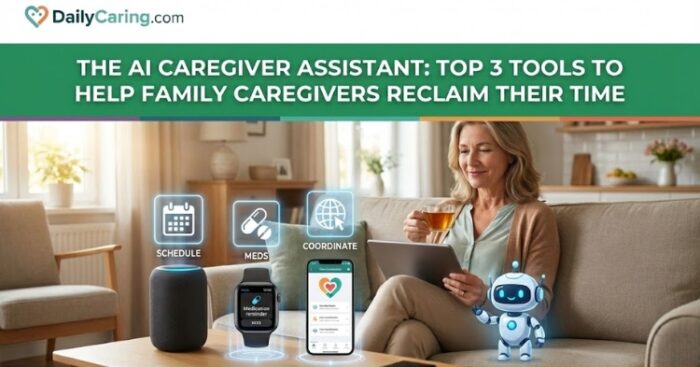
Caregiving in 2026 has become a high-stakes management role, leading most modern caregivers to lean into an AI caregiver assistant to help them carry the load. Between tracking medications, navigating insurance changes, and managing burnout symptoms, the mental load is heavier than ever.
Many families are now turning to an AI caregiver assistant to handle the “administrative side” of care. These aren't robots; they are smart apps designed to take the paperwork off your plate so you can focus on being a family member again. Here are the three best tools available today.
Why 2026 is the “Tipping Point” for Caregiver Tech
The transition from a paper log to a digital AI assistant isn’t just about being “high-tech”; it’s a necessary response to a rapidly changing healthcare landscape. Today, family caregiving has reached a critical juncture at the intersection of high demand and new digital solutions.
The Widening “Care Gap”
The number of family caregivers in the U.S. has surged to 63 million. At the same time, the “caregiver ratio” is shrinking, meaning fewer family members are available to share the load. This “care gap” is exactly why AI caregiver assistants are moving from a luxury to a necessity in 2026.
The Shift to “Hospital-at-Home”
Healthcare is moving out of the clinic and into your living room. In 2026, over 40% of family caregivers are managing complex medical tasks (like wound care and injections) that were once handled by nurses. Technology acts as the “digital safety net” that helps you manage these high-stakes tasks without a medical degree.
Reclaiming the “Administrative Load”
The average family caregiver spends 27 hours per week on care tasks. A massive chunk of that is “pajama time”; late-night hours spent on documentation, insurance calls, and scheduling.
- The Goal: Moving from manual tracking (which takes 13+ hours a week) to AI-assisted management.
- The Result: Studies show that families using coordination apps report a 30% reduction in decision fatigue.
At-a-Glance: The Move to Digital Caregiving
| Caregiver Challenge | 2026 Market Reality | The AI Solution |
|---|---|---|
| Rising Volume | 63 Million family caregivers | Scalable apps that coordinate “The Village” |
| Medical Complexity | 40% doing nurse-level tasks | AI visit summaries and “bill detectives” |
| Burnout & Time | 27 Hours per week spent on care | Automated scheduling and documentation |
Understanding this shift from manual labor to digital management is the first step toward reclaiming your time. By moving away from paper logs and ‘phone tag,' you can utilize modern technology to act as your personal digital safety net.
Here are the three best AI caregiver assistant tools to help you manage that transition today.

The Top 3 AI Caregiver Assistants for 2026
1. The “Note-Taker” for Doctor Visits: Abridge
What it does: Abridge uses “ambient AI” to securely record medical conversations. It automatically filters out small talk and creates a plain-English summary of the “medical parts,” such as new prescriptions or follow-up dates.
- Why it helps today: It removes the panic of “did I miss something?” or “I can't remember what the doctor said about that” during a 15-minute appointment. You can stay present in the room and share the summary with other family members instantly.
- Cost: Free for individual patients and families.
- Where to get it: Download the mobile app via the App Store or Google Play.
2. The “Family Command Center”: Caring Village
What it is: A coordination hub that features “Julia,” a built-in AI caregiver assistant designed to provide personalized insights and summaries for your care team.
- Why it helps today: Caring Village consolidates scattered text threads into a single, organized space for care schedules, medication tracking, and secure document storage. Julia helps by identifying patterns of stress or missed tasks before they become emergencies.
- Cost: Free basic plan; professional “Village” plans for larger families start at $20.83/month.
- Where to get it: Sign up here, at Caring Village.
The “Medical Bill Detective”: Advocara
What it is: A specialized AI tool (named “Advie“) that analyzes medical bills and insurance denials in plain English.
- Why it helps today: Medical billing is notoriously complex. You simply upload a photo of your bill, and Advocara checks it for errors or services that should be covered by Medicare, saving you from hours on hold with insurance companies.
- Cost: 100% Free (Nonprofit service).
- Where to get it: Access it directly in your browser at Advocara.org.
Summary: Comparing Your AI Caregiver Assistant 2026 Options
| App Name | Best For… | Your AI Feature | Cost (2026) |
|---|---|---|---|
| Abridge | Remembering medical advice | Automatic Visit Summaries | Free |
| Caring Village | Family coordination | “Julia” Smart Insights | Free – $20.83/mo |
| Advocara | Lowering medical bills | “Advie” Bill Auditor | Free |
Privacy and Safety: Can You Trust an AI Caregiver Assistant?
In 2026, privacy is a top concern for caregivers. Leading tools like the ones above use HIPAA-compliant encryption and often have strict “no-data-selling” policies to protect your loved one's sensitive health information. When using these tools, ensure you choose verified platforms that allow you to delete your data at any time.
Which part of your caregiving routine feels like it takes up too much time? Tell us in the comments, and perhaps our community will help you find an AI tool to simplify it!
Final Thoughts on the AI Caregiver Assistant for 2026
As mentioned earlier in this piece, we've reached a tipping point for caregivers. There's just no way for any one person to manage caregiving, hold a job, and manage a household without some help, and if it were easy, I wouldn't be writing this post! (I was once a caregiver for my late father, who had dementia.)
The shift from traditional caregiving to AI-assisted caregiving is inevitable. Caregiving is too demanding, too expensive, and too difficult for most human beings today. In the past, caregivers could push off technology, because it seemed slow to materialize for the average caregiving challenge – But not today.
AI is rapidly entering all aspects of our daily lives, and caregiving will be no different. You can either embrace it and make it work for you, or you can push it off and let the daily pressures of caregiving consume you. It's your choice.
About the Author

Chris is a seasoned healthcare executive and entrepreneur from the Pacific Northwest. He strongly advocates for older adults and the caregivers who serve them. Chris has personal experience caring for his father, who had dementia. Chris is a technology enthusiast and an avid outdoorsman; if he's not in his office, he can usually be found on a golf course or fly-fishing out west somewhere.
Good article. You mentioned that “When using these tools, ensure you choose verified platforms that allow you to delete your data at any time.”, something that to me is a major concern. It would have helped a lot, had you included this info (and whether they do not sell or share one’s info) in the review of the products that you listed.
Excellent comment, Sue, thank you for raising this. You’re right – privacy and data control are absolutely vital when choosing these kinds of tools. I’m happy to confirm that any large apps that might be operational in the EU must provide a ‘Right to Erasure’ to comply with GDPR (Article 17). This means they are legally required to allow you to delete your data upon request. Most reputable global tools today, including the three featured in this article, follow these strict standards:
Abridge: Allows you to delete recordings or your entire account at any time and does not sell your personal data.
Caring Village: Provides a clear process to delete your account and all associated files from their servers.
Advocara: Explicitly states they will never sell your data and will delete it upon request.
In the future, I’ll be sure to highlight these specific privacy and sharing details directly in our reviews. Thank you for helping us make our content more helpful for everyone!”
Those smart apps sound like a great idea! I wasn’t aware of it existing. I could see it being useful and helping with the workload for some people. AI seems to be the trend these days.
Abridge – is it not available in Canada? The App Store does not list it. The Abridge website is directed towards professionals, with no indication that there is a version for patient use.
Hi Jean, thank you for your question! Excellent observation. As of early 2026, Abridge has indeed moved toward an ‘enterprise-first’ model. While they do have a patient-facing app for visit playback and summaries, it’s often linked to healthcare providers who use the professional version.
If you’re in Canada and can’t find it, it may be due to regional licensing or because it’s currently restricted to patients of participating health systems (like Mayo Clinic, Johns Hopkins, and Sutter Health in the USA). For a Canadian-specific alternative that is gaining popularity for its accuracy and availability, you might want to look into Vero Scribe. Hope that helps. Thank you again for bringing this to our attention!